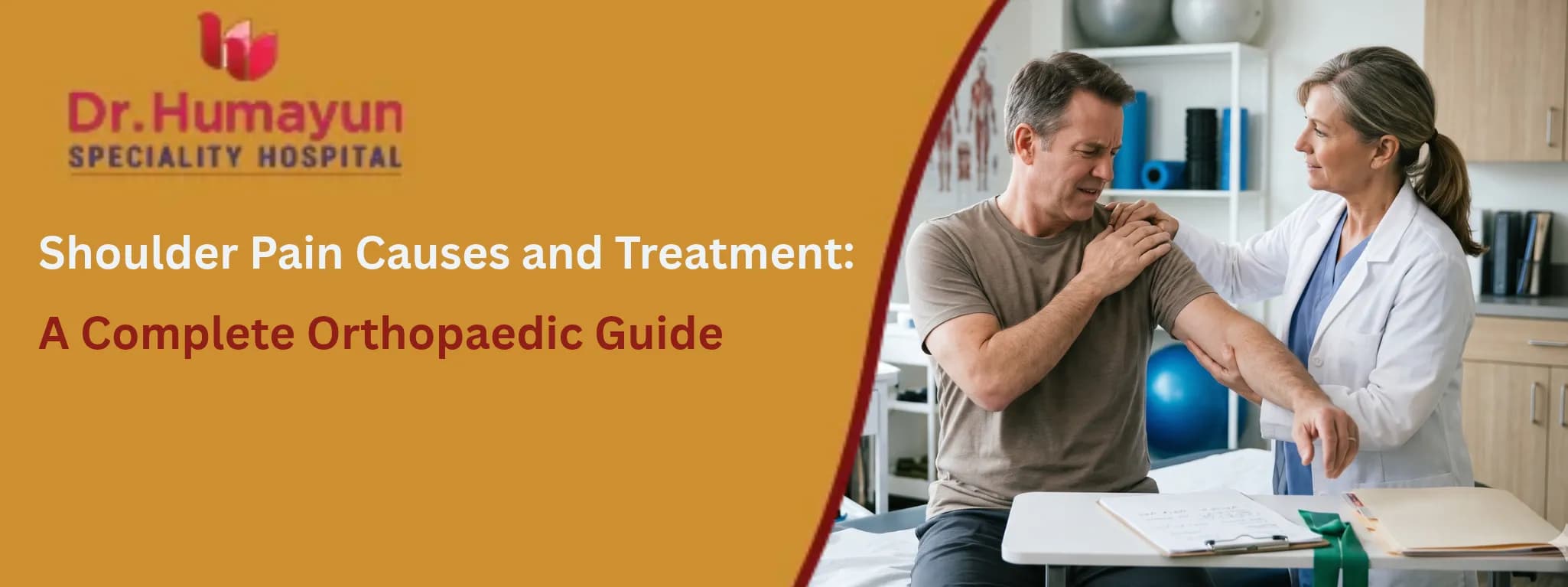

Shoulder pain is one of the most common musculoskeletal complaints seen in orthopaedic practice, affecting people of all ages and activity levels. It may develop gradually from repetitive use, appear suddenly after an injury, or arise without any obvious trigger. It can range from a mild ache that limits specific movements to severe pain that disrupts sleep and daily function.
Because the shoulder is the most mobile joint in the body, it is also one of the most complex. Understanding which structure is causing pain, and why, is the key to effective treatment. This guide covers the most common shoulder pain causes and treatment options, when to seek specialist assessment, and what orthopaedic shoulder care in T Nagar, Chennai involves.
How the Shoulder Is Structured
The shoulder is not a single joint but a complex of three bones and four joints working together. The main joint is the glenohumeral joint, where the ball of the upper arm (humeral head) sits in the shallow socket of the shoulder blade (glenoid). Because the socket is shallow, the shoulder's range of motion is exceptional but its stability depends almost entirely on the surrounding soft tissues rather than bony architecture.
The Rotator Cuff
The rotator cuff is a group of four muscles and their tendons (supraspinatus, infraspinatus, teres minor, and subscapularis) that wrap around the humeral head and attach it to the shoulder blade. The cuff simultaneously stabilises the joint and powers the shoulder's movements lifting, rotating, and reaching overhead. Because the supraspinatus tendon passes through a narrow space beneath the acromion (part of the shoulder blade), it is particularly susceptible to compression and wear.
The Bursa
The subacromial bursa is a fluid-filled sac between the rotator cuff tendons and the acromion. Its job is to reduce friction as the tendons move beneath the bone. When the bursa becomes inflamed (bursitis), it swells, reducing the space available for the tendons and contributing to the pain cycle of shoulder impingement.
The Joint Capsule
A tough fibrous sleeve the joint capsule surrounds the glenohumeral joint. When this capsule becomes inflamed and contracts, it causes frozen shoulder (adhesive capsulitis), progressively restricting range of motion in all directions.
Common Causes of Shoulder Pain
Rotator Cuff Tendinitis and Impingement
Rotator cuff tendinitis is inflammation of one or more rotator cuff tendons, usually the supraspinatus. Impingement syndrome describes the compression of the rotator cuff tendons and subacromial bursa between the humeral head and the undersurface of the acromion when the arm is raised.
Causes: Repetitive overhead activity (manual work, sport, swimming, painting), age-related thickening of the tendon, a hooked acromion shape that narrows the subacromial space.
Symptoms:
-
Aching pain in the outer shoulder and upper arm, worse when lifting the arm above shoulder height
-
Painful arc: pain specifically between 60 and 120 degrees of arm elevation
-
Night pain, particularly when lying on the affected shoulder
-
Weakness with overhead activity
Who is most affected: Active adults between the ages of 30 and 60; overhead athletes and workers; people who have recently increased their activity level.
Rotator Cuff Tears
A rotator cuff tear may be partial (the tendon is frayed or partially split) or complete (the tendon is fully torn through). Tears can result from a single acute injury such as a fall on an outstretched arm or a sudden overhead force or from progressive wear and degeneration of the tendon over years.
Symptoms:
-
Significant pain and weakness when lifting the arm
-
Difficulty reaching behind the back or overhead
-
A snapping or catching sensation in some cases
-
Complete tears may cause an inability to raise the arm against any resistance
Diagnosis: MRI is the most accurate investigation for rotator cuff tears, detailing the size, location, and degree of tendon retraction. Ultrasound is a useful and widely available alternative that accurately identifies most clinically significant tears.
Frozen Shoulder (Adhesive Capsulitis)
Frozen shoulder is progressive stiffening and pain caused by inflammation and contraction of the shoulder joint capsule. It typically passes through three phases:
-
Freezing phase (2 to 9 months): Increasing pain, particularly at night, and progressive loss of range of motion in all directions.
-
Frozen phase (4 to 12 months): Pain may reduce but stiffness reaches its maximum. Daily activities requiring shoulder movement are severely limited.
-
Thawing phase (5 to 24 months): Gradual spontaneous recovery of range of motion.
Total duration is typically 1 to 3 years, though significant functional limitation during the frozen phase makes treatment important for quality of life.
Risk factors: Diabetes (three to five times higher risk), hypothyroidism, previous shoulder surgery or immobilisation, Parkinson's disease, and cardiac disease. Women between 40 and 60 are most commonly affected.
Diagnosis: Characteristic loss of both active and passive range of motion in all planes, particularly external rotation, combined with a typical history, is usually diagnostic. MRI or ultrasound may be done to exclude other pathology.
Shoulder Bursitis
Subacromial bursitis is inflammation of the bursa beneath the acromion, often occurring alongside rotator cuff tendinitis as part of the same impingement complex. Acute bursitis can follow a direct blow to the shoulder. Chronic bursitis develops from repetitive compression.
Symptoms: Pain in the outer shoulder aggravated by arm elevation, pressing on the shoulder from above, or lying on the shoulder. Often indistinguishable clinically from rotator cuff tendinitis without imaging.
Shoulder Instability and Dislocation
The glenohumeral joint can be partially (subluxation) or fully displaced (dislocation) from its socket. Most dislocations are anterior (the ball moves forward out of the socket), typically from a fall or direct contact in sport.
Symptoms after dislocation:
-
Visible deformity and immediate severe pain
-
Complete loss of normal arm movement
-
The shoulder looking flat rather than rounded
-
Requires urgent reduction (relocating the joint) in a medical setting
Recurrent instability: After a first dislocation, the ligaments and labrum (cartilage rim) are often torn. Young, active patients (particularly under 25) have a high rate of recurrent dislocation after conservative management alone. Arthroscopic stabilisation (Bankart repair) significantly reduces recurrence.


Acromioclavicular (AC) Joint Injury and Arthritis
The AC joint connects the top of the shoulder blade (acromion) to the collar bone (clavicle). AC joint injuries (sprains or separations) are common in contact sports and cycling falls. AC joint arthritis is a common source of pain specifically at the top of the shoulder, often with tenderness on direct pressure and a painful arc at the higher end of elevation.
Shoulder Arthritis
Glenohumeral arthritis involves degeneration of the articular cartilage lining the ball and socket of the shoulder joint. It is less common than hip or knee arthritis but causes significant pain and stiffness that worsens progressively over time. It typically affects adults over 50 and may follow previous dislocation, fracture, or rotator cuff tear.
Symptoms: Deep, aching pain in the shoulder joint, stiffness particularly in the morning, grinding or crepitus with movement, progressive loss of range of motion.
Shoulder Fractures
Fractures of the shoulder region most commonly involve the clavicle (collarbone), the proximal humerus (upper arm near the shoulder), and less commonly the shoulder blade. They typically result from falls, road traffic incidents, or direct impact.
Symptoms: Severe immediate pain, rapid swelling, bruising, visible deformity in some cases, inability to move the arm normally. Urgent X-ray is required.
When to See a Shoulder Specialist Urgently
Most shoulder pain is not an emergency, but the following symptoms warrant prompt assessment:
-
Sudden severe shoulder pain without injury in a person over 50 with cardiac risk factors shoulder pain can be referred from the heart
-
Inability to lift the arm at all after a fall or acute injury
-
Fever combined with a hot, swollen shoulder (possible septic arthritis, a medical emergency)
-
Significant trauma with visible deformity
-
Shoulder pain following a cervical spine injury
How Shoulder Pain Is Diagnosed
A shoulder specialist will take a full history of how and when the pain started, what aggravates and relieves it, and which movements are affected. A physical examination assesses range of motion (active and passive), muscle strength, and specific clinical tests that help identify the likely structure involved.
| Investigation | What It Shows |
|---|---|
| X-ray | Bone fractures, AC joint arthritis, calcific deposits, glenohumeral arthritis, acromion shape |
| Ultrasound | Rotator cuff tears, bursitis, tendon thickening, subacromial fluid |
| MRI | Detailed assessment of soft tissues: rotator cuff, labrum, joint capsule, cartilage |
| CT scan | Complex fractures, bone detail before surgery |
| Diagnostic injection | Subacromial local anaesthetic injection; if pain is relieved, it confirms the subacromial space as the pain source |
Shoulder Pain Treatment Options
Most shoulder conditions respond exceptionally well to a stepwise, non-surgical approach focused on calming inflammation and restoring joint mobility. While targeted physiotherapy, medications, and image-guided injections resolve the vast majority of cases, surgical intervention remains a reliable solution when severe structural tears, joint instability, or persistent symptoms do not improve with conservative care.
Physiotherapy and Exercise Rehabilitation
Physiotherapy is the cornerstone of non-surgical shoulder pain treatment and is effective for rotator cuff tendinitis and impingement, frozen shoulder in all phases, post-surgical rehabilitation, and shoulder instability rehabilitation after initial management. A structured programme focuses on:
-
Restoring range of motion through progressive stretching
-
Strengthening the rotator cuff and scapular stabilisers
-
Correcting posture and movement patterns that contribute to impingement
-
Activity modification advice
Evidence from a large UK randomised controlled trial (708 patients with rotator cuff injuries) found that physiotherapy-guided progressive exercise and a best practice advice session produced comparable 12-month outcomes, and that a single physiotherapy session combined with a corticosteroid injection was the most cost-effective approach.
Medications
-
NSAIDs (non-steroidal anti-inflammatory drugs): Ibuprofen, diclofenac, or naproxen reduce pain and inflammation. Useful in the acute and early subacute phase. Should be taken with food and used for the shortest effective duration.
-
Analgesics: Paracetamol for pain without a strong inflammatory component.
-
Topical NSAIDs: Diclofenac gel applied to the shoulder area is effective for localised pain with fewer systemic side effects.
Corticosteroid Injections
A corticosteroid (steroid) injection into the subacromial space or the glenohumeral joint combines a long-acting corticosteroid with local anaesthetic. It provides effective short-term pain relief most notably at 6 to 8 weeks after injection and can enable more effective physiotherapy in the early weeks when pain is limiting participation. Effects typically last 6 to 12 weeks. Most guidelines recommend no more than 2 to 3 injections in a single shoulder per year.
For frozen shoulders, a suprascapular nerve block or guided glenohumeral injection in the early painful phase significantly reduces pain and accelerates recovery.
Hydrodilatation (Distension Arthrography)
For frozen shoulders that have not responded to physiotherapy and corticosteroid injection alone, hydrodilatation is a procedure in which the shoulder joint capsule is injected with a large volume of saline and steroid under image guidance (X-ray or ultrasound). The volume stretches and partially disrupts the contracted capsule, improving range of motion. It is typically performed by a musculoskeletal radiologist or orthopaedic specialist.
H3: Surgical Treatment
Surgery is considered when conservative treatment has been thoroughly and adequately tried (typically 3 to 6 months) without sufficient improvement, or when the nature of the injury makes surgery the primary treatment:
-
Arthroscopic subacromial decompression: Keyhole surgery to create more space for the rotator cuff tendons by shaving the undersurface of the acromion (acromioplasty) and removing inflamed bursa tissue. Used for impingement refractory to conservative management.
-
Rotator cuff repair: Arthroscopic or mini-open reattachment of a torn rotator cuff tendon to the bone. Most appropriate for acute tears in younger active patients and for full-thickness tears causing significant weakness.
-
Arthroscopic capsular release: For frozen shoulder not responding to non-surgical measures, keyhole surgery divides the contracted capsule and immediately restores range of motion.
-
Bankart repair: Arthroscopic reattachment of the torn labrum and ligaments after shoulder dislocation, to restore joint stability and prevent recurrence.
-
AC joint resection: Removal of the distal end of the clavicle for persistent AC joint pain.
-
Shoulder replacement (arthroplasty): For severe glenohumeral arthritis unresponsive to non-surgical management. Total shoulder replacement and reverse shoulder replacement (for arthritis combined with rotator cuff failure) restore pain-free function in appropriately selected patients.
Shoulder Pain Treatment in T Nagar at Humayun Hospital
Humayun Hospital, T Nagar, Chennai, provides specialist orthopaedic assessment and treatment for the full range of shoulder conditions including rotator cuff tears, frozen shoulder, shoulder impingement, instability, fractures, and arthritis. Care is provided by the hospital's experienced orthopaedic consultants:
-
Dr. Mani Ramesh – Senior Consultant, Orthopaedics (MBBS, MS Orthopaedics, FAOI | 43+ years of experience): Brings over four decades of clinical and surgical experience in joint replacement surgery (arthroplasty), arthroscopic keyhole procedures, complex trauma and fracture reconstruction, and general orthopaedics.
-
Dr. Dinesh Raju – Consultant, Orthopaedics (MBBS, MS Orthopaedics | 14+ years of experience): Specialises in arthroscopy and sports medicine, trauma and fracture management, joint replacement surgery, and evidence-based non-surgical orthopaedic care.
Shoulder pain treatment in T Nagar at Humayun Hospital includes:
-
Clinical and imaging-guided diagnosis (X-ray, ultrasound, and MRI review)
-
Structured physiotherapy referral and rehabilitation
-
Subacromial corticosteroid and local anaesthetic injections
-
Surgical management, including arthroscopic (keyhole) procedures and shoulder replacement where indicated
-
Post-surgical rehabilitation planning
A consultation with our orthopaedic team begins with a thorough physical assessment of the shoulder, a review of any existing investigations, and a clear explanation of your diagnosis and treatment options starting with the most conservative, evidence-based approach appropriate for your specific condition.
Chat with our care assistant to book a shoulder pain consultation in T Nagar.