
IVF, or in vitro fertilisation, is one of the most significant medical advances of the past century. Since the first IVF baby was born in 1978, more than 12 million children have been born worldwide through IVF and related assisted reproduction technologies. In India alone, the number of IVF cycles performed each year has grown to over 250,000, and that number continues to rise.
Despite how common it has become, many couples starting fertility treatment have limited understanding of what IVF actually involves, what happens at each stage, who it is suitable for, and what realistic outcomes look like. Clear information helps couples approach IVF with accurate expectations and reduces the anxiety that uncertainty creates.
This guide explains what IVF treatment for pregnancy is, how it works from the first consultation through to the pregnancy test, who it is recommended for, what the risks are, and what IVF treatment in T Nagar at Humayun Hospital, Chennai involves.
What Is IVF Treatment?
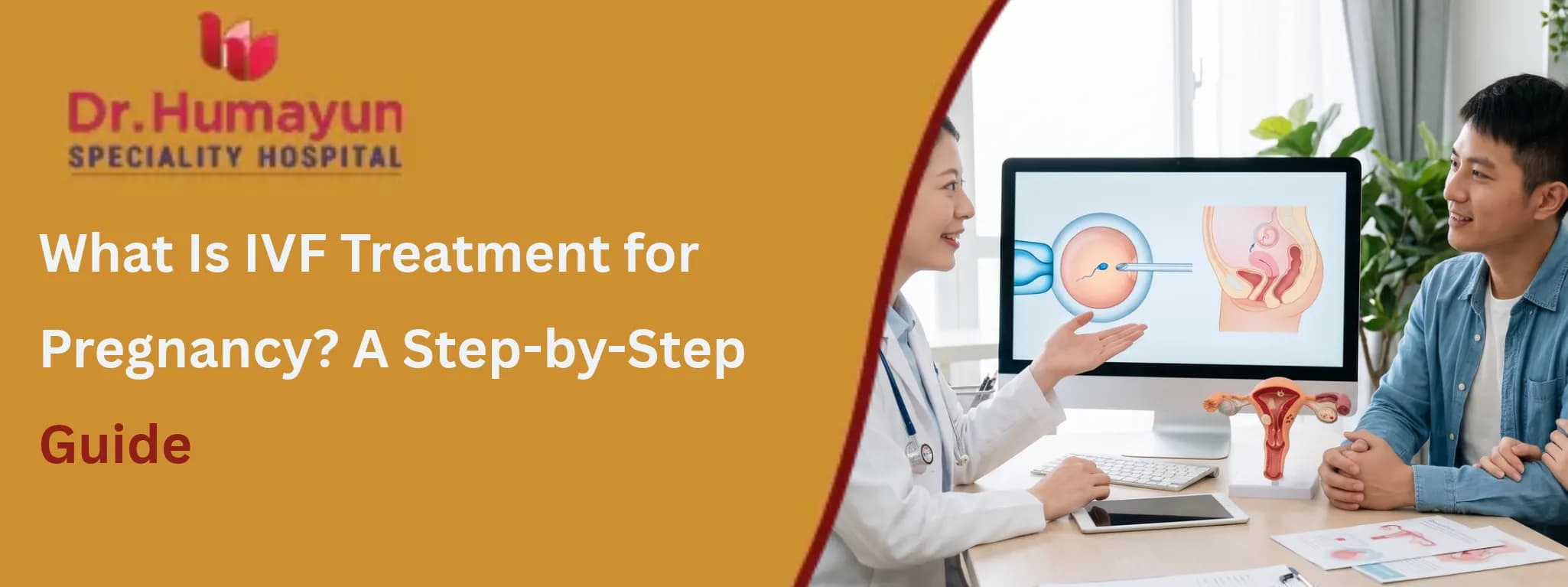
IVF stands for in vitro fertilisation. "In vitro" is Latin for "in glass" a reference to the laboratory dish in which fertilisation takes place outside the body. In a natural conception cycle, a single egg is released from an ovary, fertilised in the fallopian tube by sperm, and the resulting embryo travels to the uterus and implants. IVF reproduces this process in a controlled laboratory setting, retrieving multiple eggs from the ovaries and combining them with sperm outside the body, then transferring the resulting embryo directly into the uterus.
The key difference from natural conception is that IVF bypasses the fallopian tubes entirely, makes fertilisation observable and controllable in a laboratory, and allows the embryo to be assessed for quality before transfer. This makes IVF effective for conditions where natural conception is not possible or extremely unlikely, including blocked tubes, severe male factor infertility, and poor egg quality related to age or medical conditions.
Who Is IVF Recommended For?
IVF is not the first treatment for all causes of infertility. It is specifically recommended when simpler approaches are unlikely to succeed or when the underlying cause makes IVF the most appropriate starting point.
Conditions Where IVF Is Indicated
Tubal factor infertility: Blocked, damaged, or absent fallopian tubes prevent the egg and sperm from meeting inside the body. Because IVF takes fertilisation out of the body entirely, tubal damage is irrelevant. IVF is the treatment of choice for tubal factor infertility.
Endometriosis: Moderate to severe endometriosis impairs egg quality, creates a hostile pelvic environment, and may cause tubal damage. IVF, often following laparoscopic surgery to treat the endometriosis, is the most effective fertility treatment for women with endometriosis significantly affecting their fertility.
Severe male factor infertility: When sperm count, motility, or morphology is severely abnormal, IVF combined with ICSI (intracytoplasmic sperm injection) can achieve fertilisation even when sperm quality is too poor for natural conception or IUI to succeed.
Diminished ovarian reserve: Women with a low AMH, high FSH, and low antral follicle count whether age-related or due to previous ovarian surgery or conditions have a reduced egg supply. Simpler treatments with a low number of eggs available are unlikely to succeed. IVF maximises the use of available eggs by stimulating multiple follicles and retrieving all of them in one cycle.
Age-related infertility: Women aged 35 and above face accelerating decline in both egg quantity and quality. Because time matters significantly in this context, IVF is often recommended earlier rather than spending months on less effective treatments.
Unexplained infertility: When full investigation of both partners finds no identifiable cause, IVF is typically offered after 3 to 4 unsuccessful IUI cycles.
Recurrent miscarriage: For couples with recurrent pregnancy loss due to embryo chromosomal abnormalities, IVF with preimplantation genetic testing (PGT-A) allows embryos to be screened for chromosomal normality before transfer, selecting only euploid (chromosomally normal) embryos.
The IVF Process Step by Step
A complete IVF cycle takes approximately 4 to 6 weeks from the start of stimulation to the pregnancy test result. The cycle moves through seven distinct stages.
Stage 1: Pre-Cycle Assessment
Before any stimulation begins, both partners undergo a thorough fertility assessment. For the woman, this includes a hormonal blood panel (FSH, LH, AMH, oestradiol, prolactin, TSH), a transvaginal pelvic ultrasound assessing the uterus, uterine lining, ovaries, and antral follicle count, and baseline investigations for uterine cavity health. For the man, a comprehensive semen analysis examines sperm count, motility, morphology, and volume. Any infections, uterine abnormalities (polyps, fibroids, adhesions), or medical conditions that could affect the cycle are identified and addressed before stimulation begins.
The fertility specialist designs a personalised stimulation protocol based on the assessment the type and dose of medications, the monitoring schedule, and the planned approach to fertilisation (conventional IVF or ICSI).
Stage 2: Ovarian Stimulation
In a natural cycle, one follicle develops and releases one egg. IVF aims to develop multiple follicles simultaneously to retrieve several eggs, increasing the number of embryos available and therefore the chances of at least one high-quality embryo being available for transfer.
Daily injections of gonadotropins (FSH with or without LH) are self-administered, typically for 8 to 14 days. The medications work by overriding the body's natural single-follicle selection process and stimulating the simultaneous growth of multiple follicles. Alongside stimulation, additional medications suppress premature ovulation, ensuring follicles do not release eggs before the scheduled retrieval.
Most women manage the injections themselves at home after a short demonstration. The injections use fine needles and are given subcutaneously (under the skin of the abdomen).
Stage 3: Follicle Monitoring
Throughout the stimulation phase, progress is tracked with transvaginal ultrasound scans every 2 to 3 days and blood tests measuring oestrogen levels. The scans measure the number and size of developing follicles and the thickness of the uterine lining. Medication doses are adjusted based on the response. Approximately 5 to 8 monitoring visits take place during a stimulation cycle.
When the leading follicles reach approximately 17 to 20 mm in diameter, the follicles are considered mature. The timing of the trigger injection is then confirmed.
Stage 4: Trigger Injection and Egg Retrieval
The trigger injection (hCG or a GnRH agonist) causes the final maturation of eggs inside the follicles. Egg retrieval is precisely timed at 34 to 36 hours after the trigger, just before the follicles would naturally release their eggs.
Egg retrieval is a minor surgical procedure performed under intravenous sedation or light general anaesthesia. A fine needle is guided by transvaginal ultrasound through the vaginal wall into each follicle, aspirating the follicular fluid containing the egg. The procedure takes approximately 15 to 20 minutes. Patients go home the same day, typically within 2 hours of the procedure.
Mild cramping and spotting for 24 to 48 hours after retrieval is normal. Most women resume normal light activity the following day.
Stage 5: Fertilisation and Embryo Culture
Retrieved eggs are immediately passed to the embryology laboratory. The male partner provides a sperm sample on the same day (or previously frozen sperm is thawed). The embryologist prepares the sperm and either:
-
Places eggs and prepared sperm together in culture dishes (conventional IVF), allowing fertilisation to occur naturally overnight, or
-
Injects a single selected sperm directly into each mature egg under high-powered microscope magnification (ICSI)
Fertilisation is confirmed the following morning by checking for two pronuclei (one from the egg, one from the sperm) inside each egg. Successfully fertilised eggs are called zygotes.
The embryos are cultured in the laboratory for 3 to 5 days. Embryology laboratories use controlled incubators maintaining precise temperature, humidity, oxygen, and CO2 levels that closely replicate the environment of the fallopian tube. Daily observation tracks each embryo's development. By day 5, the embryo ideally reaches the blastocyst stage, which has a significantly higher implantation rate than earlier day-3 embryos.


Stage 6: Embryo Transfer
Embryo transfer is a simple procedure that takes approximately 5 to 10 minutes and does not require anaesthesia or sedation. With the patient lying down and a speculum in place, a fine soft catheter is guided through the cervix into the uterine cavity under ultrasound guidance. One or two embryos are gently deposited into the cavity at the optimal position for implantation.
Single embryo transfer (SET) is recommended in most cases for women with good-quality blastocysts. While transferring two embryos slightly increases the chance of pregnancy in some circumstances, it significantly increases the risk of twin pregnancy, which carries higher risks of preterm birth, low birth weight, and maternal complications. The decision on how many embryos to transfer is made jointly with the treating doctor based on age, embryo quality, and previous cycle history.
Surplus good-quality embryos that are not transferred are vitrified (ultra-rapidly frozen) and stored for future frozen embryo transfer (FET) cycles without repeating the stimulation phase.
Fresh versus frozen transfer: In some cycles, the fresh transfer is deliberately avoided for example, when ovarian stimulation has produced a large number of follicles increasing the risk of ovarian hyperstimulation syndrome (OHSS), or when the uterine lining has not developed optimally. A freeze-all strategy freezes all embryos for transfer in a subsequent prepared or natural cycle.
Stage 7: The Two-Week Wait and Pregnancy Test
Following embryo transfer, progesterone support (pessaries or injections) is given to sustain the uterine lining. The embryo takes 6 to 10 days to implant after transfer. A blood pregnancy test (serum beta-hCG) is scheduled approximately 14 days after the transfer.
The two-week wait is commonly described as one of the most emotionally challenging parts of the IVF process. Physical symptoms during this period bloating, spotting, breast tenderness are caused by the progesterone support and cannot reliably distinguish between a successful and unsuccessful implantation. Home pregnancy tests during this period can be misleading and are generally not recommended before the scheduled blood test.
IVF Success Rates and What Affects Them
Clinic brochures often quote impressive headline percentages, but real-world IVF outcomes are never one-size-fits-all. Your true chances come down to a unique blend of biological factorsmost notably your age and embryo qualitymeaning the likelihood of bringing home a baby shifts considerably from a single attempt to cumulative cycles.
Success Rates by Age
Age is the single most important factor determining IVF success, because it directly determines egg quality. In India, IVF live birth rates per embryo transfer cycle are approximately:
| Age Group | Approximate Live Birth Rate per Cycle (India) |
|---|---|
| Under 35 | 30 to 35% |
| 35 to 37 | 25 to 30% |
| 38 to 40 | 15 to 20% |
| 41 to 42 | 8 to 12% |
| Above 43 | 3 to 5% |
These are per-cycle figures. Cumulative success rates over multiple cycles (2 to 3 cycles) are significantly higher than single-cycle figures.
Other Key Factors
-
Embryo quality: The quality of the embryo available for transfer is the most direct predictor of implantation. Poor embryo quality is the most common reason for cycle failure at the transfer stage.
-
Uterine environment: A thin or poorly developed endometrial lining, fibroids distorting the cavity, or polyps reduce implantation rates. Correcting these before transfer improves outcomes.
-
Cause of infertility: Ovulatory disorders and unexplained infertility generally have better IVF outcomes than severe endometriosis or very advanced age.
-
Ovarian reserve: Women with a good antral follicle count and normal AMH typically produce more eggs per stimulation cycle, giving more embryos to work with.
-
Lifestyle factors: Smoking significantly reduces IVF success rates in both partners. A healthy BMI, moderate exercise, and avoiding alcohol during a cycle support the best possible outcomes.
Risks and Side Effects of IVF
IVF is safe for the vast majority of patients, but it is not without risks.
Ovarian Hyperstimulation Syndrome (OHSS)
OHSS is the most significant risk of ovarian stimulation. It occurs when the ovaries over-respond to stimulation medications, producing a very large number of follicles and causing fluid to leak into the abdomen. Mild OHSS (bloating, mild abdominal discomfort) is common and resolves on its own. Severe OHSS, characterised by significant abdominal swelling, pain, and in rare cases, blood clotting complications, requires medical management. Women with PCOS and high antral follicle counts are at higher risk. A freeze-all strategy, using a GnRH agonist trigger instead of hCG, and careful dose selection reduce the risk substantially.
Multiple Pregnancy
Transferring more than one embryo increases the risk of twins or higher-order multiple pregnancies. Multiple pregnancies carry significantly higher risks to both mother and babies, including preterm birth, low birth weight, and pregnancy complications. Single embryo transfer with cryopreservation of surplus embryos is the approach that best balances success rates against this risk.
Emotional and Psychological Impact
IVF is physically and emotionally demanding. The hormonal effects of stimulation, the uncertainty of each stage, and the stakes involved create significant psychological pressure. Failed cycles are common and require time and support to process. Counselling before, during, and after an IVF cycle is a meaningful part of comprehensive fertility care.
IVF Treatment in T Nagar at Humayun Hospital, Chennai
Humayun Hospital offers IVF treatment in T Nagar, Chennai, with an in-house fertility unit providing the full spectrum of assisted reproduction.
Fertility team:
-
Dr. Madhupriya Ananthakrishnan Consultant, Reproductive Medicine and Gynaecology, 22+ years of experience
-
Dr. Hemalatha Consultant, Reproductive Medicine, 25+ years of experience
-
Dr. Asma Humayun Senior Consultant Obstetrician and Gynaecologist, 17+ years of experience, F.ART, F.MAS, MRCOG (UK)
IVF and embryology laboratory at Humayun Hospital:
-
Controlled air-handling system maintaining laboratory air quality
-
Continuous-monitoring incubators for embryo culture
-
Micromanipulation equipment for ICSI
-
Vitrification and cryopreservation for embryos and gametes
-
Andrology laboratory for semen analysis and sperm preparation
-
Ultrasound for follicle monitoring and guided procedures
Both partners are assessed from the start. All costs are presented in writing before a cycle begins. Counselling is offered at every stage of the IVF process. Humayun Hospital holds JCI accreditation.
Chat with our care assistant to ask about IVF treatment or book a first consultation.