
Fractures of the wrist, ankle, and fingers are among the most common orthopaedic presentations in emergency and general medicine clinics across India. They range in severity from a hairline crack requiring only a protective splint to a displaced fracture requiring surgery, and the difference between these two outcomes is determined by the X-ray your orthopaedist takes, not by how much it hurts.
Many people in Chennai delay seeking assessment after a limb injury because they assume that if they can move the part, nothing is broken. This is a widely held but consistently incorrect belief. A fracture can be present with minimal pain, full movement, and no visible deformity, while a severe sprain with significant ligament damage can cause intense swelling and bruising. Only imaging tells the full story.
At Dr. Humayun Speciality Hospital, T. Nagar, the orthopaedic team provides simple fracture treatment in Chennai for the full spectrum of common upper and lower limb injuries, from same-day casting and splinting through to surgical fixation when alignment cannot be maintained non-operatively.
What Is a Simple Fracture?
A simple fracture, also called a closed fracture, is one in which the bone has broken but the skin remains intact. The bone may be cracked (incomplete or hairline fracture), broken into two pieces (complete fracture), or mildly displaced, but the surrounding soft tissue envelope is undamaged and there is no wound communicating with the fracture site.
Simple fractures are distinguished from compound (open) fractures, where bone penetrates the skin, and from comminuted fractures, where the bone is shattered into multiple fragments. Simple fractures are far more common in everyday injuries and in most cases can be managed effectively with non-surgical or minimally invasive treatment.
Key point: a "simple" fracture does not mean a minor injury. It refers specifically to the relationship between the bone and the skin, not the complexity of the treatment required.
Fracture Site 1: Wrist Fractures
The wrist is one of the most commonly fractured areas of the body globally. The most frequent type is a distal radius fracture, where the radius bone breaks near the wrist joint. It typically occurs when a person falls and instinctively extends the hand to break the fall.
Common symptoms:
-
Immediate pain at the wrist after a fall or impact
-
Swelling and bruising over the wrist and lower forearm
-
Visible deformity in displaced fractures ("dinner fork" deformity)
-
Tenderness on palpation of the distal radius
-
Reduced grip strength and difficulty rotating the forearm Who is most at risk:
-
Older women with low bone density (osteoporosis is the most common underlying risk factor)
-
Athletes and young adults during high-energy sports
-
Road traffic accident injuries in Chennai's urban environment
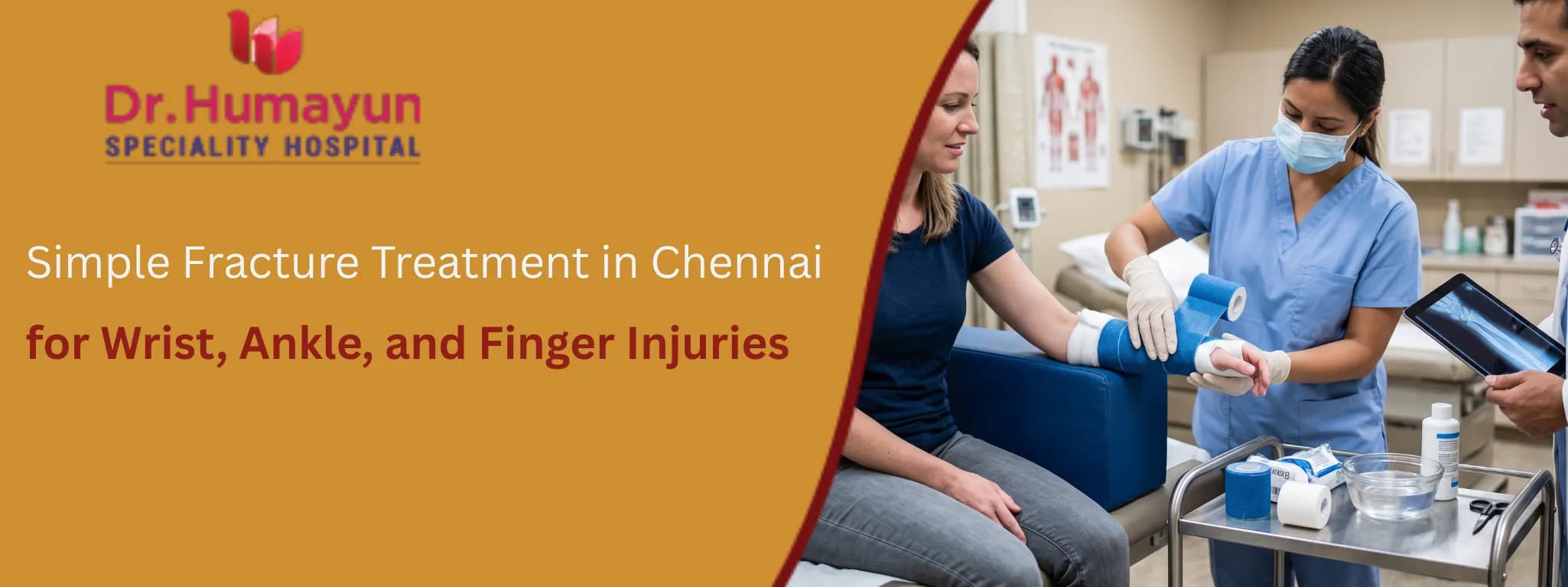
Treatment approach: Most stable, non-displaced wrist fractures are treated non-surgically with a plaster cast or fibreglass cast, worn for 4 to 6 weeks, followed by physiotherapy. As confirmed by Cleveland Clinic, the first step in treatment is making sure the broken pieces are put back into the correct position and preventing them from moving until healed.
Displaced fractures where the bone fragments have shifted out of alignment may require manipulation under anaesthesia to restore alignment before casting, or surgical fixation using metal plates and screws (ORIF) when the fracture is unstable and cannot be held in position with a cast alone.
A 2024 randomised trial confirmed that topology-optimised splints reduce complications such as skin irritation compared to traditional casting in the early weeks of recovery. The best orthopaedist in T Nagar will select the right immobilisation method based on the fracture pattern seen on X-ray.
Fracture Site 2: Ankle Fractures
Ankle fractures typically involve one or more of the three bones that form the ankle joint: the tibia, fibula, and talus. The lateral malleolus (lower end of the fibula) is the most commonly fractured ankle structure, usually from a twisting or rolling injury.
Common symptoms:
-
Immediate pain and swelling around the ankle
-
Bruising that develops over hours, often spreading below and around the ankle
-
Inability to bear weight, or significant pain when attempting to do so
-
Tenderness on direct pressure over the bone
-
Deformity in more severe injuries
The Ottawa Ankle Rules: A widely used clinical tool that helps determine whether an X-ray is needed after an ankle injury. An X-ray is recommended when:
-
There is bone tenderness at the posterior edge or tip of the lateral malleolus
-
There is bone tenderness at the posterior edge or tip of the medial malleolus
-
The patient is unable to bear weight for four steps both immediately after the injury and in the clinical setting
Treatment approach:
| Medication Type | Estimated Annual Cost in West / Middle East |
|---|---|
| Isolated lateral malleolus, undisplaced, stable | Below-knee cast or walking boot for 6 weeks |
| Bimalleolar or trimalleolar, undisplaced | Cast immobilisation with close follow-up X-rays |
| Displaced or unstable ankle fracture | Surgical fixation (ORIF) with plates and screws |
| Ankle fracture with ligament instability | Surgical assessment and possible ligament repair |
Weight-bearing in a cast or boot is permitted earlier in stable fractures and after surgical fixation, which is one advantage of operative management for selected fracture types.


Fracture Site 3: Finger Fractures
Finger fractures are among the most frequently underestimated injuries in everyday clinical practice. Because fingers remain partially mobile even when fractured, many patients wait days or weeks before seeking assessment, assuming the injury is a sprain.
Common symptoms:
-
Swelling, bruising, and tenderness over a specific bone of the finger
-
Pain on gripping or making a fist
-
Rotational deformity, where the fingertip points in a different direction from the adjacent fingers when the fist is made
-
Stiffness that worsens rather than improves over the first few days
Why early assessment matters for fingers:
Rotational deformity in a finger fracture is the most clinically important finding. A fracture that appears minimally displaced on X-ray can still cause the finger to rotate significantly when the fist is closed, which results in the fractured finger overlapping its neighbour during grip. This rotation must be identified and corrected early, as it causes permanent functional impairment if missed.
Treatment approach:
-
Most simple, non-displaced finger fractures are treated with buddy taping (strapping the injured finger to the adjacent finger for support) and early controlled movement.
-
Displaced fractures require reduction, followed by splinting or surgical fixation with wires (K-wires) or small plates when stability cannot be maintained.
-
Fractures involving the joint surface (intra-articular fractures) require particularly careful management to prevent post-traumatic arthritis.
Most paediatric hand fractures are treated non-operatively and do well with structured, early follow-up care from an experienced orthopaedic team.
The Conservative vs Surgical Decision
Not every fracture needs an operation. The decision between non-surgical and surgical treatment is based on:
-
Fracture stability: Can the bone be held in the correct position with a cast or splint?
-
Alignment: Is the bone well-aligned or has it displaced into an unacceptable position?
-
Joint involvement: Fractures entering a joint (intra-articular) require more precise restoration of alignment.
-
Patient factors: Age, bone quality, dominant hand involvement, occupational demands, and overall health.
As confirmed by a 2024 randomised trial, non-surgical treatment can be both cost-effective and highly successful when the fracture is stable and alignment is maintained. Surgery produces the most reliable results for unstable or complex fractures where plaster immobilisation alone cannot maintain position.
What Happens If a Fracture Is Not Treated
Delayed or inadequate treatment of a simple fracture leads to predictable complications:
-
Malunion: The bone heals in an incorrect position, causing deformity and reduced function
-
Non-union: The bone fails to heal, particularly in scaphoid (wrist) fractures when missed
-
Stiffness: Prolonged swelling and inflammation in an untreated injury leads to joint stiffness that is difficult to reverse
-
Post-traumatic arthritis: Intra-articular fractures with poor alignment cause accelerated joint wear
-
Nerve or tendon complications: Untreated displacement can injure adjacent structures
The most avoidable of all fracture complications is non-union of the scaphoid bone in the wrist, which is frequently missed because scaphoid fractures may not appear on initial X-rays and can feel like a sprain. Any wrist injury with tenderness in the anatomical snuffbox (the hollow on the back of the wrist at the base of the thumb) requires specialist assessment and follow-up imaging even if the initial X-ray is normal.
Simple Fracture Treatment in T Nagar at Dr. Humayun Speciality Hospital
At Dr. Humayun Speciality Hospital, the orthopaedic team provides simple fracture treatment in T Nagar for the full range of common upper and lower limb fractures, from the initial assessment through to rehabilitation.
Services include:
-
On-site X-ray for immediate fracture diagnosis
-
Fracture reduction under local or regional anaesthesia when required
-
Plaster cast and fibreglass cast application with detailed home care instructions
-
Functional bracing and walking boot provision for ankle fractures
-
Surgical fixation (ORIF, K-wire fixation) for displaced or unstable fractures
-
Scaphoid fracture assessment including CT or MRI when X-rays are inconclusive
-
Physiotherapy referral and guidance for restoration of movement after immobilisation
For families across T. Nagar, Nungambakkam, Mylapore, Alwarpet, and central Chennai, accessible orthopaedic assessment within their neighbourhood means faster diagnosis and a treatment start that protects long-term function.
Injured your wrist, ankle, or finger and unsure whether it is broken? Chat with our medical care assistant for quick guidance and support and book an orthopaedic assessment at Dr. Humayun Speciality Hospital, T. Nagar, Chennai.