
When a parent first notices a white patch on their child's skin, the experience is often one of confusion and quiet worry. What is it? Is it serious? Will it spread? Will it go away? Vitiligo is a condition many parents have heard of but know little about until it touches their own child. Understanding what vitiligo actually is, what causes it in children, how it is treated, and what the realistic expectations are helps parents move from anxiety and uncertainty to a position of clarity and action.
What Is Vitiligo?
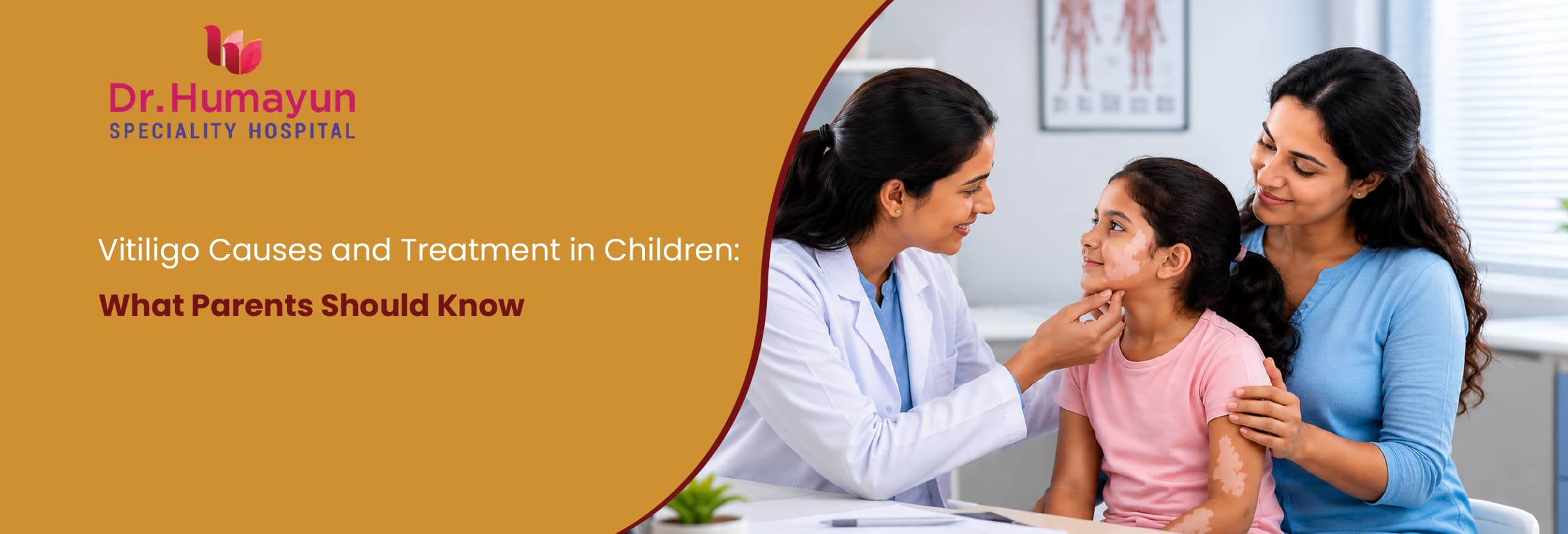
Vitiligo is a chronic skin condition characterised by the loss of pigment in patches of skin. The affected skin turns white or noticeably lighter than the surrounding area, forming patches that can appear anywhere on the body.
Melanocytes are the specialised skin cells responsible for producing melanin, the pigment that gives skin, hair, and eyes their colour. In vitiligo, these melanocytes are damaged and destroyed producing the depigmented patches that define the condition.
Vitiligo is not contagious. It is not caused by an infection. It does not spread through touch. It is not related to poor hygiene, diet, or anything the child or parent did or did not do. Parents need to hear this clearly and often, because misconceptions about vitiligo in India cause significant unnecessary stigma and distress for affected children and families.
Vitiligo in Children: Two Main Types
Understanding which type of vitiligo a child has is important because it affects prognosis, the likelihood of spread, and which treatments are most appropriate.
Nonsegmental vitiligo (NSV) is the most common type, affecting approximately 65% of younger children and 69% of adolescents with vitiligo. It is:
-
Symmetrical patches appear on both sides of the body in similar locations
-
Progressive tends to spread over time if not treated
-
Associated with autoimmune conditions including thyroid disease
-
Responsive to treatment, particularly when started early
Segmental vitiligo (SV) is less common, accounting for roughly 3.5% to 20% of paediatric vitiligo cases. It is:
-
Unilateral typically appears on one side of the body only
-
Rapid in onset but stabilises early, often within one to two years
-
Less responsive to conventional medical treatment but more amenable to surgical procedures once stable
-
Not significantly associated with systemic autoimmune disease
Vitiligo Causes in Children What the Evidence Shows
The precise trigger for vitiligo in any individual child is not always identifiable. What is well-established is the mechanism: vitiligo is an autoimmune condition, and the causes reflect a combination of genetic susceptibility and immune dysregulation.
Autoimmune Mechanism
Vitiligo is driven by autoreactive CD8+ T cells immune cells that should protect the body but instead target and destroy melanocytes. The IFN-gamma signalling pathway and the JAK-STAT pathway are central to this process. This understanding is what led to the development of JAK inhibitor therapies, which block the specific immune signalling responsible for melanocyte destruction. In simple terms: the immune system makes a mistake. It attacks the cells that produce skin colour. This is not caused by anything the child ate, touched, or was exposed to. It is an internal biological process.
Genetic Predisposition
Vitiligo runs in families. Between 20% and 30% of people with vitiligo have a family member with the condition. The genetic predisposition is polygenic multiple genes contribute to the risk rather than a single inherited gene. Having a family member with vitiligo does not mean a child will definitely develop it, but it does increase the baseline risk.
Triggers That May Activate the Condition in Susceptible Children
Several factors can activate or worsen vitiligo in a child who has a genetic predisposition:
-
Skin trauma or injury, particularly sunburn this is called the Koebner phenomenon, where new vitiligo patches develop at sites of skin injury
-
Emotional or psychological stress
-
Physical illness or infection
-
Chemical exposure to certain substances, particularly phenol-based products used in some hair dyes, adhesives, or industrial cleaners
-
Co-existing autoimmune conditions including autoimmune thyroid disease
Associated Conditions in Children With Vitiligo
Children with vitiligo are at elevated risk of co-occurring autoimmune conditions:
-
Autoimmune thyroid disease (Hashimoto's thyroiditis or Graves' disease) — the most commonly associated condition
-
Type 1 diabetes
-
Alopecia areata (patchy hair loss from immune-mediated follicle damage)
-
Halo nevi (moles with a ring of depigmented skin around them)
The presence of halo nevi in a child is a specific marker associated with vitiligo progression and warrants dermatological assessment. A child diagnosed with vitiligo should have their thyroid function tested at diagnosis and periodically during follow-up.
What Vitiligo Looks Like in Children
Vitiligo patches in children are:
-
Clearly defined areas of completely white or very pale skin
-
Most commonly found on the face (particularly around the eyes and mouth), hands, wrists, around body openings, and areas exposed to the sun
-
More visible in children with darker skin tones where the contrast between affected and unaffected skin is pronounced and can cause significant psychosocial distress
-
Sometimes associated with white hairs (poliosis) within the affected patch
-
May be more easily seen under a Wood's lamp (ultraviolet light examination), particularly in children with lighter skin
Vitiligo in children should not be confused with:
-
Tinea versicolor a fungal infection producing lighter patches, typically on the trunk, that are slightly scaly and confirmed by laboratory testing
-
Pityriasis alba a common, harmless childhood condition producing faintly lighter patches, particularly on the cheeks, without the sharp, clear-cut depigmentation of vitiligo
-
Post-inflammatory hypopigmentation lighter skin following eczema, a rash, or another skin condition that healed
A dermatologist can distinguish vitiligo from these mimics with clinical examination and, where needed, a Wood's lamp or biopsy.


The Psychosocial Impact: What Parents Often Underestimate
This section matters as much as the clinical information. Research is unambiguous about the burden vitiligo places on children.
A study of paediatric vitiligo found that affected children particularly those with darker skin tones were significantly more likely to be diagnosed with:
-
Depression
-
Generalised anxiety disorder
-
Disruptive behaviour disorders
-
Eating disorders
-
Social withdrawal
-
Suicidal ideation
These are not minor or incidental findings. Vitiligo in a child with darker skin, living in a community where the condition is stigmatised or misunderstood, carries a genuine psychological burden that requires active attention alongside skin treatment.
Parents should:
-
Acknowledge the child's experience rather than minimising it
-
Provide accurate, age-appropriate information so the child can explain it to peers
-
Engage the school where needed to address bullying or staring
-
Consider referral to a child psychologist if anxiety, withdrawal, or low mood becomes apparent
-
Connect with vitiligo support communities both online and in person
The skin condition and the psychological response to it require parallel management. Treating the skin while ignoring the emotional impact is incomplete care.
Vitiligo Treatment in Children What Is Available Now
The treatment landscape for paediatric vitiligo has evolved significantly. The 2024 JAMA Dermatology expert consensus and the January 2025 Medscape update from the annual Maui Derm conference represent the most current evidence-based guidance available.
The goal of treatment is to stop the spread of vitiligo and to stimulate repigmentation of existing patches. Early treatment particularly for nonsegmental vitiligo produces better outcomes than delayed intervention. Vitiligo that begins before age 12 tends to be more extensive and requires early, sustained treatment.
First-Line Treatments
Topical calcineurin inhibitors (TCIs): tacrolimus and pimecrolimus These are the most recommended first-line treatments in the 2024 JAMA Dermatology consensus for paediatric vitiligo. TCIs reduce the localised immune attack on melanocytes without the skin-thinning side effects associated with long-term corticosteroid use which makes them particularly appropriate for children and for delicate areas including the face and skin folds. They are applied twice daily and require a sustained treatment period to produce repigmentation. Many children show meaningful colour return within three to six months of consistent application.
Topical corticosteroids (TCSs) Topical steroids remain a widely used option, particularly for areas of thicker skin such as the body or scalp. Short courses or intermittent regimens (twice-weekly application) reduce the risk of skin thinning. They are considered first-line for some body sites and second-line on the face, where TCIs are preferred. Consistent use over several months is required to assess response.
Narrowband UVB (NB-UVB) phototherapy Light therapy remains one of the most effective treatments for vitiligo across age groups. Narrow-band UVB is delivered in controlled doses at a dermatology facility, typically two to three times weekly. A systematic review published in the Journal of Investigative Dermatology (March 2026) found that some children particularly those with facial patches and early-stage disease achieved over 70% colour return with light therapy, with mostly mild side effects including temporary redness.
Newer Treatments (Ages 12 and Above)
Topical JAK inhibitor: ruxolitinib 1.5% cream Ruxolitinib is the first FDA-approved topical treatment specifically indicated for nonsegmental vitiligo. It blocks the JAK1/2 signalling pathway that drives melanocyte destruction. In clinical trials, it produced significant repigmentation in both adults and adolescents aged 12 and above.
The 2024 JAMA Dermatology expert consensus recommends topical ruxolitinib as a first- or second-line treatment for patients aged 12 and above, within the limitation of 10% body surface area to minimise systemic absorption. For children under 12, evidence is still limited and its use is not currently recommended outside specialist assessment.
Surgical Options for Stable Segmental Vitiligo
For segmental vitiligo that has been stable for at least one to two years and has not responded to medical therapy, surgical options including melanocyte transplantation (suction blister grafting, split-thickness skin grafting, or cell transplantation) can achieve meaningful and lasting repigmentation. Surgical approaches are suitable only when the vitiligo has been definitively stable — active spreading makes surgical outcomes unpredictable.
When Should Parents Consult a Dermatologist?
This is the central practical question this blog is designed to answer.
Consult a dermatologist promptly if:
-
A new white or pale patch appears on your child's skin that does not fade after two weeks
-
The patch has a sharp, clearly defined border rather than a blurred, gradual fade
-
The patch is located on the face, around the eyes or mouth, or on the hands — where vitiligo is most visible and where early treatment has the best outcomes
-
New patches are appearing rapidly, suggesting active progression
-
Your child is showing signs of emotional distress related to their appearance
-
There is a family history of vitiligo or other autoimmune conditions
-
The child has halo nevi or has been diagnosed with another autoimmune condition
Do not wait for:
-
A patch to "go away on its own" vitiligo rarely resolves without treatment and early intervention produces better long-term outcomes
-
The condition to become more extensive before seeking care smaller, early patches respond better to treatment than extensive disease
-
A second opinion after a dismissive consultation children with vitiligo deserve proactive, evidence-based management from a clinician familiar with current paediatric vitiligo guidelines
Vitiligo Care for Children at Humayun Hospital, T Nagar
At Humayun Hospital, T Nagar, Chennai, our dermatology team provides comprehensive, family-centred assessment and management for children with vitiligo. We offer:
-
Clinical examination and Wood's lamp assessment for accurate diagnosis and extent mapping
-
Thyroid function and autoimmune screening at diagnosis and on follow-up
-
Individualised treatment plans using topical TCIs, topical corticosteroids, and phototherapy referral
-
Access to specialist management for children aged 12 and above eligible for newer JAK inhibitor therapy
-
Psychological awareness and family counselling support alongside skin treatment
-
Monitoring for halo nevi and disease progression markers requiring early intervention
We understand that vitiligo in a child is not simply a skin issue. It is an experience that affects the child's confidence, social life, and family dynamics. Our approach recognises and addresses all of these dimensions.
Chat with our care medical assistant for quick guidance and support.