
Sports drinks and electrolyte drinks: DesignedIt starts the way it always does. A child who seemed fine at dinner is awake at midnight, vomiting. By morning there is diarrhoea. By afternoon the child is quieter than normal, refusing all food and drinking very little.
Stomach flu in children is one of the most common and most distressing experiences for parents, particularly because the combination of vomiting, diarrhoea, and a miserable, listless child naturally generates alarm. But for the majority of children with gastroenteritis, the illness itself is self-limiting. What makes it dangerous is not the virus but the dehydration that accompanies it when fluid losses outpace what the child is taking in.
Understanding how to recognise dehydration, what oral rehydration solution (ORS) is and exactly how to use it, which fluids help and which actively make things worse, and when home management is no longer sufficient is the knowledge that keeps most children safely through a bout of stomach flu without a hospital visit.
What Is Stomach Flu in Children?
Stomach flu is the common name for viral gastroenteritis, an inflammation of the stomach and intestinal lining caused by a viral infection. The most common causative viruses are:
-
Rotavirus: Historically the most common cause of severe gastroenteritis in children under five, now significantly reduced by vaccination in countries with rotavirus immunisation programmes
-
Norovirus: Extremely contagious, spreading rapidly through households and childcare settings. Causes sudden-onset vomiting followed by diarrhoea.
-
Adenovirus and astrovirus: Less common causes with similar presentations
-
Sapovirus: Increasingly recognised as a significant cause of paediatric gastroenteritis
Despite being called stomach flu, viral gastroenteritis has nothing to do with influenza. Stomach flu causes no cough, no runny nose, and no respiratory symptoms. A child with primarily respiratory symptoms alongside vomiting may have a different illness requiring separate assessment.
The illness follows a typical pattern:
-
Sudden onset vomiting, often quite severe in the first 12 to 24 hours
-
Diarrhoea beginning within hours to a day of the vomiting
-
Low-grade fever in many cases
-
Reduced appetite, fatigue, and abdominal cramping
-
Resolution of most symptoms within five to seven days for most viral causes
Why Dehydration Is the Real Danger in Stomach Flu
The virus itself does not require specific antiviral treatment and resolves on its own. The danger in paediatric gastroenteritis is what the vomiting and diarrhoea do to the body's fluid and electrolyte balance.
Children lose fluids far more rapidly than adults during gastroenteritis, relative to their body size. A young child can lose 5 to 10% of their body weight in fluid within 24 hours during severe gastroenteritis. This level of fluid loss produces significant physiological disruption:
-
Blood volume decreases, reducing delivery of oxygen and nutrients to organs
-
Electrolyte imbalances, particularly in sodium and potassium, disrupt nerve and muscle function
-
The kidneys begin to concentrate urine and reduce output to conserve fluid
-
In severe cases, circulatory compromise follows
Dehydration continues to be a major contributor to morbidity and mortality in children globally. In India, where gastroenteritis is extremely common and access to hospital care varies, the appropriate management of dehydration at home through oral rehydration is one of the most important pieces of health knowledge a parent can have.
What Is ORS and Why Does It Work?
Oral rehydration solution is a precisely formulated mixture of glucose, sodium, potassium, and water designed to maximise intestinal water absorption.
The science behind ORS is elegant and important. Glucose and sodium are co-transported across the intestinal wall by a specific transporter called SGLT1 (sodium-glucose linked transporter 1). When glucose and sodium are present together in the correct ratio in the intestinal lumen, this transporter actively pulls both across the intestinal wall, and water follows passively. This mechanism continues to function even in the inflamed, diarrhoeal gut when normal absorption is severely disrupted.
The WHO low-osmolality ORS formula, which has been the international standard since the early 2000s and was reaffirmed in the July 2025 AAP Pediatrics in Review as the global standard for paediatric dehydration, contains:
-
Sodium: 75 mmol/L
-
Glucose: 75 mmol/L
-
Potassium: 20 mmol/L
-
Citrate: 10 mmol/L
-
Total osmolality: 245 mOsm/L
This specific formulation is what makes ORS work so much better than alternatives. It is not simply water with some sugar. It is a solution engineered to exploit the gut's own absorption mechanism.
ORS solution should contain a combination of glucose and sodium to take advantage of the sodium-glucose cotransport in the gut and improve absorption.
Why Common Home Substitutes for ORS Do Not Work
This is one of the most practically important sections for parents, because the most common mistake in managing gastroenteritis at home is using an ineffective fluid instead of ORS.
Plain water: Replaces fluid but not electrolytes. Drinking large amounts of plain water without sodium causes a condition called hyponatraemia (low blood sodium), which can cause seizures in severe cases. It also does not utilise the sodium-glucose cotransport mechanism and is therefore absorbed far less efficiently than ORS.
Fruit juice: High in fructose, low in sodium. Fructose is poorly absorbed in the inflamed gut and draws water into the intestinal lumen by osmosis, worsening diarrhoea rather than treating it. Multiple studies have confirmed that juice worsens diarrhoea duration in children with gastroenteritis.
for exercise-related fluid losses, not illness-related losses. They contain insufficient sodium, too much sugar, and the wrong electrolyte ratios for gastroenteritis management. They are not appropriate substitutes for ORS in sick children.
Soft drinks and carbonated beverages: High sugar, no useful electrolytes, and the carbonation can worsen nausea. Entirely inappropriate for a child with gastroenteritis.
Rice water or home-made salt-sugar solutions: Sometimes recommended as traditional alternatives. The problem is inconsistency: a homemade solution without precise measurement of salt and sugar may be dangerously hypertonic (too much salt) or hypotonic (too little sodium), and neither works as reliably as properly formulated ORS. If commercially prepared ORS is available, it should be used in preference.
Coconut water: Contains potassium and some electrolytes but insufficient sodium for the sodium-glucose cotransport mechanism to function optimally. It is a reasonable oral fluid when ORS is not available but should not be relied upon as the primary rehydration intervention during active illness.


How to Give ORS to a Child During Stomach Flu
The most common reason ORS administration fails at home is giving too much too quickly during active vomiting, triggering further vomiting, and the parent concluding that the child cannot keep anything down. The correct approach during active vomiting:
Start Very Small and Very Slowly
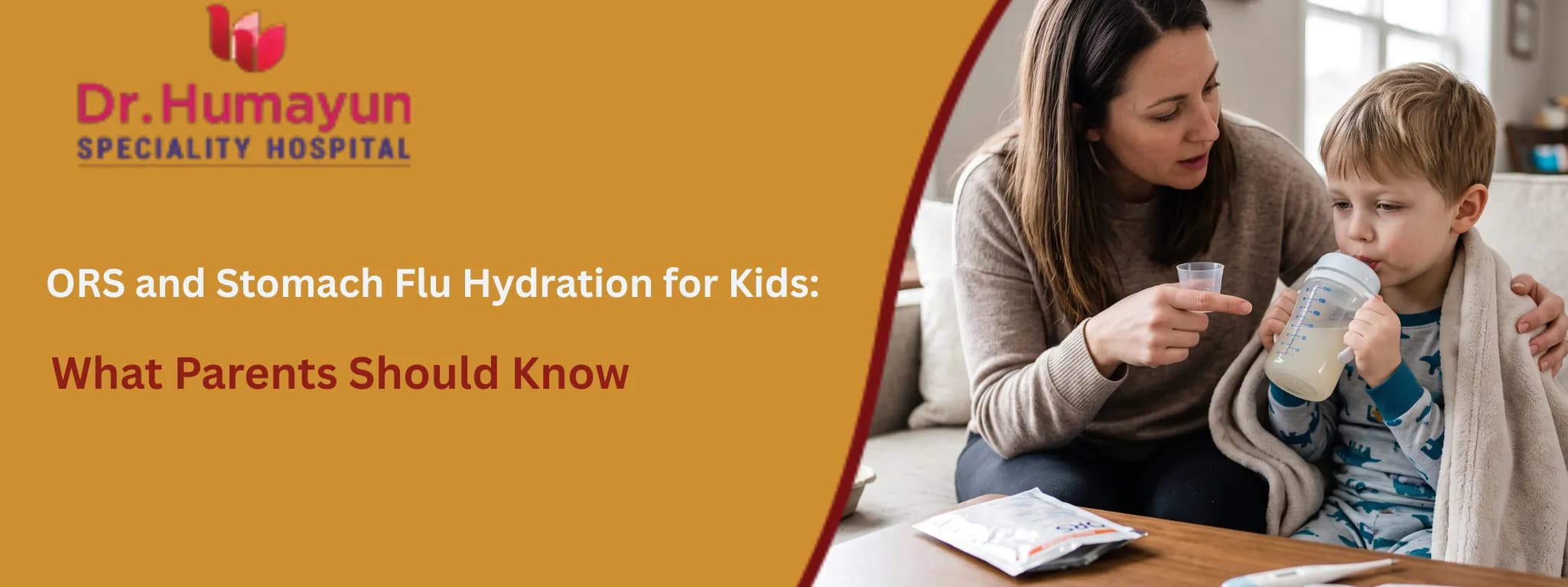
Give 5 ml (one teaspoon) of ORS every one to two minutes using a syringe, a small spoon, or a medicine cup. Do not give a cup or bottle of ORS and expect the child to drink normally.
At this rate, 5 ml every minute delivers 300 ml per hour. Most vomiting children can tolerate 5 ml increments even when they cannot keep larger volumes down, because the small volume passes out of the stomach rapidly before triggering the vomiting reflex.
Children should be given 50 to 100 ml per kilogram of ORS over a two to four-hour period to replace their estimated fluid deficit, with additional ORS given to replace ongoing losses: 10 ml per kilogram for each loose stool and 2 ml per kilogram for each vomiting episode.
Increase Gradually as Tolerance Improves
As the child goes 20 to 30 minutes without vomiting, the volume per sip can increase gradually. From a teaspoon to a dessertspoon to small sips from a cup as tolerance improves over the first few hours.
Preparation
Dissolve one ORS sachet in exactly one litre of boiled and cooled water. Do not use less water to make a stronger solution. Do not add sugar or salt to the prepared solution. Make fresh solution every 24 hours.
For Breastfed Infants
Breastfeeding should continue throughout gastroenteritis. Breast milk provides nutrition, immunological support, and fluid. It should not be stopped in favour of ORS alone. ORS is given alongside breastfeeding to supplement fluid intake.
For Older Children
Older children who are mildly dehydrated and not actively vomiting may drink ORS from a cup. Chilled ORS is better tolerated than room temperature in many children. ORS ice lollies (freezing prepared ORS solution) are a useful trick for children who refuse the liquid form.
Recognising Dehydration: From Mild to Severe
The ability to recognise the degree of dehydration is the most important clinical skill for a parent during a stomach flu episode.
Signs of Mild Dehydration (5% body weight loss)
-
Slightly dry mouth
-
Mildly reduced urine output
-
Normal or slightly reduced activity level
-
Normal skin turgor (skin springs back immediately when pinched)
-
The child is alert, making eye contact, and responding normally
-
Mild dehydration: continue ORS at home as described above.
Signs of Moderate Dehydration (5 to 10% body weight loss)
-
Dry mouth and cracked lips
-
No urine for six to eight hours
-
Sunken eyes
-
Skin that is slower to return to normal when pinched (reduced turgor)
-
Irritable or unusually quiet
-
Rapid heart rate
-
Crying with fewer or no tears
Moderate dehydration: seek paediatric assessment. Oral rehydration can still be attempted but the child needs clinical monitoring and assessment of whether IV fluids are required.
Signs of Severe Dehydration (greater than 10% body weight loss)
-
No urine for eight or more hours
-
Very sunken eyes and fontanelle (in infants)
-
No tears at all when crying
-
Cold, mottled, or grey skin
-
Very rapid, weak pulse
-
The child is limp, extremely drowsy, or difficult to rouse
-
Breathing rapidly without respiratory illness
Severe dehydration is a medical emergency. Go to the emergency department immediately. Intravenous fluid replacement is required.
Feeding a Child With Stomach Flu: What the Evidence Says
Fasting during gastroenteritis was a historical recommendation that is now clearly contradicted by evidence. Early refeeding, as soon as the child can tolerate it, is recommended by all current paediatric guidelines.
The principle is simple: the gut heals faster when it is fed. The intestinal epithelial cells that are damaged by gastroenteritis require nutrients to regenerate. Withholding food for 24 hours or more delays this recovery.
After the acute vomiting phase has settled:
-
Offer small amounts of bland, easily digestible food: rice, soft bread, banana, plain crackers, soup
-
Continue breastfeeding throughout the illness for breastfed infants
-
Formula-fed infants should resume full-strength formula as soon as tolerated, not diluted formula
-
Avoid dairy in older children for the first 24 to 48 hours if they appear to be intolerant (lactase enzyme is temporarily reduced in the inflamed gut)
-
Avoid high-fat, high-fibre, and spicy foods until full recovery
A child who refuses food entirely is less concerning than a child who refuses all fluids. Adequate fluid replacement takes priority over food in the acute phase.
What Not to Give Children With Stomach Flu
-
Antibiotics: Stomach flu is viral. Antibiotics have no effect on viral infections. Giving antibiotics for gastroenteritis contributes to antibiotic resistance without any clinical benefit.
-
Anti-diarrhoeal medications (loperamide): Not recommended in children with acute gastroenteritis. They slow gut motility but do not address the cause, and in children can cause serious side effects including toxic megacolon. Not recommended for children under 12 in most guidelines.
-
Anti-emetic medications (metoclopramide, domperidone): Routine use is not recommended for uncomplicated gastroenteritis in children. Ondansetron, a different class of anti-emetic, may be prescribed by a doctor in specific clinical situations to facilitate ORS administration when vomiting is preventing all oral intake, but this is a clinical decision, not a home management one.
-
Antidiarrhoeal herbal or traditional remedies: Many traditional remedies for diarrhoea are either ineffective or have potential for harm in children. No traditional herbal remedy has the evidence base of ORS for paediatric gastroenteritis management.
When to Seek Medical Assessment
Seek same-day paediatric assessment for:
-
Any infant under six months with vomiting and diarrhoea
-
Signs of moderate dehydration as described above
-
Blood in the stool or vomit
-
Vomiting that is projectile, persistent, or that contains bile (green colour)
-
High fever above 39 degrees Celsius alongside gastroenteritis
-
Symptoms not improving after 48 to 72 hours of appropriate home management
-
A child who is refusing all fluids and cannot be given ORS by small sips
-
A child whose usual activity level and responsiveness has notably declined
Go to the emergency department immediately for:
-
Signs of severe dehydration: limp child, no tears, very sunken eyes, no urine in eight or more hours
-
Blood in the stool in significant amounts
-
A child who cannot be roused to normal alertness
-
A child under three months with any vomiting and diarrhoea
-
Green (bilious) vomiting, which may indicate an intestinal obstruction rather than simple gastroenteritis
Paediatric Care at Humayun Hospital, T Nagar
At Humayun Hospital, T Nagar, Chennai, our paediatric team provides prompt assessment and management for children presenting with gastroenteritis and dehydration at every severity level.
We offer:
-
Clinical assessment of dehydration severity using validated paediatric dehydration scoring
-
Blood electrolyte testing where indicated by clinical presentation
-
Supervised oral rehydration with monitoring for children with moderate dehydration
-
Intravenous fluid therapy for children who cannot maintain oral intake or who present with moderate to severe dehydration
-
Nasogastric tube rehydration for selected children who cannot drink but do not require IV access
-
Clear parent education on ORS preparation, administration technique, feeding during illness, and signs of worsening
-
Assessment for secondary causes of persistent diarrhoea when gastroenteritis does not resolve in the expected timeframe
Most children with stomach flu do not need hospital admission. But accurate assessment of dehydration and clinical support for parents managing a sick child at home makes the difference between safe home recovery and a complication that requires more intensive treatment.
Chat with our medical assistant for quick guidance and support.