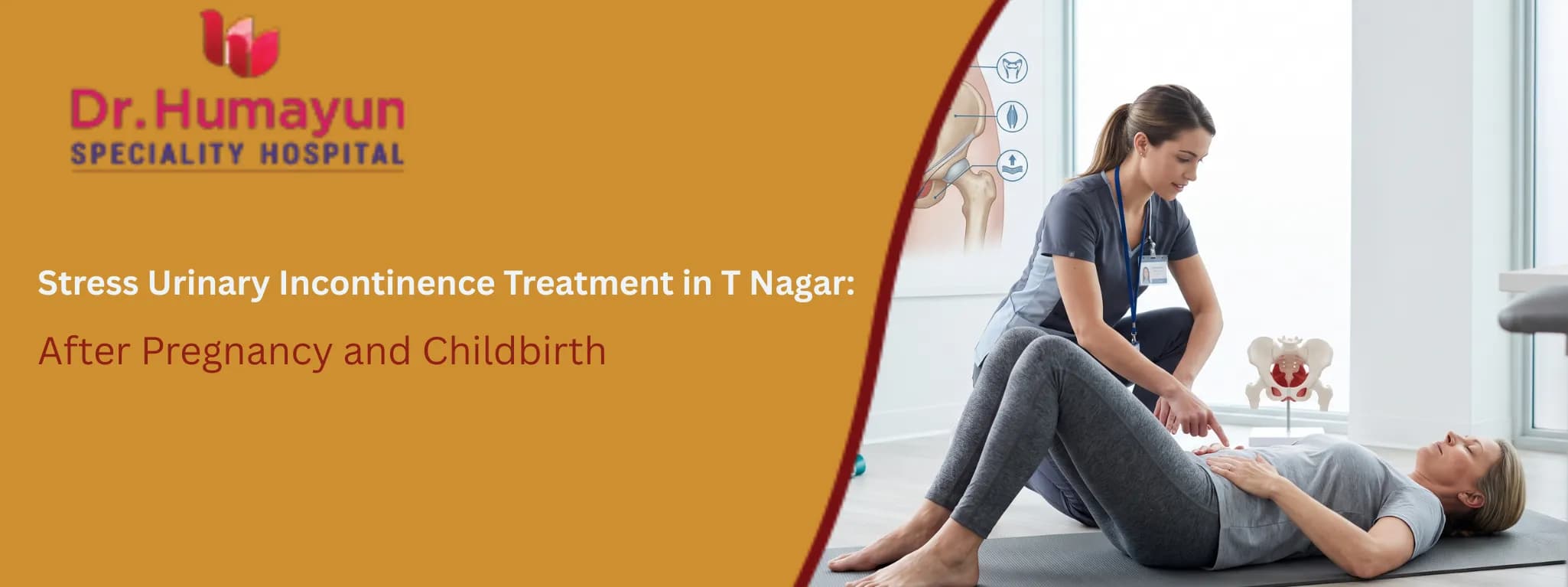

It happens when you cough. When you sneeze during a cold. When you laugh too hard at something. When you pick up your baby from the cot. A small but mortifying leak of urine that you did not choose, cannot control, and that no one warned you would happen after having a baby.
Stress urinary incontinence after childbirth is one of the most common and most underreported conditions in postpartum women. Studies show that up to 38 to 40% of new mothers experience some form of urinary incontinence after delivery. Most say nothing to their doctor. Many assume it is simply what happens to a woman's body after having children, something to quietly manage and endure.
This assumption is wrong in two important ways. First, postpartum SUI is a medical condition with effective treatments, not a permanent consequence of motherhood that must be accepted. Second, the earlier appropriate treatment is started, the better the outcomes. Women who receive structured pelvic floor rehabilitation in the months after delivery have significantly better long-term continence than those who wait until leakage becomes severe.
Understanding what causes SUI after pregnancy, what treatment involves, and when specialist assessment is needed is the purpose of this guide.
What Is Stress Urinary Incontinence?
Stress urinary incontinence is defined by the International Continence Society as an involuntary loss of urine following physical exertion, sneezing, or coughing. The word "stress" refers not to emotional stress but to the physical stress applied to the bladder and pelvic floor by sudden increases in intra-abdominal pressure.
Activities that typically trigger SUI:
-
Coughing or sneezing
-
Laughing
-
Lifting heavy objects including a baby or toddler
-
Jumping, running, or brisk walking
-
Climbing stairs
-
Getting up quickly from a chair or bed
The leakage is caused by a failure of the urethral closure mechanism under this increased pressure. Normally, when the abdomen compresses the bladder during a cough or jump, the urethra and its surrounding support structures respond reflexively by tightening to prevent leakage. When the pelvic floor is weakened or the urethral support is damaged, this reflex is insufficient and leakage occurs.
SUI is distinct from urge urinary incontinence, where leakage accompanies a sudden urgent need to urinate rather than physical activity, though both types commonly co-exist in postpartum women as mixed urinary incontinence.
Why Pregnancy and Childbirth Cause Stress Urinary Incontinence
Understanding the mechanism clarifies why SUI is so common after childbirth and why certain deliveries carry higher risk.
The Effect of Pregnancy on the Pelvic Floor
During pregnancy, the growing uterus places sustained, progressive downward pressure on the pelvic floor throughout the nine months of gestation. The pelvic floor muscles, the hammock-like group of muscles and connective tissue structures spanning the base of the pelvis and supporting the bladder, uterus, and rectum, bear an increasing mechanical load as the pregnancy advances.
Simultaneously, the hormone relaxin, which increases significantly during pregnancy to prepare the body for delivery, softens and loosens the connective tissue throughout the pelvis. This relaxation facilitates delivery but also reduces the firmness and support capacity of the pelvic floor structures that maintain urethral closure.
The Effect of Vaginal Delivery
Vaginal delivery, particularly in prolonged labour, instrument-assisted delivery (forceps or ventouse), and delivery of a large baby, significantly increases the risk of pelvic floor injury and postpartum SUI.
During descent of the baby through the birth canal, the pelvic floor muscles are stretched to several times their resting length. Pudendal nerve injury from compression and stretch during delivery is common and may be subclinical, reducing the neural drive to the pelvic floor muscles and urethral sphincter in the postpartum period. Levator ani muscle avulsion, where the pelvic floor muscle partially or completely tears from its bony attachment, occurs in approximately 10 to 30% of vaginal deliveries and is strongly associated with postpartum SUI.
A systematic review found a double prevalence of SUI in the vaginal delivery group (31%) compared to the caesarean section group. While this does not mean caesarean section is the preferred mode of delivery for SUI prevention, it explains why risk assessment and early pelvic floor rehabilitation are particularly important after vaginal delivery.
Risk Factors for Postpartum SUI
Not all women who deliver vaginally develop SUI. Specific factors elevate individual risk:
-
Prolonged second stage of labour (pushing phase)
-
Instrumental delivery (forceps more than ventouse)
-
Birth of a large baby (birthweight above 4 kg)
-
Multiple previous vaginal deliveries
-
Perineal tears, particularly third or fourth degree
-
Pre-existing stress incontinence during pregnancy (pregnancy-onset SUI)
-
Obesity, where elevated intra-abdominal pressure adds to the pelvic floor load
-
Chronic cough from asthma, smoking, or recurrent chest infections
-
Connective tissue disorders that affect ligament strength
When Does Postpartum SUI Resolve on Its Own?
An important question for new mothers is whether SUI will simply improve with time.
The honest answer is: for many women, yes, and for many others, no, and the difference depends significantly on whether appropriate treatment is started early.
Many cases of postpartum SUI that begin immediately after delivery improve significantly in the first six to twelve weeks as the pelvic floor recovers from the acute injury of delivery. This spontaneous improvement is more likely when the SUI is mild, when there is no significant levator ani injury, and when the woman is young and otherwise healthy.
However, SUI that persists beyond three months with moderate to significant leakage is unlikely to resolve fully without treatment. A Frontiers in Global Women's Health 2025 systematic review confirmed that persistent postpartum SUI significantly impacts women's psychological wellbeing, social activity, sexual function, and return to work, making early treatment not just clinically appropriate but a quality-of-life priority.
Women who have SUI during pregnancy are particularly likely to have persistent SUI postpartum. Persistent stress urinary incontinence during pregnancy and one year after delivery carries a measurably higher prevalence than incontinence appearing only postpartum.
Stress Urinary Incontinence Treatment in T Nagar: Conservative Options
The large majority of postpartum SUI responds to conservative management, and conservative treatment is always the appropriate starting point.
Pelvic Floor Muscle Training (PFMT)
PFMT is the first-line treatment for postpartum SUI, recommended by all international guidelines including the International Continence Society, IUGA, and WHO.
PFMT involves systematic exercises to strengthen the pubococcygeus and surrounding pelvic floor muscles that contribute to urethral closure. The exercises involve identifying the correct pelvic floor muscles (not the abdomen, buttocks, or thighs), contracting them for sustained holds, and performing rapid contractions for the fast-twitch muscle fibres involved in reflex sphincter closure during coughing and sneezing.
A systematic review found that supervised PFMT, with physiotherapy guidance on correct technique and a structured progressive programme, is significantly more effective than unsupervised Kegel exercises performed at home without instruction. Many women perform pelvic floor exercises incorrectly, inadvertently increasing intra-abdominal pressure rather than recruiting the pelvic floor, and achieve minimal benefit.
Key principles of effective PFMT for postpartum SUI:
-
Exercises should begin as soon as comfortable after delivery, once perineal pain allows
-
A minimum of three to four months of consistent exercise is required to assess the full benefit
-
Supervision by a pelvic floor physiotherapist significantly improves adherence and technique
A combination of sustained holds (building endurance) and rapid contractions (building reflex responses) addresses both aspects of urethral closure function


Supervised Physiotherapy With Electrostimulation
For women with significant pelvic floor weakness where voluntary contraction is insufficient or unreliable, pelvic floor electrostimulation (using a small probe that delivers gentle electrical stimulation to the pelvic floor) can assist muscle recruitment. The evidence base supports electrostimulation as an adjunct to PFMT in postpartum SUI, producing better outcomes than PFMT alone in selected patients.
Supervised physiotherapy with or without electrostimulation is consistently identified as the most effective non-surgical intervention for postpartum SUI.
Lifestyle and Behavioural Modifications
Alongside pelvic floor exercises, specific lifestyle measures reduce the mechanical stress on the pelvic floor during recovery:
-
Weight management: Excess weight increases intra-abdominal pressure on the pelvic floor with every step, cough, and breath. Even modest weight reduction produces measurable improvement in SUI severity.
-
Managing chronic cough: Persistent cough from smoking, asthma, or recurrent respiratory infections significantly worsens SUI by repeatedly stressing the pelvic floor. Addressing the underlying cause of cough is a practical SUI management step.
-
Avoiding constipation and straining: Straining at stool repeatedly applies high intra-abdominal pressure to the pelvic floor. High-fibre diet and adequate hydration to maintain soft stools reduces this additional pelvic floor load.
-
Bladder training: Timed voiding and bladder training reduce urge symptoms and help regulate voiding patterns in women with mixed SUI and urgency.
-
Pessary for urethral support: A ring or dish pessary inserted into the vagina provides mechanical support to the urethra and can significantly reduce SUI symptoms during activities like exercise. It is particularly useful for women who want to resume sport or exercise while awaiting further treatment.
Topical Oestrogen for Postmenopausal Atrophy
For postmenopausal women or women with significant vaginal atrophy from breastfeeding-related oestrogen suppression, topical vaginal oestrogen improves the trophic state of the urethral and vaginal tissues and can improve mild SUI. It is not the primary treatment for SUI but is an appropriate adjunct when atrophy is a contributing factor.
When Conservative Treatment Is Not Enough: Surgical Options
Approximately 20 to 30% of women with postpartum SUI do not achieve adequate improvement with conservative management and warrant surgical assessment. Surgery is considered when:
-
Moderate to severe SUI persists after three to six months of appropriately supervised PFMT
-
Quality of life is significantly impacted by leakage affecting work, exercise, social activities, or sexual function
-
Conservative management has been completed but the woman continues to experience significant leakage
-
Urodynamic testing confirms genuine stress incontinence with adequate bladder capacity and stability
Mid-Urethral Sling (MUS)
The mid-urethral sling is the gold standard surgical treatment for SUI and is the most widely performed continence procedure worldwide. A thin, narrow strip of polypropylene mesh is placed under the mid-urethra through a small vaginal incision, supporting the urethra during increases in intra-abdominal pressure.
Two approaches are used:
-
Tension-free vaginal tape (TVT): The tape is passed retropubically (behind the pubic bone). Extensively validated over 25 years with long-term durability data.
-
Trans-obturator tape (TOT): The tape passes through the obturator foramen laterally. A modified surgical approach with equivalent efficacy and a slightly different risk profile.
Cure rates for SUI after mid-urethral sling at 12 months are 80 to 90%, and long-term durability is excellent. A systematic review showed very long-term TVT efficacy maintained at 17 to 20-year follow-up in the majority of women.
The procedure is performed under general or regional anaesthesia, typically as a day procedure or with a single overnight stay. Recovery to light activities takes one to two weeks, and full return to exercise is recommended at six to eight weeks.
Colposuspension (Burch Procedure)
Laparoscopic Burch colposuspension, where the bladder neck is elevated and supported by sutures attached to the ligaments behind the pubic bone, is an alternative for women who are not suitable for mesh due to specific clinical factors or personal preference. It has slightly lower long-term cure rates than mid-urethral sling but is an established and effective alternative.
Bulking Agents
Urethral bulking agents, injected around the urethra to increase urethral resistance, are a minimally invasive option suitable for women who cannot undergo or prefer to avoid more extensive surgery. They are less durable than mid-urethral sling but carry a lower procedural risk profile and can be repeated.
When to Seek Assessment for Postpartum SUI
Many women delay seeking help for SUI for months or years because of embarrassment, normalising the symptom, or not knowing treatment exists. This delay is not in their interest. Seek assessment for stress urinary incontinence treatment in T Nagar if:
-
You are leaking urine during coughing, sneezing, laughing, or exercise at any point after delivery
-
Leakage is affecting your confidence, social activity, return to exercise, or sexual function
-
You experienced leakage during pregnancy that has not fully resolved by three months postpartum
-
Your leakage is not improving after three months of home-based pelvic floor exercises
-
You want structured, supervised pelvic floor physiotherapy rather than attempting unsupervised exercises
-
You have had a prolonged labour, instrumental delivery, or a significant perineal tear and want a postnatal pelvic floor assessment
There is no minimum severity threshold below which treatment is not warranted. Even mild SUI that is currently manageable should be assessed and treated because without intervention, it commonly worsens with subsequent pregnancies, weight gain, or menopause.
Care at Humayun Hospital, T Nagar
At Humayun Hospital, T Nagar, Chennai, Dr. Asma Humayun provides specialist, confidential, and compassionate assessment and treatment for stress urinary incontinence after pregnancy and childbirth.
Dr. Asma Humayun is a Gynaecologist and Obstetrician with over 15 years of clinical experience. Her qualifications include MBBS (Rajiv Gandhi University of Health Sciences, 2006), DGO (Sri Ramachandra University, 2011), Fellowship in Assisted Reproductive Techniques (F.ART), Fellowship in Minimal Access Surgery (F.MAS), Diploma in Reproductive Medicine (Germany), and MRCOG (Royal College of Obstetricians and Gynaecologists, UK).
Her F.MAS qualification reflects specific training in laparoscopic surgical techniques including laparoscopic colposuspension, and her broad gynaecological expertise covers the full range of pelvic floor conditions.
We offer:
-
Detailed assessment of SUI severity, type, and impact on quality of life
-
Urodynamic testing where indicated to confirm genuine SUI and exclude bladder overactivity
-
Supervised pelvic floor muscle training referral with specialist physiotherapy coordination
-
Conservative management guidance including lifestyle modification and pessary fitting
-
Surgical assessment for women who have completed conservative management
-
Mid-urethral sling surgery (TVT or TOT) for confirmed SUI requiring surgical correction
-
Postoperative follow-up and long-term continence monitoring
Stress urinary incontinence after childbirth is treatable. No woman should spend months or years managing leakage in silence when effective, evidence-based treatment is available.
Chat with our medical assistant for quick guidance and support.