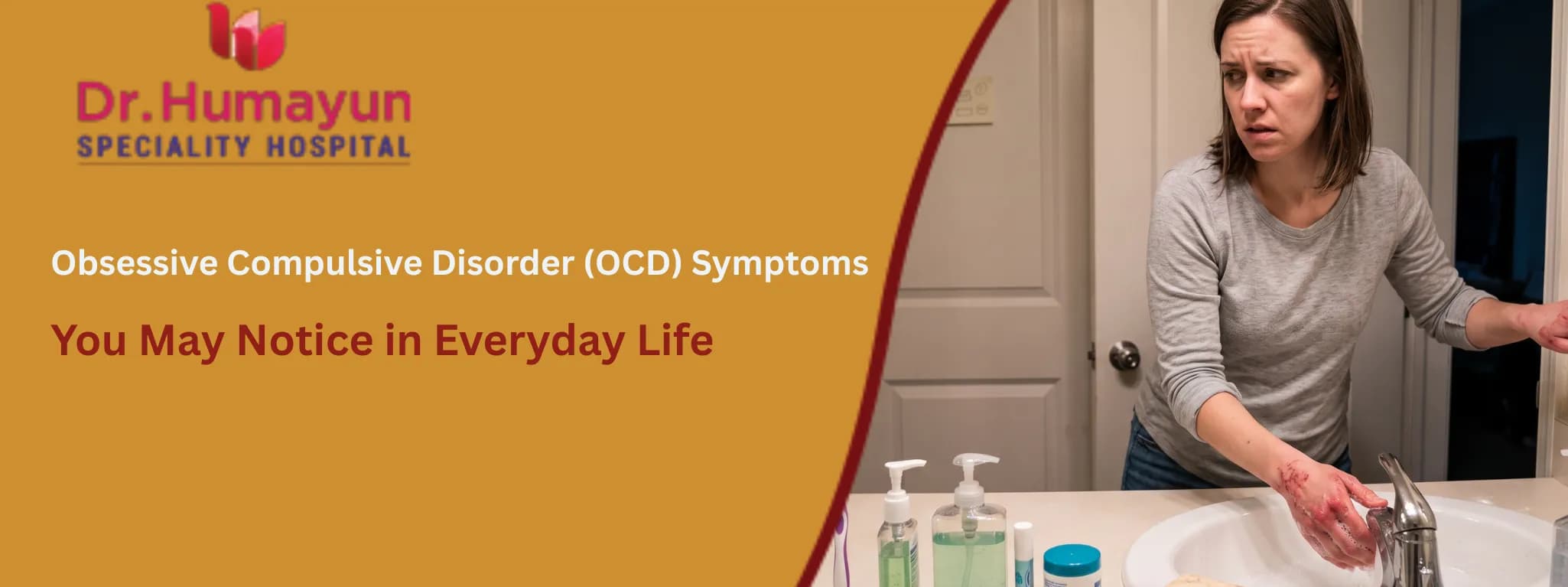

You have heard people say it casually. "I am so OCD about keeping my desk tidy." "I am a bit OCD about the kitchen." The phrase gets used to describe a preference for neatness, a tendency toward routine, or a dislike of disorder.
This casual usage does a significant disservice to the people who actually live with obsessive compulsive disorder. For them, OCD is not a preference for cleanliness or an admirable work habit. It is an exhausting cycle of unwanted intrusive thoughts and rituals that they cannot stop even when they desperately want to. It consumes hours of every day. It disrupts work, relationships, and the ability to function in ways that are invisible to almost everyone around them.
Understanding what obsessive compulsive disorder OCD symptoms actually look like in everyday life, and how to distinguish OCD from ordinary habits and preferences, is the starting point for recognising a condition that is far more common and far more treatable than most people realise.
What OCD Actually Is
Obsessive compulsive disorder is a chronic mental health condition characterised by two interconnected features.
Obsessions are repeated, intrusive, unwanted thoughts, urges, or mental images that are distressing and difficult to dismiss. They force their way into consciousness repeatedly and produce significant anxiety. The person experiencing them often knows intellectually that the obsession is irrational or exaggerated. This does not reduce the distress or the frequency of the thought. Trying to suppress it typically makes it more intrusive, not less.
Compulsions are repetitive behaviours or mental acts that a person feels compelled to perform in response to an obsession. The compulsion is performed to reduce the distress the obsession causes or to prevent a feared consequence from occurring. It provides temporary relief, but the relief is brief. The obsession returns, and the compulsion must be repeated. This cycle is the defining clinical feature of OCD.
The critical threshold that separates OCD from ordinary habits or preferences is functional impact and time. People with OCD generally:
-
Cannot control their obsessions or compulsions even when they know they are excessive
-
Spend more than one hour per day on obsessions or compulsions
-
Do not get genuine pleasure from compulsions, only temporary anxiety relief
-
Experience significant problems in daily life, work, or relationships as a result
The Most Common OCD Symptom Types in Everyday Life
OCD does not look the same in every person. The obsessions and compulsions vary enormously, and some presentations are recognised immediately as OCD while others are mistaken for anxiety, personality traits, or simply unusual habits. The following are the most common OCD symptom types that appear in the everyday lives of affected individuals.
Contamination Obsessions and Cleaning Compulsions
This is the most widely recognised OCD presentation. The person has persistent, distressing obsessions about contamination: being infected by germs, spreading illness to others, or touching something dirty. The compulsions are cleaning and washing rituals.
What this looks like in everyday life:
-
Washing hands repeatedly after any contact with surfaces, people, or objects perceived as contaminated, sometimes 20 to 30 times per day
-
Following a precise sequence when washing that must be completed in full and restarted if interrupted
-
Refusing to touch door handles, public transport rails, or other people's belongings without using a barrier
-
Extensive cleaning of the home that takes hours and must be repeated if disturbed
-
Avoiding certain places, activities, or people entirely because of contamination fear
The key distinction from ordinary hygiene consciousness: the handwashing is distressing and time-consuming, the person often wants to stop but cannot, and stopping or being prevented from washing produces intense anxiety rather than mild inconvenience.
Checking Obsessions and Compulsions
Checking is one of the most common OCD symptom patterns and one of the most frequently dismissed as simple anxiety or neuroticism rather than recognised as OCD.
The obsession is a persistent doubt or fear: did I leave the gas on, did I lock the door, did I run over someone while driving, did I send an email with an embarrassing mistake. The compulsion is checking, repeatedly, to relieve the doubt. But the relief is temporary. Within minutes or hours, the doubt returns and checking begins again.
What this looks like in everyday life:
-
Returning home multiple times after leaving to check that the door is locked or the gas is off
-
Being unable to leave the house until every switch, socket, and appliance has been checked in a specific sequence
-
Driving back along a route to check whether an accident occurred without noticing
-
Re-reading emails or messages many times before sending and still being uncertain whether they are correct
-
Asking family members repeatedly for reassurance that something is fine, with temporary relief that quickly dissolves
For some people with checking OCD, the journey to work takes one to two hours longer than it should because they return home to check again and again before they can leave.
Symmetry, Ordering, and Arranging Compulsions
Some people with OCD experience obsessions about symmetry, evenness, or things being "just right." The distress is not specifically about contamination or harm but about a persistent sense that something is wrong or incomplete until objects, actions, or sequences are arranged in a precise way. What this looks like in everyday life:
-
Items on a desk or bookshelf must be positioned in precise alignment and any disturbance causes significant distress
-
Repetitive actions such as touching, tapping, or arranging must be performed an exact number of times or in a specific pattern before they feel complete
-
Sentences must be rewritten until they feel exactly right, making writing or email correspondence extremely time-consuming
-
Steps, tiles, or cracks must be avoided or stepped on in a specific pattern when walking
-
A physical or mental sensation that something is "not right" that persists until the correct arrangement or action is achieved
This presentation is sometimes misidentified as perfectionism or an unusual personality trait because it can superficially resemble high standards rather than compulsive behaviour.


Harm Obsessions
Harm obsessions are among the most distressing OCD symptom types and among the most stigmatised. The person experiences repeated, unwanted intrusive thoughts about harming themselves or others, typically someone they love. They do not want to act on these thoughts. The thoughts are entirely unwanted and extremely distressing precisely because they conflict with the person's values and character.
What this looks like in everyday life:
-
Persistent intrusive images of harming a family member while using a kitchen knife, driving near them, or standing near a height
-
Being unable to use certain objects or be in certain situations because the intrusive thought is triggered
-
Extreme self-monitoring and reassurance-seeking to confirm they have not acted on thoughts they have no desire to act on
-
Avoiding being alone with loved ones out of fear of the unwanted thought
-
Significant shame and reluctance to disclose the symptom because of fear of being misunderstood
People with harm obsessions in OCD do not pose a danger to others. Their distress arises precisely because the thoughts are ego-dystonic, completely contrary to who they are and what they want. This is fundamentally different from genuine harmful intent and the distinction is clinically important.
Religious and Moral Obsessions (Scrupulosity)
Scrupulosity is an OCD subtype characterised by obsessions about religious, moral, or ethical matters. The person is persistently preoccupied with whether they have sinned, whether they have evil thoughts, whether they have been dishonest in some minor way, or whether they have offended a religious principle.
What this looks like in everyday life:
-
Repeatedly confessing the same sin or transgression to a religious authority despite having been forgiven
-
Praying repeatedly in a specific sequence until it feels "done correctly"
-
Being unable to focus on worship because of intrusive blasphemous or immoral thoughts
-
Reviewing all interactions at the end of the day to check whether something dishonest or unkind was said
-
Excessive guilt about minor moral lapses that the person logically knows were not significant
Scrupulosity is culturally shaped. Its specific content reflects the religious and moral framework of the individual's culture, making it particularly relevant to understand in a population where religious observance is a significant part of daily life.
Intrusive Thoughts Without Obvious Compulsions
Not all OCD presentations involve visible repetitive behaviours. A significant proportion of people with OCD experience what is called "Pure O," though this term is somewhat misleading. These individuals experience frequent, distressing obsessive thoughts without performing obvious external rituals.
However, the compulsions are present in mental form rather than behavioural: mental reviewing, mental reassurance-seeking, mental neutralisation of thoughts. The person spends hours mentally going over events, mentally analysing whether a thought means something about their character, or performing mental acts designed to undo or neutralise the obsessive thought.
This presentation is among the least recognised as OCD because nothing visible is happening. The person appears to be simply thinking, worrying, or being anxious.
OCD vs Normal Habits and Preferences: The Critical Difference
The single most important distinction between OCD and normal habits or preferences is the distress and functional impact.
Many people are neat, like routines, double-check things occasionally, or have superstitions. These are not OCD. The difference:
| Feature | Normal Habit or Preference | OCD Symptom |
|---|---|---|
| Control | Chosen and controllable | Not controllable, driven by anxiety |
| Time | Brief, practical | More than 1 hour per day |
| Purpose | Personal preference or efficiency | To reduce distress from an obsession |
| Distress if interrupted | Mild inconvenience | Significant anxiety or panic |
| Impact on daily life | None | Disrupts work, relationships, routine |
| Insight | Recognised as a preference | Recognised as excessive but cannot stop |
A person who says "I am so OCD about my desk" and means they prefer tidiness is not describing OCD. A person who spends 45 minutes re-arranging their desk before they can begin work, knows it is excessive, and cannot leave until it feels right, may be describing a genuine OCD symptom.
When and Why OCD Is Underdiagnosed
Most people with OCD are diagnosed between age 10 and age 20, but many adults live with significant OCD symptoms for years or decades without a diagnosis. The reasons include:
-
Shame about the content of obsessions, particularly harm, sexual, or religious obsessions
-
Believing that the obsessions reflect something true about their character rather than being a symptom of a treatable disorder
-
Managing symptoms through avoidance rather than seeking help
-
Symptoms being misidentified as generalised anxiety disorder or depression
-
The casual "I am so OCD" cultural usage that minimises the severity of the actual condition and makes it harder for people with genuine OCD to take their symptoms seriously
The WHO identifies OCD as one of the top 10 most disabling disorders globally. When untreated, it progressively expands to occupy more and more of the affected person's daily life.
Treatment for OCD Is Highly Effective
This is the message that counterbalances the clinical weight of the symptoms described above. OCD is one of the most treatable of all mental health conditions when appropriate treatment is received.
Cognitive Behavioural Therapy with Exposure and Response Prevention (CBT-ERP) is the gold standard psychological treatment. It involves gradual, structured exposure to the feared stimulus or thought, combined with active prevention of the compulsive response. Over time, the anxiety associated with the obsession reduces, and the compulsion loses its grip. CBT-ERP produces lasting improvement for most patients and is the first-line recommendation in all major clinical guidelines.
Selective serotonin reuptake inhibitors (SSRIs) are the first-line pharmacological treatment for OCD. They are effective at reducing obsession frequency and intensity and are used alone or in combination with CBT-ERP depending on severity. The doses required for OCD are typically higher than those used for depression, and response may take 8 to 12 weeks.
Treatment can take time, but many people find significant relief and regain control over their lives. Getting the right help is not about willpower. It is about understanding what OCD is and accessing the therapies that specifically work for it.
Assessment at Humayun Hospital, T Nagar
At Humayun Hospital, T Nagar, our internal medicine and mental health team provides assessment for patients presenting with features consistent with obsessive compulsive disorder OCD symptoms, alongside structured referral to psychological and psychiatric specialists for evidence-based management. We offer:
-
Clinical assessment and structured symptom evaluation using validated OCD screening tools
-
Differentiation from other anxiety disorders, depression, and conditions that may overlap with OCD
-
Appropriate psychiatric and psychological referral for CBT-ERP and pharmacological management
-
Support for family members who are affected by a loved one's OCD and need guidance on how to respond to reassurance-seeking behaviours
-
Ongoing internal medicine monitoring for patients on SSRI therapy
If you recognise the patterns described in this guide in your own daily life, or in someone close to you, the most important step is not managing it alone. OCD does not improve through willpower or by dismissing the thoughts as irrational. It improves with the right treatment, delivered by clinicians who understand how OCD specifically works.
Chat with our medical care assistant for quick guidance and support.