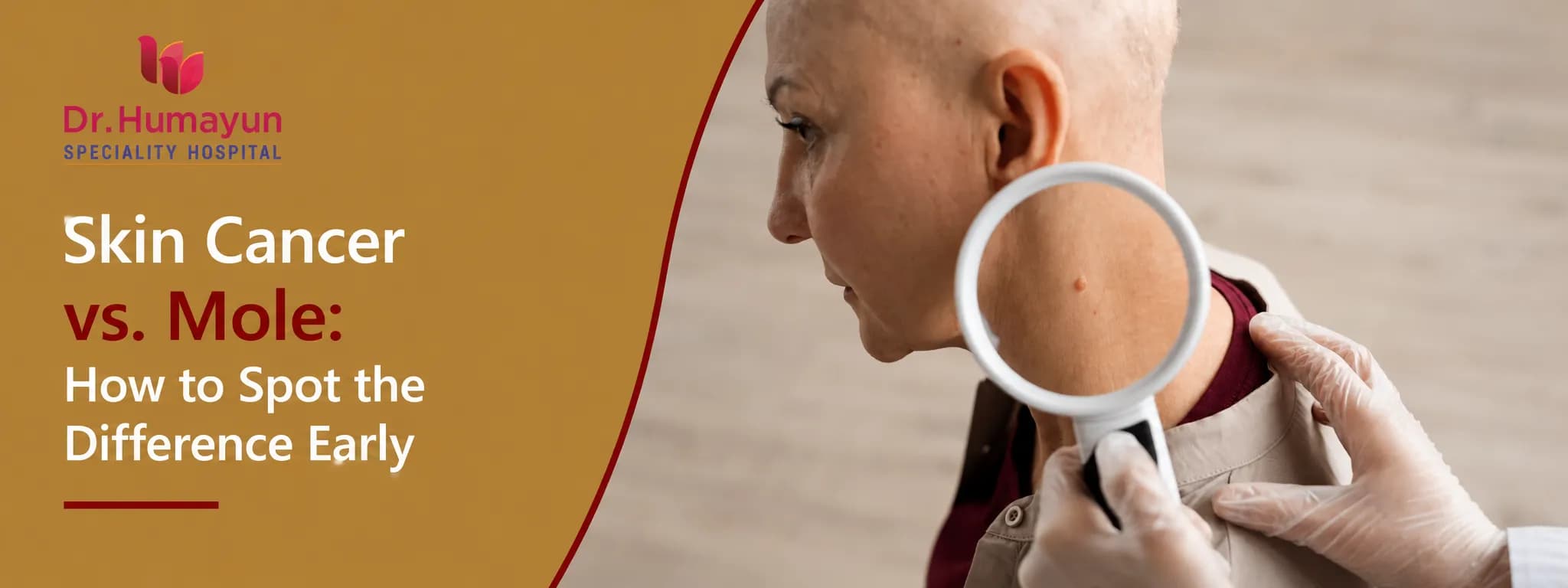

Almost everyone has a few spots, freckles, or moles on their body. For the vast majority of us, these marks are completely harmless beauty spots that we live with our entire lives without a second thought. However, because our skin is constantly exposed to sunlight, environmental changes, and aging, new spots can appear, and old moles can sometimes change their structure.
When you notice a new mark or see an old spot growing, it is incredibly natural to feel a wave of anxiety. You might find yourself wondering: "Is this just a normal mole, or could it be an early sign of skin cancer?"
Distinguishing between a harmless mark and a serious skin change does not require a medical degree. By learning what to look for and checking your skin regularly, you can easily catch subtle warnings early.
What Happens Beneath the Skin: How Moles and Skin Cancer Begin
To understand why moles and skin cancers look different, it helps to look at the cells right beneath the surface of your skin. Your skin contains specialized cells called melanocytes. These cells produce melanin, the natural pigment that gives your skin, hair, and eyes their color.
When these pigment cells grow in a small, tight cluster instead of spreading out evenly, they form a common mole. Because the cells in a normal mole are completely healthy, they grow slowly, stay confined to a small circular area, and stop growing once they reach a certain size.
According to dermatological guidelines highlighted by the American Academy of Dermatology (AAD), skin cancer develops when the DNA inside these pigment cells becomes damaged, often due to ultraviolet (UV) radiation from sunlight. This damage causes the cells to mutate and multiply rapidly in an uncoordinated way. Because these mutated cells are growing out of control, they break out of the neat, round boundaries of a normal mole, creating irregular shapes, uneven edges, and mixed colors on your skin surface.
The Simple ABCDE Checklist to Spot the Difference
Doctors use a highly reliable, easy-to-remember framework called the ABCDE rule to evaluate skin spots. You can easily use this same checklist at home to examine any spot on your body:
-
A is for Asymmetry: Draw an imaginary line right through the center of your mole. If both halves look identical and form a neat circle, it is likely a normal mole. If one half looks completely different in shape compared to the other half, it is an asymmetrical warning sign.
-
B is for Border: Normal moles have smooth, distinct, and clearly defined edges. If the border of your skin spot looks blurry, jagged, notched, or looks like ink bleeding into the surrounding skin, it needs a professional check.
-
C is for Color: A harmless mole is typically one solid, uniform shade of tan, brown, or black throughout. If a single spot contains a mix of colors, such as different shades of brown, patches of black, pink, red, or white, it is a sign of abnormal cell activity.
-
D is for Diameter: Most benign moles are quite small, usually smaller than the width of a standard pencil eraser (about 6 millimeters across). If a new or existing spot is larger than 6 millimeters, it should be monitored closely by a doctor.
-
E is for Evolving: This is the most important factor. A normal mole looks exactly the same month after month, year after year. If a spot is actively evolving, meaning it is growing larger, changing its color, oozing, itching, scaling, or starting to bleed out of nowhere, it is a clear physical indicator that the cells are changing.
The Main Causes and Risk Factors
Understanding your personal risk profile helps you know how closely you should monitor your skin changes:
-
Chronic Sun Exposure: Spending long hours working or playing outdoors in intense sunlight without sun protection causes cumulative DNA damage inside your skin cells over time.
-
Frequent Sunburns: Having a history of severe, painful sunburns during childhood or teenage years significantly increases your risk of developing abnormal skin spots later in life.
-
A High Number of Moles: Individuals who naturally have a large number of common moles (more than 50 across their body) need to be more proactive with routine visual checks.
-
Family History: If your close relatives have experienced skin changes or melanoma, your genetic makeup may make your pigment cells more sensitive to UV damage.


Simple Steps You Can Take at Home
Protecting your skin and catching changes early is a simple process that you can incorporate into your monthly wellness routine:
Perform a Monthly 10-Minute Skin Audit
Once a month, after a warm bath, stand in front of a full-length mirror in a well-lit room. Use a small hand mirror to check hard-to-see areas, including your scalp, your back, behind your ears, and even the soles of your feet. Note down the location of your existing moles so you can easily spot if any new ones appear.
Look for the "Ugly Duckling" Sign
Most of the normal moles on your body will look very similar to one another, they will share the same general color and shape. If you spot a single mark that looks completely different from all the surrounding moles, like an "ugly duckling" in a crowd, that individual spot should be your priority for a medical evaluation.
Adopt Daily Sun-Safety Habits
Whenever you step outside during peak sunny hours (between 10 AM and 4 PM), apply a broad-spectrum sunscreen with an SPF of 30 or higher to exposed skin. Wear a wide-brimmed hat and protective clothing to act as a physical shield, stopping UV rays from mutating your skin cells.
How the Doctors at Humayun Hospital Can Help
Discovering whether a spot on your skin is a cause for concern is a quick, completely painless process. You do not need to live with uncertainty or anxiety. Choosing our comfortable, specialized 100-bed boutique facility in T. Nagar provides you with a calm, reassuring, and highly expert medical experience:
- Advanced Visual Examinations: Our senior consultants use high-precision tools called dermascopes to illuminate and magnify your skin spots, allowing them to look deep into the pigment structures non-invasively.
- Clear, Jargon-Free Answers: We explain the exact structure of your moles in plain, simple English, ensuring you fully understand your skin health without any scary medical terms.
- Precise Minor Interventions: If a spot looks suspicious, our surgical team can perform a quick, highly precise excision biopsy or minor surgical removal right at our center under local numbing, ensuring an accurate tissue analysis and your total peace of mind.
Conclusion: Early Awareness Ensures Absolute Safety
When it comes to skin health, early detection is your absolute superpower. The vast majority of skin spots are entirely benign, but for the few that do turn out to be abnormal, catching them early makes them incredibly easy to treat with simple, minor procedures. By using the ABCDE checklist, tracking monthly changes, and getting a professional opinion whenever a spot looks unusual, you can protect your skin perfectly and move forward with total health confidence.
Need Clear Answers About Your Health?
Don't spend your days worrying or guessing about a spot on your skin. If you have noticed a new mole, an old mark that is changing shape, or a spot that scratches and bleeds, we are right here to give you accurate, professional answers.
Chat with our medical care assistant to easily find the right treatment options and support for your health journey.