
Platelets are the smallest of the blood's cellular components, but their role is anything but small. When a blood vessel is damaged, platelets are the first responders. They cluster at the injury site within seconds, forming a physical plug that stops bleeding. Without adequate platelets, even a minor cut becomes difficult to stop. Without enough of them, internal bleeding can begin spontaneously.
A low platelet count, medically called thrombocytopenia, is a condition that can range from a mild and incidentally discovered laboratory finding to a life-threatening haematological emergency sometimes within days. Understanding what causes it, what it looks and feels like, and which symptoms must never be dismissed is the purpose of this guide.
What Is a Platelet Count and What Do the Numbers Mean?
Platelets (thrombocytes) are small blood cells that cause blood to clot and stop bleeding when a blood vessel is damaged. When a blood vessel is injured, platelets cluster at the site to form a plug, a process called haemostasis.
A normal platelet count ranges from 150,000 to 450,000 per microlitre of blood. Thrombocytopenia is defined as a count below 150,000.
The severity and risk associated with low platelet counts follow a clear gradient:
-
100,000 to 150,000: Mildly low. Usually asymptomatic. Requires monitoring and cause investigation.
-
50,000 to 100,000: Increased bleeding risk with injury. Surgery becomes higher risk.
-
20,000 to 50,000: Spontaneous bleeding can occur. Medical management is typically needed.
-
Below 20,000: High risk of spontaneous bleeding, including into internal organs.
-
Below 10,000: Medical emergency. Risk of life-threatening bleeding, including into the brain.
The count alone does not tell the whole story. Symptoms, rate of fall, and the underlying cause all determine urgency and treatment.
The Three Fundamental Low Platelet Count Causes
Every case of thrombocytopenia comes down to one of three mechanisms, or a combination of them:
-
Insufficient platelet production in the bone marrow The bone marrow is where platelets are made. When bone marrow function is impaired from disease, damage, or suppression fewer platelets enter the bloodstream.
-
Accelerated destruction of platelets The immune system mistakenly targets platelets for destruction, or platelet consumption outpaces production during active infection, inflammation, or clotting disorders.
-
Sequestration in an enlarged spleen Normally, the spleen holds about one-third of the body's platelets. When the spleen is enlarged (splenomegaly), it traps a disproportionately large proportion of platelets, reducing the circulating count.
Understanding which mechanism is responsible is the key to identifying the correct treatment.
Low Platelet Count Causes The Full Clinical Picture
Dengue Fever
In Chennai and across South India, dengue is one of the most common and most clinically significant acute causes of a low platelet count. Thrombocytopenia is the most consistent haematological finding in dengue infection.
The platelet count in dengue typically falls progressively through the febrile phase, reaching its lowest point around day seven to eight of illness, before recovering around day ten in uncomplicated cases. The drop is caused by a combination of immune-mediated platelet destruction and suppression of platelet production in the bone marrow by the dengue virus itself.
A platelet count falling below 20,000 during dengue particularly alongside any of the warning symptoms described below indicates severe dengue and requires immediate hospital assessment and close monitoring. Parents and patients tracking dengue at home must understand that a dropping platelet count during fever is not something to monitor comfortably at home; it is a reason to move to hospital level care.
Immune Thrombocytopenic Purpura (ITP)
ITP is an autoimmune condition where the immune system produces antibodies that target and destroy the patient's own platelets. It is one of the most common non-infectious low platelet count causes, occurring in both children and adults.
In children, ITP often follows a viral illness and is typically self-limiting, resolving within weeks to months without specific treatment. In adults, ITP tends to be more chronic and may require treatment to prevent dangerous bleeding.
Characteristic features of ITP:
-
Sudden appearance of bruising or petechiae (pinpoint red spots under the skin)
-
Bleeding from gums or nose without obvious cause
-
Very heavy menstrual periods in women
-
No fever, no significant illness preceding the platelet drop (in chronic adult ITP)
-
No enlarged spleen or lymph nodes (distinguishes it from haematological malignancy)
Bone Marrow Disorders and Haematological Malignancies
When the bone marrow fails to produce adequate platelets, the cause is frequently a disorder affecting the marrow itself. Aplastic anaemia is a condition where the bone marrow stops producing all blood cells, including platelets, red cells, and white cells. It causes pancytopenia, a drop in all three blood cell lines simultaneously.
Leukaemia particularly acute leukaemia crowds out normal platelet-producing cells (megakaryocytes) in the bone marrow, causing a rapidly falling platelet count alongside anaemia and elevated or depressed white cell counts. A blood test that shows a simultaneously low platelet count, low haemoglobin, and abnormal white cell count should always be urgently reviewed.
Myelodysplastic syndrome (MDS) is a group of bone marrow disorders in which abnormal blood cell production leads to low counts across one or more cell lines, including platelets.
Chemotherapy and radiation therapy directly suppress bone marrow function, causing predictable drops in platelet counts during treatment cycles.
Medications
Drug-induced thrombocytopenia is a reversible but important low platelet count cause. It should be specifically considered in anyone who develops a new low platelet count without obvious infectious or haematological explanation after starting or changing a medication. Common culprits include:
-
Heparin (including low molecular weight heparins) — causes heparin-induced thrombocytopenia (HIT), a particularly dangerous drug reaction where low platelets are paradoxically accompanied by blood clotting
-
Quinine and chloroquine
-
Certain antibiotics including linezolid, rifampicin, and sulfa-containing drugs
-
Anticonvulsants including valproate
-
Non-steroidal anti-inflammatory drugs (NSAIDs)
-
Some chemotherapy agents
Any patient on regular medications who develops an unexplained low platelet count should have their drug list reviewed as part of the initial assessment.
Liver Disease and Hypersplenism
Chronic liver disease from any cause — including hepatitis B, hepatitis C, alcohol-related liver disease, and non-alcoholic fatty liver disease — causes portal hypertension, leading to splenomegaly. An enlarged spleen sequesters platelets, reducing the circulating count. Simultaneously, a damaged liver produces fewer thrombopoietin (the hormone that stimulates platelet production), compounding the problem.
Thrombocytopenia in the context of liver disease is therefore a combination of reduced production and excessive sequestration. It is often an incidental finding during monitoring of the liver condition but is clinically relevant when bleeding risk is assessed.
Pregnancy-Related Causes
Two distinct pregnancy-related low platelet count causes require awareness: Gestational thrombocytopenia is the most common, accounting for the majority of low platelet counts discovered incidentally in routine pregnancy blood tests. It is mild, typically with counts above 70,000, is not associated with maternal or fetal complications, and resolves after delivery. No specific treatment is required.
HELLP syndrome (Haemolysis, Elevated Liver enzymes, Low Platelets) is a serious obstetric emergency occurring in the context of severe preeclampsia. Platelet counts fall rapidly and may reach dangerously low levels. HELLP syndrome requires urgent obstetric management and often early delivery. Any pregnant woman with a falling platelet count, upper right abdominal pain, and elevated blood pressure should be assessed urgently.
Infections Beyond Dengue
Several other infections common in India cause thrombocytopenia:
-
Malaria: particularly Plasmodium falciparum — causes platelet destruction through immune mechanisms
-
Typhoid fever can suppress bone marrow function and reduce platelet counts during the acute illness
-
Scrub typhus often presents with fever and low platelet count, mimicking dengue in the early phase
-
Viral hepatitis both hepatitis B and C can cause immune-mediated platelet destruction
-
HIV infection causes thrombocytopenia through multiple mechanisms including direct immune destruction and bone marrow suppression
In Chennai's disease environment, where multiple vector-borne and water-borne infections circulate simultaneously, a low platelet count in the context of acute fever requires specific infectious disease testing rather than empirical management.
Other Notable Low Platelet Count Causes
-
Thrombotic thrombocytopenic purpura (TTP): A rare but life-threatening condition causing platelet-rich blood clots throughout small vessels, with platelet counts plummeting and neurological and kidney involvement. Requires emergency treatment.
-
Disseminated intravascular coagulation (DIC): Occurs in sepsis, major trauma, or obstetric emergencies. Platelets and clotting factors are consumed simultaneously, causing both bleeding and clotting.
-
Vitamin B12 or folate deficiency: Can suppress platelet production alongside anaemia.
-
Alcohol use: Directly suppresses megakaryocyte function in the bone marrow. Autoimmune conditions including lupus and antiphospholipid syndrome.


Warning Symptoms That Must Never Be Ignored
This section is the heart of the blog's purpose. A low platelet count may be discovered on a routine blood test before any symptoms appear. But when symptoms do develop, they are the body's direct signal that platelet levels have fallen to a clinically dangerous level.
Symptoms That Indicate Low Platelet Count
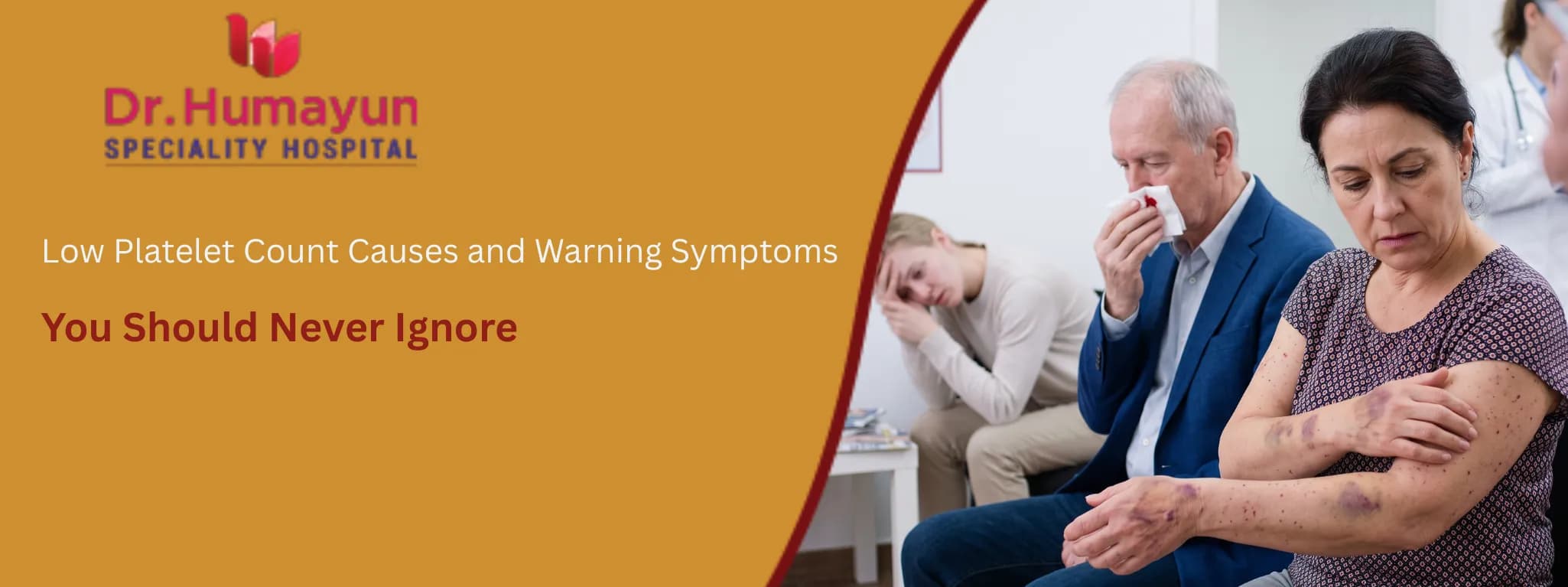
Petechiae Tiny, flat, pinpoint-sized red or purple spots appearing on the skin, often on the lower legs or forearms. They do not fade when pressed with a glass (non-blanching). Petechiae represent tiny bleeds from capillaries and are one of the earliest and most reliable visible signs of significant thrombocytopenia.
Unexplained bruising Bruises appearing without any significant trauma, often in unusual locations. In severe thrombocytopenia, even gentle pressure or the lightest knock can produce large bruises.
Bleeding gums or nose Spontaneous bleeding from the gums, particularly during tooth brushing, or nosebleeds that are difficult to stop and recur without obvious cause. These indicate that the platelet level has dropped to a point where normal mucosal surfaces bleed without injury.
Blood in urine (haematuria) or stools (melaena or haematochezia) Blood appearing in the urine or stools without a known urological or gastrointestinal cause indicates internal bleeding from low platelet levels. Black, tarry stools suggest upper gastrointestinal bleeding. Visible red blood in the stool suggests lower GI bleeding. Both require immediate assessment.
Heavy or prolonged menstrual bleeding Periods that are significantly heavier than usual, lasting longer than seven days, or requiring frequent pad or tampon changes, can indicate thrombocytopenia in women of reproductive age. This is frequently dismissed as a gynaecological issue before the underlying platelet count is checked.
Prolonged bleeding from cuts or wounds A small cut that takes 20 minutes or more to stop bleeding is a practical indicator of significantly reduced platelet function or count.
Warning Symptoms That Require Immediate Emergency Care
These symptoms indicate that platelet levels may have dropped to a critically dangerous level or that bleeding has already begun in a vital organ. They are not symptoms to observe at home.
Go to emergency care without delay for:
-
Severe headache that is sudden, intense, or "the worst of your life" may indicate intracranial (brain) bleeding
-
Sudden vision changes, blurred vision, or visual disturbance in the context of a known or suspected low platelet count
-
Confusion, difficulty speaking, sudden weakness on one side signs of stroke or intracranial haemorrhage
-
Vomiting blood or passing large amounts of black or bloody stool
-
Severe abdominal pain with a known or suspected very low platelet count
-
Any significant injury or fall in a patient with a platelet count below 50,000
-
A platelet count below 10,000 discovered on testing, regardless of whether symptoms are present at that moment
A platelet count below 10,000 is a haematological emergency. Do not wait for symptoms to develop. Seek care immediately.
How a Low Platelet Count Is Investigated
No single test identifies the cause of thrombocytopenia. A structured investigation is needed.
-
Full blood count (FBC): Confirms the platelet count and identifies whether other blood cell lines (red cells, white cells) are also affected, which narrows the differential diagnosis.
-
Peripheral blood smear: A blood film examined under microscope provides information about platelet morphology, the presence of immature or abnormal cells, and can identify conditions like TTP (platelet clumps), malaria (parasites within red cells), or leukaemia (blast cells).
-
Dengue NS1 antigen and IgM serology: First-line investigation in febrile patients with low platelet count during Chennai's monsoon and post-monsoon season.
-
Malarial parasite test: Essential in the acute febrile thrombocytopenia workup in India.
-
Liver function tests: Assess hepatic cause and complication of liver disease.
-
Bone marrow biopsy: Required when bone marrow disease is suspected particularly when all three cell lines are low, when blast cells are seen on peripheral smear, or when the cause remains unclear after initial investigation.
Anti-platelet antibody testing and coagulation studies: Used when ITP or coagulopathy is suspected.
Treatment Cause-Directed, Not Generic
Treatment of a low platelet count is entirely dependent on what is causing it.
-
Dengue thrombocytopenia: Supportive care, hydration, and close platelet monitoring. Platelet transfusion is only given for severe bleeding, not simply for a low count.
-
ITP: Corticosteroids as first-line treatment in adults. Intravenous immunoglobulin (IVIg) for rapid platelet elevation when needed. Thrombopoietin receptor agonists (TPO-RAs) for chronic refractory ITP.
-
Drug-induced thrombocytopenia: Stopping the causative medication typically results in platelet recovery within days to weeks.
-
Bone marrow disease or leukaemia: Specific haematological treatment including chemotherapy, targeted therapy, or stem cell transplantation.
-
HELLP syndrome: Urgent obstetric management and delivery.
-
TTP: Plasma exchange therapy is an emergency treatment.
Platelet transfusion is reserved for patients with active significant bleeding or platelet counts below 10,000. It does not treat the underlying cause and its benefit is temporary.
Assessment at Humayun Hospital, T Nagar
At Humayun Hospital, T Nagar, Chennai, we take a low platelet count seriously at every level from the mildly low reading on a routine test to the critically low count discovered in an acutely unwell patient.
Our internal medicine and haematology team provides:
-
Complete blood count with peripheral smear review
-
Targeted infectious disease testing for dengue, malaria, typhoid, scrub typhus, and hepatitis
-
Liver function assessment and abdominal imaging for structural causes
-
Bone marrow evaluation when haematological malignancy or aplasia is suspected
-
ITP management including corticosteroid and IVIg protocols
-
Platelet transfusion when clinically indicated
-
Clear follow-up monitoring for patients with chronic or recurrent thrombocytopenia
Whether your low platelet count was discovered incidentally on a routine test or is producing visible symptoms, the right assessment is the starting point for effective management.
Chat with our medical care assistant for quick guidance and support.