
Surgery has changed more in the last three decades than in the century before. The shift from large open incisions to small keyhole openings has transformed what surgery means for patients: shorter hospital stays, less pain, faster return to daily life, and a recovery measured in days rather than weeks.
Laparoscopic surgery, also called keyhole surgery or minimally invasive surgery, is now the standard approach for a wide range of abdominal and pelvic procedures that once required open operations. Understanding how it works, which conditions it treats, what the procedure involves, and what recovery actually looks like helps patients make informed decisions when surgery is recommended.
Laparoscopic surgery in T Nagar at Humayun Hospital is performed across gynaecological and abdominal indications, with the aim of achieving the same clinical outcomes as open surgery while protecting the patient from the greater physical burden of a large incision.
How Laparoscopic Surgery Works
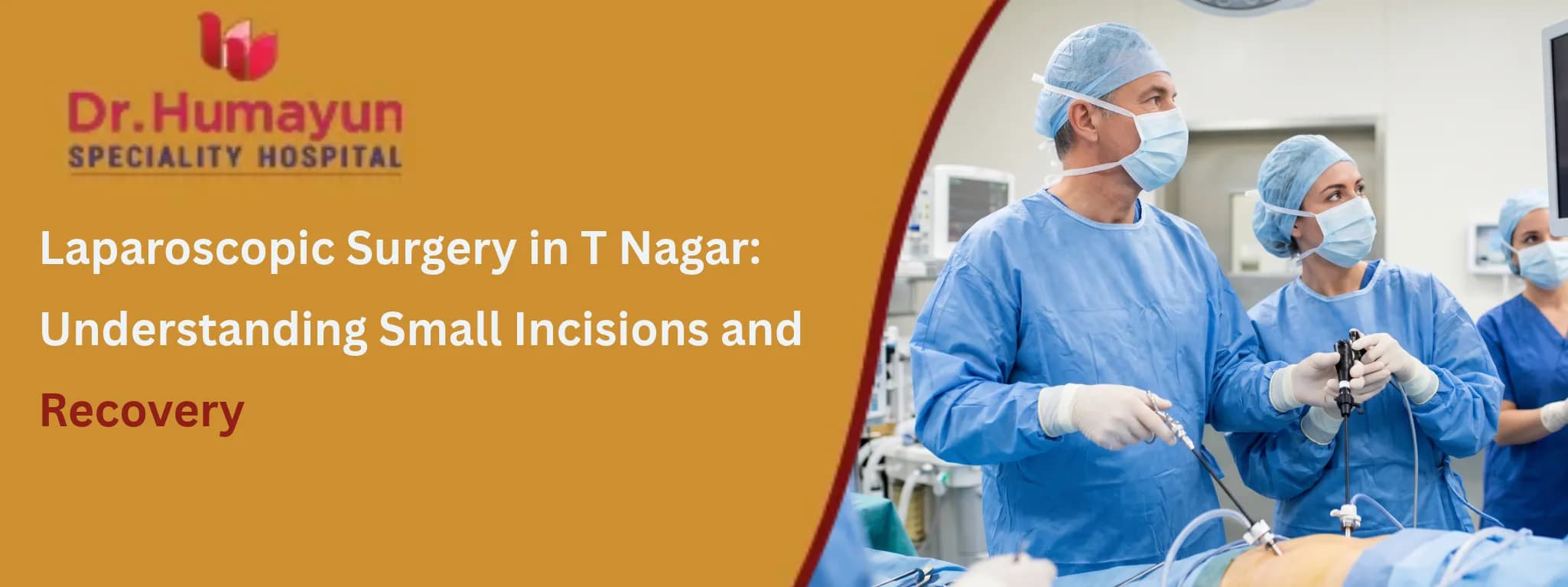
The fundamental difference between laparoscopic and open surgery is access. Open surgery requires a single large incision, often 10 to 20 cm or longer, to give the surgeon direct visual and manual access to the operating area. Laparoscopic surgery achieves the same access through several small incisions, each typically 0.5 to 1.5 cm long.
The Procedure Step by Step
1. Preparation and anaesthesia: Laparoscopic surgery is performed under general anaesthesia. The patient is positioned on the operating table, and the abdomen is cleaned and draped. A urinary catheter may be placed for procedures lasting more than an hour or involving the pelvis.
2. Creating the working space: The first small incision is made, usually at or near the navel. A hollow needle is inserted and carbon dioxide (CO2) gas is gently pumped into the abdominal cavity. This inflates the abdomen like a dome, lifting the abdominal wall away from the internal organs. This inflation, called pneumoperitoneum, creates the working space the surgeon needs to see and operate without direct physical access. It also reduces the risk of inadvertently contacting adjacent structures.
3. Inserting the laparoscope: A port (a small tube) is placed through the first incision and the laparoscope is passed through it. The laparoscope is a thin, rigid or flexible tube with a high-definition camera and a light source at its tip. The camera transmits a magnified, brightly lit image of the internal structures to a large monitor positioned in the surgeon's field of view. The surgeon operates watching this monitor, not looking directly into the body.
4. Additional working ports: Two to four additional small incisions are made in positions relevant to the target organ. Ports are placed through these incisions and the operating instruments, including graspers, scissors, dissectors, clip applicators, and energy devices for cutting and sealing tissue, are passed through these ports.
5. Performing the procedure: The surgeon manipulates the instruments through the ports, guided entirely by the laparoscopic image on the monitor. Modern laparoscopes provide a magnified view that in many respects offers better visualisation than open surgery, particularly in confined spaces such as the pelvis.
6. Closing: When the procedure is complete, the instruments are removed, the CO2 gas is released from the abdomen, and the ports are removed. The small incisions are closed with a single stitch or surgical tape. Dressings are applied.
The entire procedure in a typical laparoscopic cholecystectomy (gallbladder removal) takes 45 to 90 minutes. Gynaecological laparoscopic procedures vary from 30 minutes for a diagnostic laparoscopy to two to three hours for complex endometriosis surgery.
Conditions Treated With Laparoscopic Surgery
Laparoscopic surgery in Chennai covers a wide spectrum of abdominal and pelvic conditions across gynaecology and general surgery.
Gynaecological Laparoscopic Procedures
Minimally invasive surgery has transformed gynaecological care, and it is an area where laparoscopy produces particularly strong clinical outcomes compared to open alternatives.
-
Endometriosis: Laparoscopic excision or ablation of endometriotic deposits is the gold standard surgical treatment for endometriosis. It provides direct visualisation of the pelvis and allows precise treatment of deposits on the ovaries, peritoneum, and adjacent structures while protecting normal tissue.
-
Ovarian cysts: Laparoscopic ovarian cystectomy removes the cyst while preserving healthy ovarian tissue, important for women of reproductive age. It avoids the large incision and recovery of open surgery.
-
Fibroids: Laparoscopic myomectomy removes uterine fibroids through keyhole incisions. It is suitable for subserosal and intramural fibroids in appropriately selected patients and preserves the uterus for women who wish to conceive.
-
Ectopic pregnancy: Surgical management of ectopic pregnancy is now almost always performed laparoscopically. Laparoscopic salpingostomy (opening the tube to remove the ectopic) or salpingectomy (removing the affected tube) is safer and has a shorter recovery than open surgery.
-
Hysterectomy: Laparoscopic or laparoscopic-assisted vaginal hysterectomy is associated with less blood loss, shorter hospital stay, and faster recovery compared to abdominal hysterectomy, and is now the preferred route for many indications.
-
Pelvic organ prolapse and incontinence surgery: Laparoscopic sacrocolpopexy for vault prolapse and laparoscopic colposuspension for stress urinary incontinence are established minimally invasive options.
-
Sterilisation: Laparoscopic tubal ligation is a day procedure with rapid recovery.
-
Diagnostic laparoscopy: When pelvic pain, subfertility, or suspected endometriosis or adhesions need investigation, a diagnostic laparoscopy provides direct visualisation that no imaging can replicate.
General Surgical Laparoscopic Procedures
- Cholecystectomy (gallbladder removal): The most commonly performed laparoscopic procedure globally. Laparoscopic cholecystectomy for gallstones or cholecystitis has almost entirely replaced open cholecystectomy. Hospital stay is typically one night and most patients return to work within a week.
- Appendectomy: Laparoscopic appendectomy for acute appendicitis is associated with lower wound infection rates and faster recovery than open appendectomy, particularly in women of reproductive age where visualisation of the pelvis is an added advantage.
- Hernia repair: Laparoscopic inguinal hernia repair (TAPP or TEP) and ventral hernia repair are associated with less postoperative pain and faster return to activity than open repair, though they require general anaesthesia where some open repairs can be done under local anaesthesia.
- Bariatric surgery: Laparoscopic sleeve gastrectomy and Roux-en-Y gastric bypass are now standard approaches for weight loss surgery, with open bariatric surgery rarely performed.
- Colorectal surgery: Laparoscopic colectomy for colon cancer, diverticular disease, and inflammatory bowel disease produces equivalent oncological outcomes to open surgery with significantly faster recovery.


Benefits of Laparoscopic Surgery Over Open Surgery
The clinical advantages of laparoscopic surgery over traditional open surgery are well established across multiple specialties and have been confirmed in numerous randomised controlled trials and systematic reviews.
Less Pain and Reduced Medication Need
The most immediately noticeable benefit for patients is substantially reduced postoperative pain. The pain after laparoscopic surgery comes primarily from the small port sites and from residual CO2 gas in the abdomen causing referred shoulder tip pain for 24 to 48 hours, not from a large healing abdominal wound. The requirement for strong opioid pain medication after laparoscopic surgery is significantly lower than after open surgery, which reduces opioid-related side effects including nausea, constipation, and sedation.
Shorter Hospital Stay
Most laparoscopic procedures are performed as day surgery or with a one to two night hospital stay. Open surgery for the same conditions typically requires three to seven days. Shorter hospital stays reduce exposure to hospital-acquired infections and lower the total cost of care.
Lower Infection Risk
Smaller incisions present a significantly smaller surface area for bacterial contamination. The body's systemic inflammatory response to surgery is also reduced after laparoscopy compared to open surgery, which lowers susceptibility to postoperative infection. Wound infections are one of the most common complications of open abdominal surgery and are substantially less frequent after laparoscopic procedures.
Minimal Scarring
Open abdominal surgery leaves a scar of 10 cm or longer, sometimes extending the full length of the abdomen for major procedures. Laparoscopic surgery leaves three to four small scars of 0.5 to 1.5 cm that fade significantly over the following months. For many patients, particularly women having gynaecological surgery, this is an important quality of life consideration.
Fewer Internal Adhesions
Adhesions are bands of scar tissue that form between internal organs and abdominal structures after surgery. They are a significant source of post-surgical chronic pelvic pain, bowel obstruction, and infertility. Laparoscopic surgery produces fewer adhesions than open surgery, partly because the smaller incisions cause less tissue trauma and partly because avoiding direct manual handling of internal organs reduces the adhesion-forming stimulus.
Faster Return to Normal Activity
The reduced pain, smaller wounds, and lower physiological stress of laparoscopic surgery allow patients to return to normal activities significantly sooner than after open surgery. Typical timelines:
| Activity | Laparoscopic Surgery | Open Surgery |
|---|---|---|
| Walking | Same day or day 1 | Day 2 to 3 |
| Discharge from hospital | 24 to 48 hours | 3 to 7 days |
| Light household activity | 3 to 5 days | 2 to 4 weeks |
| Return to office work | 1 to 2 weeks | 4 to 6 weeks |
| Return to physical work | 2 to 4 weeks | 6 to 8 weeks |
| Driving | 1 to 2 weeks | 4 to 6 weeks |
These are general benchmarks and vary by procedure, age, fitness level, and any complications.
Risks and Limitations of Laparoscopic Surgery
Laparoscopic surgery is safe and well established, but it is still surgery and carries risks that patients should understand.
Procedure-Specific Risks
-
Injury to adjacent structures: The close proximity of bowel, bladder, ureter, and blood vessels to the operating area means that inadvertent injury is possible, as it is in open surgery. The risk is low in experienced hands but is the most serious potential complication.
-
Conversion to open surgery: In some cases, the laparoscopic approach cannot be completed safely, for example when bleeding cannot be controlled, when dense adhesions from previous surgery obscure the view, or when anatomical variations are encountered. The surgeon converts to open surgery in these situations. This is not a complication in itself but a safety decision.
-
CO2-related shoulder tip pain: Residual carbon dioxide in the abdomen after the procedure can irritate the diaphragm and cause referred pain in the shoulder and upper chest for 24 to 48 hours. It resolves as the gas is absorbed and is managed with simple analgesia and movement.
-
Port site complications: Hernia formation at the port site is rare but possible, particularly at port sites of 10 mm or larger. Port site infection is uncommon.
-
Deep vein thrombosis: As with all surgery, the risk of blood clot formation in the leg veins (DVT) is present. Compression stockings, early mobilisation, and anti-clotting medications (LMWH) are used to manage this risk.
When Open Surgery Is Preferred
Laparoscopic surgery is not always the right choice. Open surgery may be preferred or necessary when:
-
Dense adhesions from multiple previous abdominal operations make laparoscopic access unsafe
-
The condition requires a very large specimen to be removed (such as a very large uterine fibroid) that cannot be extracted through small incisions
-
Emergency surgery for severe haemorrhage requires immediate open access
-
The patient has significant cardiorespiratory conditions that make pneumoperitoneum (the abdominal CO2 inflation) unsafe to maintain
-
A very large tumour requiring extensive resection and reconstruction is better approached openly
-
The surgeon's assessment determines that the risks of the laparoscopic approach outweigh the benefits in a specific patient
Laparoscopic Surgery in T Nagar at Humayun Hospital
At Humayun Hospital, T Nagar, Chennai, Dr. Asma Humayun provides specialist laparoscopic gynaecological surgery for women across a full range of conditions requiring minimally invasive care.
Dr. Asma Humayun is a Gynaecologist and Obstetrician with over 15 years of clinical experience. Her qualifications include MBBS, DGO (Sri Ramachandra University), Fellowship in Assisted Reproductive Techniques (F.ART), Fellowship in Minimal Access Surgery (F.MAS), Diploma in Reproductive Medicine (Germany), and MRCOG (Royal College of Obstetricians and Gynaecologists, UK). Her Fellowship in Minimal Access Surgery reflects dedicated specialist training in laparoscopic techniques applied to gynaecological conditions, including operative laparoscopy for endometriosis, ovarian cysts, fibroids, ectopic pregnancy, and pelvic floor conditions.
Laparoscopic surgery in Chennai at Humayun Hospital includes:
-
Diagnostic laparoscopy for pelvic pain, subfertility, and suspected endometriosis
-
Laparoscopic ovarian cystectomy
-
Laparoscopic myomectomy for fibroids
-
Laparoscopic treatment of endometriosis
-
Laparoscopic management of ectopic pregnancy
-
Laparoscopic hysterectomy and laparoscopic-assisted vaginal hysterectomy
-
Laparoscopic pelvic floor and continence procedures
-
Coordination for general surgical and bariatric laparoscopic procedures through our network of surgical specialists
Our care pathway includes a preoperative assessment consultation where the indication, surgical approach, risks, and recovery expectations are discussed in detail. Women are counselled on what the procedure involves so that their consent is genuinely informed, not just a signature.
Chat with our medical assistant for quick guidance and support.