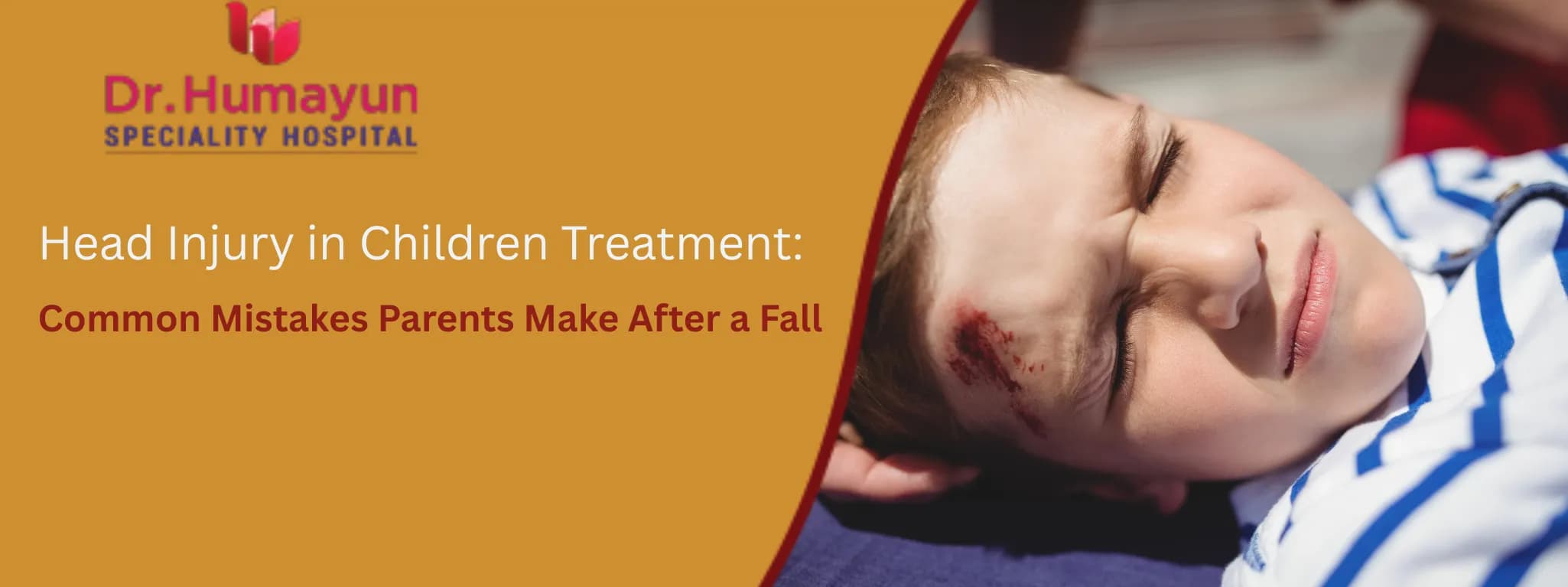

A toddler tumbles off the sofa. A school-age child falls off a bicycle. An older child collides with a classmate during football practice. In the seconds that follow, most parents experience a rush of panic followed by urgent questions: How serious is this? Do we need to go to the hospital? Is my child okay?
The vast majority of childhood head injuries are minor. A bump, a bruise, perhaps brief crying, and then back to normal. But a small, important proportion are not minor at all and the decisions parents make in the first minutes and hours after a head injury directly affect how quickly serious conditions are identified and treated.
Understanding what constitutes correct head injury in children treatment, and what the most common parental mistakes are, gives every family a clearer, calmer response plan when a fall happens.
Not All Head Injuries Are the Same
| Type | What It Involves | Usual Urgency |
|---|---|---|
| Scalp bump or goose egg | Bruising or fluid under the scalp skin | Usually minor, monitor at home |
| Scalp laceration (cut) | Cut to the scalp which may bleed significantly | Assess if bleeding does not stop or wound is deep |
| Concussion | Temporary disruption of brain function | Always needs medical review |
| Skull fracture | Break in the skull bone | Urgent assessment required |
| Intracranial haemorrhage | Bleeding inside or around the brain | Emergency |
Falls and motor vehicle accidents are the most common causes of head injury in children. Most injuries are to the scalp and are minor. Traumatic brain injury (TBI), however, is a significant contributor to mortality and disability in children aged 1 to 18, and it can follow injuries that appear mild initially.
Common Mistakes Parents Make After a Head Injury
Mistake 1: Assuming "Fine Now" Means "Fine"
This is the most dangerous error parents make after a head injury.
A child who cries briefly, then gets up and seems normal, does not necessarily have a minor injury. Concussion symptoms can be delayed by up to 48 hours after the injury. More seriously, an epidural haematoma (bleeding between the skull and the brain's outer lining) produces a classic pattern called the "lucid interval": the child seems completely well after the injury, then deteriorates rapidly hours later as the blood accumulates.
What parents should do instead:
Watch the child closely for at least 24 to 48 hours after any significant head impact Know the red flag symptoms that require immediate emergency care (listed below) Do not dismiss the event simply because the child seems normal in the immediate aftermath
Mistake 2: Keeping the Child Awake
One of the most persistent myths in head injury management is that a child must be kept awake after a head injury to prevent them from "slipping into a coma."
This is not accurate. It is a common myth that parents should keep their child awake after a head injury. Rest is crucial for helping a child heal, particularly after a concussion. There is no need to forcibly keep a child awake unless their doctor specifically instructs it.
What parents should do instead:
-
Allow the child to sleep if they are tired
-
Check on the child occasionally during sleep to confirm their breathing and skin colour are normal
-
Contact a doctor or go to emergency care if the child cannot be roused normally during sleep
Mistake 3: Not Seeking Care Because "The Bump Is on the Outside"
A visible, raised bump (haematoma) on the scalp can actually be a reassuring sign. It means the bleeding from the impact is occurring under the scalp skin rather than inside the skull. The visible swelling itself is not the problem.
However, parents sometimes reason that because there is an obvious external bump, there cannot be an internal injury. This is not a reliable conclusion. A significant internal injury can coexist with an external bump, particularly following high-impact falls, falls from height, or impacts at high speed.
The location of the injury also matters. For children over two years, forehead bumps are generally more resilient and less concerning than injuries at the back of the head, at the base of the skull, or behind the ear.
What parents should do instead:
-
Take note of how the injury happened, not just how it looks
-
Falls from height greater than the child's own height, high-speed impacts, and falls onto hard surfaces all warrant assessment regardless of the external appearance


Mistake 4: Giving Aspirin or Adult Pain Medication
Many parents reach instinctively for whatever pain reliever is in the medicine cabinet. Aspirin should never be given to children following a head injury (or indeed any childhood illness). It is associated with Reye's syndrome, a rare but serious condition affecting the liver and brain.
For pain relief after a minor head injury:
-
Paracetamol (acetaminophen) at the correct weight-based dose is appropriate
-
Ibuprofen is an alternative but check with a doctor for children under 6 months Never give aspirin to children or adolescents
Mistake 5: Returning to Activity Too Quickly
After a concussion or significant head injury, returning a child to physical activity before symptoms have fully resolved risks a second injury occurring while the brain is still vulnerable. Second impact syndrome, where a second concussion occurs before the brain has recovered from the first, can cause severe and sometimes fatal brain swelling.
After any suspected concussion:
-
The child should stop the activity immediately
-
They should not return to sport or strenuous physical activity until assessed and cleared by a doctor
-
The phrase "when in doubt, sit it out" applies here
Screen use also matters. Continuous texting, gaming, or graphics-heavy screen time in the first 48 hours after concussion can slow recovery. Encourage rest, including screen rest, in the immediate recovery period.
Mistake 6: Applying Pressure to a Suspected Skull Fracture
If there is any possibility that the skull itself is fractured, applying direct downward pressure to the wound is dangerous. A depressed skull fracture or open fracture can be worsened by direct pressure.
What parents should do:
-
For scalp bleeding without suspected fracture: apply firm, clean direct pressure
-
If a skull fracture is suspected (visible deformity, swelling or bruising behind the ear, clear fluid from the nose or ears): do not press on the wound. Cover it loosely and seek emergency care immediately
Mistake 7: Underestimating Head Injuries in Infants Under Two
Infants and toddlers under two years old require a different level of caution than older children, for two reasons. First, their skulls are still soft and developing. The fontanelle (soft spot on top of the head) has not yet closed. The developing skull provides less protection than a fully formed one.
Second, infants cannot tell you how they feel. A baby who seems sleepy, is not feeding well, is vomiting, or has a bulging fontanelle after a head injury may be showing the only signs of a serious injury they are able to show.
For children under two: any scalp bump or head impact should prompt a more cautious assessment, and medical advice should be sought rather than home observation alone.
Red Flag Symptoms That Always Require Emergency Care
Parents should seek immediate emergency care for head injury in children treatment if any of the following are present.
| Red Flag Symptom | Why It Matters |
|---|---|
| Loss of consciousness, even briefly | May indicate significant brain involvement |
| Seizure following head injury | Indicates significant neurological disturbance |
| Vomiting more than twice | May indicate rising intracranial pressure |
| Severe or worsening headache | May indicate bleeding inside the skull |
| Confusion, unusual behaviour, or not recognising familiar people | Indicates brain function disturbance |
| Unequal pupils or eyes that will not focus | Indicates possible pressure on the brainstem |
| Clear fluid from nose or ears | May indicate skull base fracture |
| Bruising behind the ears or around both eyes | Battle's sign / raccoon eyes signs of skull base fracture |
| Weakness or numbness in limbs | Indicates possible spinal or brain involvement |
| Difficulty waking the child from sleep | Indicates deepening altered consciousness |
| Infant with bulging fontanelle | Indicates raised intracranial pressure |
| Neck pain alongside head injury | Requires assessment for spinal injury |
If any of these are present: do not wait, do not drive if the child is deteriorating, and do not give food or water in case surgery is needed. Call for emergency transport or go directly to emergency care.
What Correct Head Injury in Children Treatment Looks Like
Responding correctly to a pediatric head injury requires balancing vigilant home observation with immediate medical intervention when necessary. Because a child’s skull and brain are still developing, treatment protocols split cleanly between at-home comfort measures for minor bumps and rapid, advanced clinical triage for structural trauma.
For Minor Head Injuries (No Red Flag Symptoms)
-
Have the child rest in a calm, quiet environment
-
Apply a cold pack wrapped in cloth (not directly on skin) to any swelling for 15 to 20 minutes
-
Give paracetamol at the correct weight-based dose if the child is in pain
-
Monitor closely for 24 to 48 hours for the development of any red flag symptoms
-
No screen time, no sport, no rough play during the observation period
-
Call a doctor to discuss the injury even if emergency care is not immediately needed
For Moderate or Serious Head Injuries (Red Flags Present)
Hospital assessment will include:
-
Clinical examination and neurological assessment
-
CT scan of the brain if red flag symptoms or high-risk mechanism are present
-
Observation and monitoring of neurological status
-
Neurosurgical consultation for haematoma or skull fracture
-
In severe cases, management in a paediatric intensive care setting
The CATCH (Canadian Assessment of Tomography for Childhood Head injury) rule is a validated clinical decision tool used by emergency physicians to guide CT scan decisions in children with minor head injury, reducing unnecessary radiation exposure while identifying high-risk cases.
When to Be More Cautious Age and Mechanism Matter
Higher concern situations that warrant earlier medical assessment:
-
Any head injury in an infant under 12 months
-
Falls from height greater than the child's own standing height
-
High-speed impact (road traffic accident, ball sport)
-
Impact on a hard surface (concrete, tiles)
-
History of a previous concussion in the same season
-
Child with a known bleeding disorder or on anticoagulant medication
Generally lower concern (can monitor at home):
-
Child over two years, fell from standing height or less
-
Brief cry followed by return to normal behaviour
-
Small scalp bump with no red flag symptoms
-
Forehead location in a child over two
Even in lower-concern situations, monitoring for 24 to 48 hours and calling a doctor remains appropriate.
Head Injury in Children Treatment at Humayun Hospital, T Nagar
At Humayun Hospital, T Nagar, Chennai, our paediatric and emergency team assesses head injuries in children across the full severity spectrum, from the anxious parent bringing in a toddler who bumped their head to the more complex presentation requiring imaging and neurosurgical input.
We provide:
-
Rapid clinical assessment and neurological examination
-
Evidence-based CT decision-making to minimise unnecessary radiation in low-risk cases
-
Clear advice and a monitoring plan for parents of children being discharged home
-
Emergency management and specialist referral when serious injury is identified
We understand that every parent facing this situation is frightened. Our team is trained to assess quickly, communicate clearly, and ensure that no child with a potentially serious injury goes home unrecognised, and no child with a minor injury receives unnecessary investigation.
Chat with our medical care assistant for quick guidance and support.