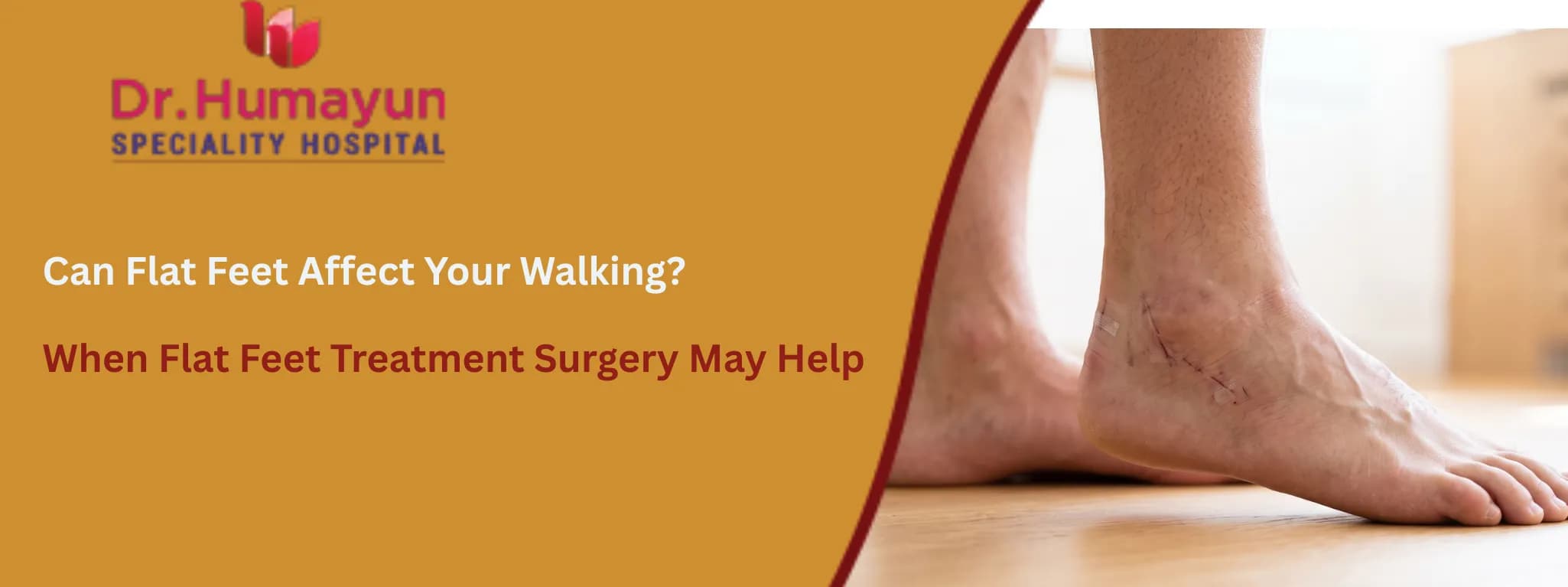

Standing in front of a mirror and looking at your feet, you notice that the inner arches appear to have flattened completely. When you step in wet sand and look at the footprint left behind, there is no curve on the inner side. Just a full, flat imprint from heel to toe.
For most people, this is simply the shape of their feet. Flat feet, also called pes planus, are extremely common and for the majority of people, they cause no pain, no functional limitation, and no need for any treatment whatsoever.
But for some people, flat feet contribute to foot pain, ankle pain, knee problems, hip discomfort, and altered gait patterns that become genuinely disruptive to daily life. And for a smaller subset, conservative measures do not provide adequate relief, and flat feet treatment surgery becomes a genuine clinical conversation.
Understanding where on this spectrum your flat feet fall, and what the pathway from self-care to surgery actually looks like, is the purpose of this guide.
What Are Flat Feet and Why Do Some People Have Them?
The foot's arch is formed by a combination of bones, ligaments, tendons, and the plantar fascia. In a normally developed foot, this structure creates a curved inner arch that lifts the foot off the ground when standing. Flat feet occur when this arch is reduced or absent, allowing the entire sole of the foot to come into contact with the ground. There are two main types:
Flexible flat feet: The arch is present when the foot is not bearing weight but disappears when the person stands or walks. This is by far the most common type. Flexible flat feet are generally benign and often asymptomatic. Over 50% of people with flat feet have a family member with the same condition, indicating a significant genetic component.
Rigid flat feet: The arch is absent even when not bearing weight. This is less common and more likely to be associated with structural abnormalities including tarsal coalition (bones that have fused abnormally) or neuromuscular conditions.
Adult-acquired flatfoot: Develops in adulthood, typically due to the gradual weakening or tearing of the posterior tibial tendon, the main tendon that supports the inner arch. This is a progressive condition rather than a developmental one, and it tends to worsen over time if not managed.
How Flat Feet Affect Walking and Daily Life
The arch plays a shock-absorbing role during walking and running. When the arch is absent or reduced, the forces of weight-bearing are distributed differently across the foot and the lower limb. For many people with flat feet, the body compensates effectively and walking is entirely normal. For others, the biomechanical changes produce a cascade of symptoms.
Flat feet can contribute to overpronation, where the foot rolls inward excessively during walking and running. This may lead to knee, hip, or lower back pain, and affect gait and posture. Issues like bunions, plantar fasciitis, or Achilles tendinitis may be made worse by the lack of arch support. Long-term cases may even result in arthritis in the foot and ankle joints.
Symptoms that bring patients with flat feet to seek assessment:
-
Pain along the inner ankle and foot, particularly after prolonged standing or walking
-
Fatigue in the feet and legs after moderate activity that was previously comfortable
-
Swelling along the inner ankle
-
Heel pain, particularly at the start of activity
-
Knee pain that is worsened by activities requiring sustained standing
-
A change in the shape of the foot over time, with the arch visibly collapsing further
-
Difficulty fitting into shoes comfortably
The arch height alone does not predict pain. What matters is whether the foot compensates effectively and how much load it handles. Flat-footed patients who run marathons without pain alongside flat-footed patients disabled by daily walking exist in the same clinical population. The biomechanics matter more than the arch height.
When Conservative Treatment Is Sufficient
The starting point for almost all symptomatic flat feet, and the approach that works for the large majority of patients, is conservative management. Conservative treatments may not change the deformity but help to reduce the symptoms associated with flat feet. Surgery is not the goal. Symptom control without structural correction is the goal for most patients.
Conservative management options include:
Custom Orthotics and Supportive Footwear
Custom orthotics are the most commonly used and most effective non-surgical intervention for symptomatic flat feet. A pressure-plate analysis or gait assessment determines the specific pattern of overpronation and arch collapse, allowing orthotics to be designed to redistribute plantar pressure and support the arch during weight-bearing.
Over-the-counter arch supports are not equivalent to custom orthotics for significant symptomatic flat feet. The most common mistake seen in clinical practice is buying motion-control shoes without a gait assessment, which may not match the specific biomechanical pattern of the individual patient.
Supportive footwear characteristics that benefit flat feet:
-
A firm, non-flexible midsole
-
A structured heel counter
-
Motion-control features for significant overpronation
-
A shoe that bends only at the toe box, not throughout the sole
Narrow, flat, floppy shoes worsen symptoms in patients with flat feet and should be avoided.
Physiotherapy and Targeted Exercise
Posterior tibial tendon strengthening is the most important exercise-based intervention for flat feet, particularly adult-acquired flatfoot where tendon weakness is the primary driver of arch collapse. Calf stretching, heel raises, and intrinsic foot muscle strengthening together form the core of a physiotherapy programme that supports the arch through muscular effort.
Physical therapy as a first step before considering surgery is the recommended approach. A structured programme over 12 to 24 weeks, with consistent adherence, produces meaningful symptom improvement in the majority of symptomatic flat feet patients.
Activity Modification and Weight Management
Reducing activities that disproportionately load the plantar surface, such as prolonged standing on hard surfaces, high-impact sports without appropriate footwear, and running on uneven terrain, reduces symptom burden while rehabilitation is ongoing.
In patients who are overweight, weight reduction meaningfully reduces the load placed on the foot with each step and can produce significant symptom improvement independent of any other intervention.
Conservative treatment is effective in 85 to 90% of symptomatic flat feet cases when it is applied correctly and consistently. The trial period should typically be three to six months minimum before surgical options are discussed.


When Does Flat Feet Treatment Surgery Become Appropriate?
Surgical correction is reserved for cases where conservative care has failed despite an adequate trial, typically three to six months minimum, often longer, or where the deformity is severe enough to cause joint damage.
Surgery is not appropriate for painless flat feet, for mild symptoms that have not been through a proper conservative management trial, or for patients who are not committed to the post-operative rehabilitation that is essential for surgical success.
The specific indications for flat feet treatment surgery include:
-
Failure of conservative treatment: The most common indication. The patient has completed a genuine three to six month course of orthotics, targeted physiotherapy, and footwear modification, and continues to have pain that significantly limits walking, standing, exercise, and daily activity.
-
Progressive posterior tibial tendon dysfunction (PTTD): Adult-acquired flatfoot caused by PTTD that is progressing despite conservative management. PTTD follows a staged progression from tendon inflammation through partial tear, complete rupture, and fixed deformity. Surgery at earlier stages produces better outcomes than waiting for complete tendon failure.
-
Rigid flat feet causing joint damage: When a rigid flat foot deformity is producing degenerative changes in the foot and ankle joints that are progressive and cannot be managed conservatively.
-
Rapid arch collapse: A sudden, significant collapse of the arch on one foot, particularly if accompanied by pain and swelling along the inner ankle, may indicate a posterior tibial tendon rupture requiring prompt surgical assessment.
-
Tarsal coalition: A structural fusion of foot bones producing a rigid flat foot, which may require surgical release or fusion depending on the specific bones involved.
Types of Flat Feet Treatment Surgery
The surgical procedure selected depends on the type of flat foot (flexible or rigid), the severity of the deformity, the patient's age, activity level, and the specific structures that need to be addressed.
Subtalar Arthroereisis
A subtalar arthroereisis involves placing a small implant into the subtalar joint (the joint between the heel bone and the talus) to limit the excessive inward rolling of the rear foot that produces the flat foot posture. It is a joint-sparing procedure with a relatively straightforward recovery and is particularly used for flexible flat feet in children and adolescents, and in selected adults.
Calcaneal Osteotomy
A calcaneal osteotomy is a bone-cutting procedure that repositions the heel bone to correct the alignment of the rear foot. It is frequently combined with other procedures, including lengthening of the Achilles tendon (when the tendon is too tight and contributing to the deformity) and soft tissue repair of the posterior tibial tendon or spring ligament.
Flatfoot Reconstruction
Flatfoot reconstruction is a combination of surgical procedures that repairs the foot's ligaments and tendons as well as other deformities in the bones to restore, support, and build the arch. It is used for more complex deformities and typically combines osteotomy, tendon transfer, and ligament reconstruction tailored to the specific pattern of each patient's deformity.
Arthrodesis (Joint Fusion)
Joint fusion is reserved for rigid flat feet with significant joint degeneration, where restoring motion through osteotomy is not feasible. One or more joints in the hindfoot are fused in a corrected position, providing stability and pain relief at the cost of some range of motion. Triple arthrodesis (fusion of three hindfoot joints simultaneously) is the most common fusion procedure for severe flat foot deformity.
What Recovery from Flat Feet Surgery Involves
Recovery timelines vary by procedure, but patients should have realistic expectations about the duration and demands of post-surgical rehabilitation before committing to surgery.
General post-operative expectations:
-
Non-weight-bearing for six to eight weeks after most flat foot reconstructive procedures, with a cast or boot
-
Gradual return to weight-bearing under physiotherapy guidance over the following weeks
-
Return to light walking typically at three to four months
-
Return to unrestricted activity including sport at six to twelve months depending on procedure complexity
-
Physiotherapy throughout the recovery period to restore strength, proprioception, and gait patterns
Compliance with post-operative restrictions, particularly non-weight-bearing periods, is essential for surgical success. Premature loading of a surgically repaired foot significantly increases the risk of complications and hardware failure.
Flat Feet Assessment and Treatment at Humayun Hospital, T Nagar
At Humayun Hospital, T Nagar, Chennai, Dr. Omer Sheriff, Consultant Orthopaedic and Joint Replacement Surgeon, provides comprehensive assessment and management of flat feet from initial evaluation through to surgical correction where indicated.
Dr. Omer Sheriff holds an MBBS, Diploma in Orthopaedics (Sri Ramachandra University), MS in Orthopaedics, and a Fellowship in Joint Replacement. He trained at CMC Vellore with international experience from Hamad Medical Corporation, Doha, Qatar. With over 25 years of clinical experience and more than 3,500 successful orthopaedic procedures, his approach to flat feet management reflects the same principle that guides conservative vs surgical decisions in clinical research: the arch height alone does not determine treatment. Pain, function, and the impact on daily life do.
We offer:
- Clinical gait assessment and X-ray evaluation of arch structure and alignment
- Custom orthotic prescription and physiotherapy coordination as first-line management
- Assessment of posterior tibial tendon integrity for adult-acquired flatfoot
- Surgical consultation for patients who have completed conservative management without adequate relief
- Full surgical capability including subtalar arthroereisis, calcaneal osteotomy, flatfoot reconstruction, and arthrodesis
- Post-operative rehabilitation planning and physiotherapy coordination
Pain is never normal, whether it comes from flat feet, a tendon problem, or altered gait. If your feet are affecting your walking, your exercise, or your daily life, a proper assessment is the starting point.
Chat with our care assistant for quick guidance and support.