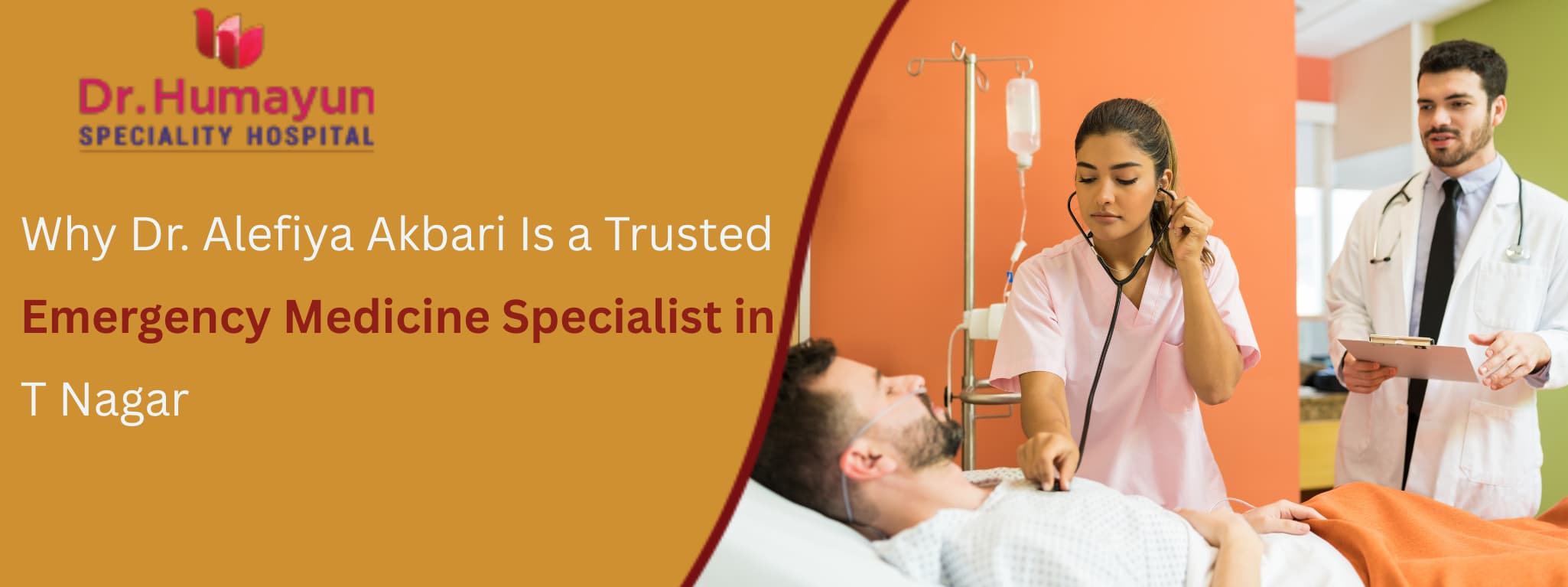

Emergencies do not follow a schedule. A sudden chest pain at midnight, a high fever in a child that will not break, a road accident injury, or a severe allergic reaction these situations demand immediate, expert care delivered by someone trained to make fast, accurate decisions under pressure.
In these moments, the qualifications and focus of the doctor you reach first matter enormously. That is what makes having a dedicated emergency medicine specialist in T Nagar, Chennai, not a convenience but a necessity.
At Humayun Hospital, T Nagar, Dr. Alefiya Akbari brings specialised emergency medicine expertise to one of Chennai's most accessible and well-equipped multidisciplinary facilities. This guide explains what emergency medicine actually involves, why the specialty matters, and why patients across Chennai trust Dr. Alefiya Akbari for urgent care.
What Is Emergency Medicine and Why Does Specialisation Matter?
Managing a critical health crisis requires far more than generic medical knowledge under a tight deadline. True emergency care is a highly specialized branch of medicine focused entirely on stabilizing patients during their most vulnerable biological moments, ensuring that high-stakes diagnostic decisions are executed flawlessly within the first few minutes of arrival.
Emergency Medicine Is Not General Practice Under Pressure
There is a common misconception that any doctor can handle an emergency. In reality, emergency medicine is a recognised clinical speciality that requires dedicated training in rapid assessment, stabilisation, triage, and the management of a wide range of acute and life-threatening conditions often simultaneously and with incomplete information.
An emergency medicine specialist is trained to:
-
Rapidly identify and prioritise life-threatening conditions across multiple body systems
-
Stabilise patients whose condition is deteriorating in real time
-
Make high-stakes clinical decisions with limited diagnostic time
-
Manage multiple patients at different levels of acuity simultaneously
-
Coordinate with other specialists, surgeons, and intensive care teams seamlessly
This is a skill set built through dedicated postgraduate training in emergency medicine, not simply accumulated through years of general medical practice. In India, emergency medicine is now a recognised DNB (Diplomate of National Board) and MD speciality, reflecting the growing clinical and academic depth of the field.
The Conditions That Bring Patients to Emergency Care
Acute illnesses and traumatic injuries demand distinct, immediate protocols depending on the organ system involved. A modern emergency department operates on precise clinical tracks, ensuring that everything from a sudden cardiac anomaly to a severe pediatric infection receives targeted, time-critical intervention.
Cardiac and Vascular Emergencies
Chest pain, palpitations, shortness of breath, and sudden collapse are among the most time-critical emergencies a doctor will face. A myocardial infarction (heart attack) has a narrow window during which intervention can prevent permanent cardiac damage or death. Rapid ECG interpretation, early stabilisation, thrombolysis where indicated, and coordination with a cardiologist are all within the emergency medicine specialist's domain. Aortic dissection, pulmonary embolism, and hypertensive emergencies are equally dangerous and demand swift, accurate diagnosis. The ability to differentiate between conditions with overlapping symptoms in a short clinical window is a hallmark of emergency medicine training.
Neurological Emergencies
A stroke, once called a "brain attack," has a treatment window of just a few hours. Every minute of untreated ischaemic stroke results in the loss of approximately 1.9 million neurons. The emergency medicine specialist is often the first physician to assess stroke symptoms, apply validated stroke screening tools, order urgent imaging, and activate the appropriate care pathway.
Other neurological emergencies including seizures, meningitis, encephalitis, and acute spinal cord injury all require the kind of structured, rapid assessment that emergency medicine specialists are specifically trained to deliver.
Respiratory Emergencies
Acute asthma attacks, severe pneumonia, anaphylaxis, and acute respiratory failure demand immediate airway assessment and management. Emergency medicine specialists are trained in advanced airway management, oxygen therapy titration, nebulisation protocols, and the early recognition of patients who need intensive respiratory support. Delay in identifying a deteriorating respiratory patient can be fatal.
Paediatric Emergencies
Children present differently from adults. Vital sign norms, drug doses, and clinical signs of serious illness are different at every developmental stage. A febrile infant, a child with difficulty breathing, or a toddler who has ingested a household chemical each require a clinical approach adapted to age and physiology. Emergency medicine training covers paediatric emergencies explicitly, which general practitioners may not encounter or manage with the same frequency.
Trauma and Injuries
Road traffic accidents, falls, sports injuries, burns, and penetrating injuries all require systematic trauma assessment — typically using the structured ATLS (Advanced Trauma Life Support) approach. Emergency medicine specialists are trained to manage the ABCs (Airway, Breathing, Circulation) simultaneously, identify hidden injuries, and determine when surgical intervention is urgently required. In a city like Chennai, where road traffic volumes are high, having an experienced emergency medicine specialist in T Nagar who is trained in trauma management is genuinely significant for the local community.
Acute Infections and Sepsis
Sepsis a life-threatening response to infection remains one of the leading causes of emergency death globally. Its early signs are often non-specific: elevated heart rate, high temperature, low blood pressure, and altered mental status. An emergency medicine specialist recognises the sepsis constellation early, initiates the sepsis care bundle promptly, and prevents progression to septic shock. Acute severe infections including meningitis, severe urinary tract infections, and necrotising fasciitis all require immediate clinical judgement that a trained emergency medicine specialist is best positioned to provide.
Who Is Dr. Alefiya Akbari?
Dr. Alefiya Akbari is a highly dynamic emergency medicine specialist currently practicing at Dr. Humayun Speciality Hospital in T. Nagar, Chennai. She holds an MBBS alongside a prestigious Fellowship in Emergency Medicine (FEM), a dedicated credential that equips her with advanced skills in critical care triage, trauma resuscitation, and acute medical stabilization.
With over 5 years of intensive, hands-on experience in high-volume emergency rooms, Dr. Alefiya Akbari focuses exclusively on navigating complex, time-sensitive medical crises.
Her daily practice covers the full spectrum of acute, life-threatening presentations, including:
-
Emergency Cardiac Life Support: Immediate intervention for acute heart attacks, severe arrhythmias, and sudden cardiac arrest.
-
Neurological Crises: Rapid assessment and time-critical thrombolysis protocols for acute ischemic strokes.
-
Acute Trauma Care: Full-scale stabilization of severe multi-trauma, head injuries, and complex fractures.
-
Respiratory Emergencies: Managing severe respiratory distress, acute asthma exacerbations, and lung failures.
-
Toxicological & Infectious Emergencies: Prompt treatment for acute poisoning, drug overdoses, and severe septic shock.
A Patient-Centred Approach to Urgent Care
The atmosphere of an emergency room is inherently high-pressure, but Dr. Alefiya Akbari is widely recognized for her exceptional clinical composure and empathetic communication style. She balances decisive medical action with clear, calm updates, stripping away the intense panic and confusion that families carry during a sudden health crisis.
Upon arrival at Humayun Hospital, patients undergo a highly systematic triage process directed by Dr.Alefiya Akbari. This ensures that critically ill patients are identified instantly and moved ahead for immediate life-saving care without a single moment of administrative delay.
Supported by a Full Multidisciplinary Team
Emergency medicine cannot achieve its best results in isolation; it requires a powerful ecosystem of supporting infrastructure. At Dr. Humayun Speciality Hospital, Dr. Alefiya Akbari works in a state-of-the-art facility where specialized intensive care units, advanced diagnostic labs, and modern operating theaters function 24/7.
Because Humayun Hospital houses leading Centres of Excellence in Cardiology, Orthopaedics, Paediatrics, and High-Risk Obstetrics under one roof, Dr. Alefiya Akbari coordinates directly with senior consultants instantly. Whether a patient requires an immediate cardiac angioplasty, emergency orthopedic surgery for a fracture, or urgent neonatal intervention, the transition from emergency stabilization to definitive specialist care is entirely seamless.


Why T Nagar Is a Strategically Important Location for Emergency Care
During a time-sensitive medical event, the geographic location of your care provider acts as a critical link in the survival chain. Setting up an advanced resuscitation center in a highly accessible central hub ensures that patients can bypass heavy urban congestion and reach definitive treatment faster.
Accessibility Across Chennai
T Nagar is one of Chennai's most densely populated and centrally located neighbourhoods, with direct connectivity to Nungambakkam, Kodambakkam, Adyar, Mylapore, Ashok Nagar, and West Mambalam. For residents of central and south Chennai, Humayun Hospital in T Nagar represents one of the closest access points to a hospital with qualified specialist coverage.
In medical emergencies, distance and travel time directly affect outcomes. A stroke patient who reaches emergency care within 60 minutes has dramatically better prospects than one who travels an hour across the city. The presence of a dedicated emergency medicine specialist in T Nagar is not a geographic convenience it is a clinical advantage for the surrounding community.
A Hospital Built for Comprehensive Care
Humayun Hospital's facility in T Nagar is built on over 20 years of trusted multidisciplinary care. The hospital combines modern diagnostic infrastructure, advanced operating theatres, and specialist consultants with a deeply patient-centred culture. For emergency patients, this means rapid diagnostics, swift specialist consultation, and care continuity from the emergency assessment through to definitive treatment all within one institution.
When Should You Go to Emergency Care vs. an OPD?
Distinguishing between an urgent clinical crisis and a routine health concern can be challenging for families during a moment of panic. Establishing a clear, structured boundary line helps you recognize instantly when a symptom demands immediate emergency stabilization versus a standard outpatient consultation.
This is a question many patients and families struggle with. Here is a practical framework:
Go to emergency care immediately for:
-
Chest pain, tightness, or pressure, especially with sweating or breathlessness
-
Sudden weakness, facial drooping, slurred speech, or confusion (stroke signs)
-
Severe difficulty breathing or a complete inability to breathe
-
High-grade fever with altered consciousness or severe headache
-
Uncontrolled bleeding
-
Head injuries with loss of consciousness
-
Suspected poisoning or drug overdose
-
Severe allergic reactions (throat swelling, widespread hives with breathing difficulty)
-
Seizures, especially in someone with no known epilepsy
-
Major trauma from a fall, road accident, or assault
Consider an OPD or same-day appointment for:
-
Low-grade fever without other alarming symptoms
-
Mild to moderate pain with a known cause
-
Chronic conditions with a minor flare
-
Symptoms that have been present for several days without worsening
When in doubt, the emergency department is always the safer choice. The risk of arriving and being told it was not an emergency is far smaller than the risk of waiting too long with a genuine one.
Choosing the Right Emergency Medicine Specialist in Chennai
An optimized emergency system relies on formal post-graduate emergency training and seamless coordination with underlying critical care subspecialties. Prioritizing these foundational criteria guarantees that your family is backed by elite trauma and resuscitation standards when an emergency unfolds.
What to Prioritise
When evaluating your options for an emergency medicine specialist in Chennai, the following factors deserve attention. First, confirm that the doctor holds dedicated postgraduate qualifications in emergency medicine, not just general medicine or surgery with emergency department experience. Second, assess the hospital's breadth of specialist support. Emergency care without cardiology backup, surgical coverage, or paediatric support is limited in what it can manage in-house. Third, consider location and travel time to the hospital from your home. In an emergency, every minute of delay has a clinical cost.
Dr. Alefiya Akbari at Humayun Hospital, T Nagar meets all three of these criteria, dedicated emergency medicine training, a multidisciplinary hospital environment, and a central Chennai location that serves a large proportion of the city's population.
Chat with our care assistant for quick guidance and support.