
Congenital clubfoot, or congenital talipes equinovarus, is one of the most common musculoskeletal birth conditions globally, affecting approximately 1 in 1,000 live births. In India, this translates to tens of thousands of new cases every year.
The condition involves a complex twisting of the foot inward and downward, with shortening of the structures along the inner foot and calf. Without treatment, it causes significant walking difficulty and lifelong disability. With early, structured treatment, particularly the internationally recognised Ponseti method, outcomes are excellent in the vast majority of cases.
The critical message for every parent in Chennai who receives this diagnosis is simple: start treatment as early as possible. The newborn foot is uniquely receptive to gentle correction. The soft tissues, cartilage, and ligaments of a newborn respond to gradual repositioning far more effectively than in older infants or children. Time matters, and early access to the right care at the right facility changes the trajectory entirely.
At Dr. Humayun Speciality Hospital, T. Nagar, clubfoot treatment in Chennai is available from the first weeks of life, delivered by an experienced paediatric orthopaedic team committed to giving every child the best possible start.
What Causes Clubfoot and Who Is at Risk?
Clubfoot occurs during fetal development, typically between the 9th and 12th week of pregnancy, when the foot fails to rotate into its normal position. The exact cause is multifactorial:
-
Genetic factors play a role. A sibling with clubfoot increases the risk significantly.
-
A first-degree relative with clubfoot raises the probability in subsequent pregnancies.
-
Reduced amniotic fluid (oligohydramnios) and restricted fetal movement can contribute.
-
Certain neuromuscular conditions are associated with a higher rate of clubfoot.
In approximately 80% of cases, clubfoot is idiopathic, meaning no specific underlying cause is identified. Both feet are affected in approximately 50% of cases. Boys are affected twice as frequently as girls.
Clubfoot is frequently detected on antenatal ultrasound from around 18 to 20 weeks. When it is detected prenatally, parents have the advantage of being able to plan post-birth care and identify a specialist team in advance.
Why the First Weeks Matter Most
The newborn foot is not simply a smaller version of an adult foot. At birth, the foot structures are composed largely of cartilage rather than rigid bone, and the soft tissues including ligaments, tendons, and joint capsules are highly malleable.
As confirmed by Shriners Children's (December 2025), at this stage, babies' soft tissues are more adaptable, which allows the foot to be repositioned gradually using a well-established technique known as the Ponseti method.
The Ponseti method, a series of gentle manipulations and serial casting beginning in the first weeks of life, has improved clubfoot treatment with success rates exceeding 95%.
Tissue adaptability is highest in the first weeks and months of life and declines progressively with age. This does not mean that older infants cannot be treated effectively. A 2025-2026 systematic review and meta-analysis published in SICOT-J, which analysed 467 patients and 689 feet, found that early initiation (within 4 weeks of birth) and later initiation (after 4 weeks) produced comparable outcomes in terms of relapse rate and need for tenotomy. The number of casts was slightly higher with very early initiation, but this did not significantly affect final results.
The clinical message is: start as soon as possible. Waiting significantly beyond the first few months of life increases treatment complexity and may reduce the achievable correction.
The Ponseti Method: How It Works Step by Step
The Ponseti method is the internationally recognised gold standard for clubfoot treatment. It requires no surgery in the vast majority of cases and produces functional, normal-appearing feet when followed correctly.
Stage 1: Serial Casting (Weeks 1 to 8 approximately)
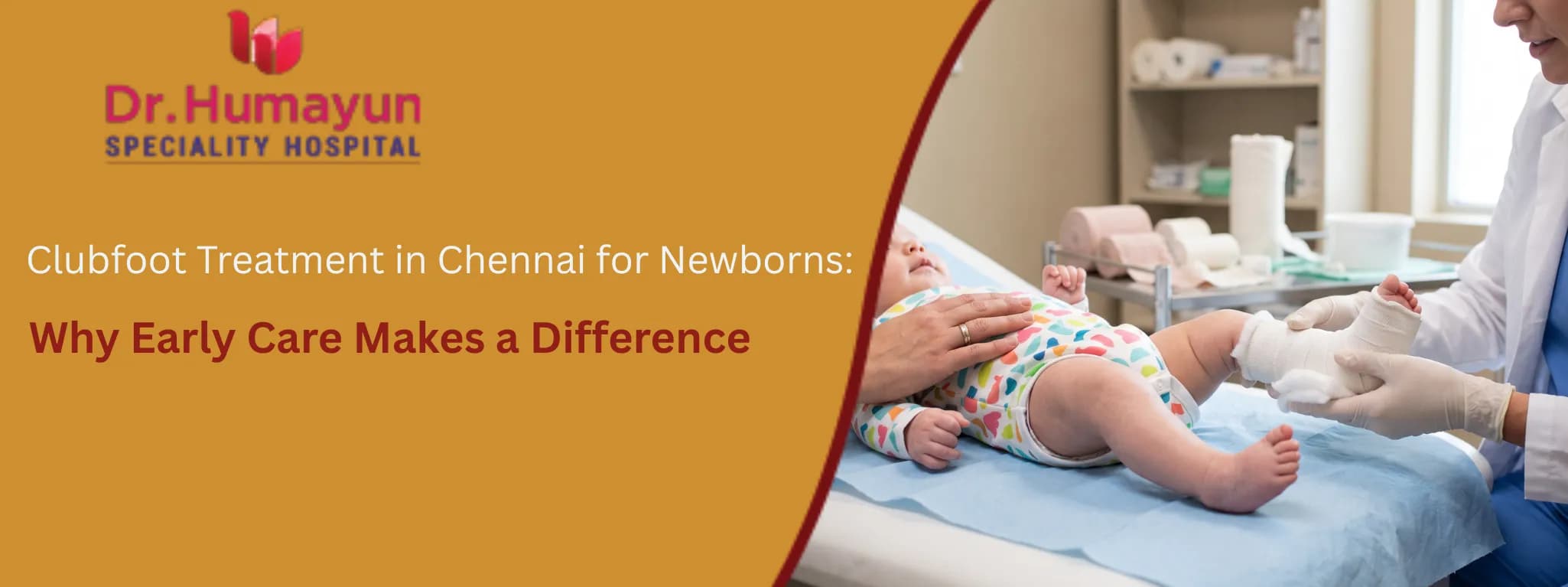
The orthopaedic specialist gently manipulates the baby's foot toward the corrected position and applies a plaster cast from the toes to above the knee to hold the foot in its new position. This is repeated weekly or fortnightly, with each cast gradually improving the alignment of the foot.
Most feet require 4 to 8 casts to achieve near-full correction. The casting is gentle, painless for the baby, and does not require sedation.
Stage 2: Achilles Tenotomy (in most cases)
Once the foot is adequately corrected in all planes except the upward movement (dorsiflexion), most babies require a small procedure called an Achilles tenotomy. Under local anaesthesia, the tight Achilles tendon is released through a tiny incision, allowing the heel to come down fully into the correct position. A final cast is applied for 3 weeks while the tendon heals.
The Ponseti method has gained international prominence due to its effectiveness and reduction in the need for surgical procedures.
Stage 3: Foot Abduction Brace (3 months to age 4)
After casting is complete, the foot must be held in the corrected position while the child grows and the tissues consolidate. This is achieved with a foot abduction brace (also called a boots-and-bar), which holds both feet turned outward. The brace is worn full-time for the first 3 months and then during sleep and naps until approximately age 4.
Brace compliance is the single most important factor in preventing relapse. When the brace is worn as prescribed, the relapse rate is very low.
| Stage | What Happens | Duration |
|---|---|---|
| Serial casting | Weekly casts gradually correct foot position | 4 to 8 casts (6 to 10 weeks) |
| Achilles tenotomy | Minor procedure to release tight tendon | Same day, final cast for 3 weeks |
| Foot abduction brace | Holds corrected position during growth | Full-time 3 months, then nights until age 4 |


What Happens If Treatment Is Delayed
Parents who receive a clubfoot diagnosis at birth sometimes wait, hoping the foot will correct on its own, or they are not directed to a specialist promptly. This delay has measurable clinical consequences:
-
The foot becomes progressively stiffer as cartilage begins to ossify into bone
-
More casts are required to achieve the same degree of correction
-
The risk of requiring surgical intervention increases
-
The quality of the final correction may be reduced
Untreated clubfoot causes lifelong walking difficulty, with the child walking on the outer edge of the foot, developing painful callosities, and being unable to wear standard footwear.
Early clubfoot treatment in Chennai, beginning in the first weeks of life, produces outcomes that are consistently better than delayed treatment.
When Surgery Is Needed
The Ponseti method is non-surgical in the vast majority of cases. Surgery is considered when:
-
The deformity is associated with a neuromuscular condition (such as spina bifida) that increases rigidity and relapse risk
-
The initial correction is incomplete despite an adequate casting course
-
Relapse occurs after brace non-compliance and re-casting has been insufficient
-
The child presents at an age when correction is no longer achievable by manipulation alone
When surgery is required, it typically involves release of tightened soft tissue structures and, in older children, bony procedures to realign the foot. Surgical outcomes are good but are generally considered a second-line approach after the Ponseti method has been optimised.
Signs Your Baby May Have Clubfoot
Parents and healthcare providers should be aware of the following at birth:
-
One or both feet turned inward and downward
-
The sole of the foot facing upward or inward rather than downward
-
The foot appears smaller or the calf thinner on the affected side
-
The heel appears pulled upward and inward
-
The foot does not correct fully when gently moved toward a normal position
If your baby was born with any of these features, or if a clubfoot was identified on your antenatal scan, a referral to a paediatric orthopaedic specialist should happen within the first 1 to 2 weeks of birth.
Clubfoot Treatment in Chennai at Dr. Humayun Speciality Hospital, T. Nagar
At Dr. Humayun Speciality Hospital, the paediatric orthopaedic team provides comprehensive clubfoot treatment in Chennai for newborns and infants, delivered through the internationally established Ponseti protocol. Services include:
-
Initial assessment and Pirani severity scoring at the first appointment
-
Weekly Ponseti casting with experienced orthopaedic application
-
Achilles tenotomy under local anaesthesia when indicated
-
Foot abduction brace prescription and fitting with parent education
-
Regular follow-up through the bracing phase to monitor for relapse
-
Surgical management when required for complex or relapsed cases
-
Multidisciplinary involvement when clubfoot is associated with a neuromuscular condition
The team works closely with parents throughout treatment, providing clear guidance on cast care, brace wearing schedules, and what to expect at each stage.
Baby born with clubfoot or clubfoot identified on your antenatal scan?
Chat with our medical care assistant for quick guidance and support and book an early paediatric orthopaedic assessment at Dr. Humayun Speciality Hospital, T. Nagar, Chennai.