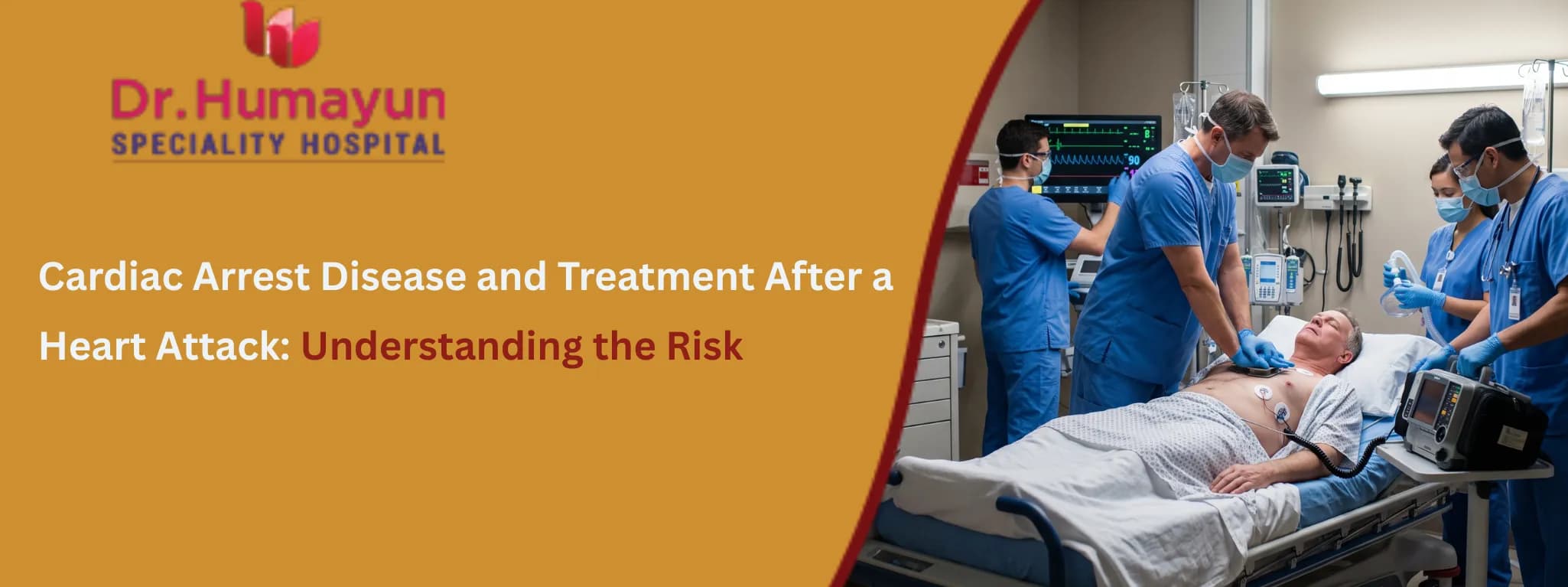
Two events. One connected chain. A heart attack occurs when a blocked coronary artery cuts off blood supply to part of the heart muscle. The muscle begins to die. The heart's electrical system, which depends on healthy muscle to function, becomes unstable. In that period of instability, the heart can suddenly shift from its normal rhythm into ventricular fibrillation, a chaotic, ineffective quivering that delivers no blood to the brain or body. That is cardiac arrest.
Many people use the terms heart attack and cardiac arrest interchangeably. They are not the same event, but they are closely connected, and understanding that connection, including what it means for long-term risk, how cardiac arrest disease and treatment has advanced, and what cardiac arrest treatment in Chennai involves, is essential knowledge for every heart patient and every family member of one.
Heart Attack vs Cardiac Arrest: The Critical Distinction
The difference between a heart attack and cardiac arrest is a distinction that saves lives when it is understood by bystanders who witness either event.
A heart attack is a plumbing problem. A coronary artery becomes blocked, typically by a ruptured atherosclerotic plaque and a blood clot forming over it. Blood flow to the downstream heart muscle stops. The muscle begins to die progressively the longer the blockage persists.
Symptoms of a heart attack:
-
Chest pain, tightness, pressure, or heaviness, often radiating to the left arm, jaw, or back
-
Breathlessness
-
Sweating, nausea, and light-headedness
-
The patient is conscious and can describe symptoms
Cardiac arrest is an electrical problem. The heart's electrical system fails, producing a lethal arrhythmia, most commonly ventricular fibrillation (VF) or pulseless ventricular tachycardia (VT). The heart stops pumping. Blood flow to the brain ceases. The patient loses consciousness within seconds.
Symptoms of cardiac arrest:
-
Sudden collapse
-
Unresponsive to voice or touch
-
No normal breathing (absent or gasping)
-
No detectable pulse
A heart attack can cause cardiac arrest. But cardiac arrest also occurs without a preceding heart attack, from other causes including primary arrhythmias, cardiomyopathy, and drug-induced electrical disturbance.
When cardiac arrest occurs during or immediately after a heart attack, the cause is almost always ventricular fibrillation triggered by the electrical instability of the ischaemic (oxygen-deprived) or dying heart muscle.
Why Heart Attack Survivors Are at Elevated Cardiac Arrest Risk
The connection between a heart attack and subsequent cardiac arrest extends beyond the acute event. A patient who survives their heart attack carries ongoing elevated risk of sudden cardiac death, which is cardiac arrest outside a healthcare setting, driven by arrhythmias arising from the damaged heart tissue.
The reasons are structural and electrical:
-
Myocardial scarring: When heart muscle dies after a heart attack, it is replaced by scar tissue. Scar tissue does not conduct electrical impulses normally. It creates zones of slow conduction and electrical heterogeneity within the heart muscle that can generate re-entrant ventricular arrhythmias, the substrate for ventricular tachycardia and fibrillation.
-
Reduced ejection fraction: The ejection fraction (EF) is the percentage of blood the left ventricle pumps with each contraction. After a significant heart attack, EF may fall substantially. A reduced EF is one of the strongest predictors of sudden cardiac death risk. Patients with an EF of 35% or below after a heart attack have a significantly elevated long-term risk of life-threatening arrhythmias.
-
Ongoing ischaemia: If the coronary blockage that caused the heart attack is not fully resolved, ongoing ischaemia continues to destabilise the heart's electrical system.
-
The timing of highest risk: The first 30 days after a heart attack carry the highest absolute risk of sudden cardiac death. Risk remains elevated for years in patients with significantly impaired left ventricular function, though it gradually reduces in patients who recover good function with optimal medical therapy.
Cardiac Arrest During a Heart Attack: Immediate Management
When cardiac arrest occurs in the setting of an acute heart attack, the immediate priorities are simultaneous: resuscitate the patient and open the blocked artery.
The Role of CPR and Defibrillation
Cardiac arrest from ventricular fibrillation is treated by defibrillation, a controlled electrical shock that depolarises all cardiac muscle cells simultaneously, allowing the heart's normal pacemaker to re-establish a coordinated rhythm. Time is everything.
Survival rates fall by approximately 10% for every minute that defibrillation is delayed after cardiac arrest. CPR (cardiopulmonary resuscitation) buys time by maintaining some blood flow to the brain and vital organs, keeping the heart and brain viable until defibrillation is possible.
The 2025 AHA guidelines emphasise high-quality chest compressions, early defibrillation, and the integration of advanced resuscitation techniques as the foundation of improved survival rates following cardiac arrest. In Chennai's urban environment, where the distance to emergency care varies significantly, bystander CPR is the most critical link in the chain of survival for out-of-hospital cardiac arrest.
Emergency Coronary Angiography After Cardiac Arrest
Once return of spontaneous circulation (ROSC) is achieved, the next priority in a patient with suspected heart attack-related cardiac arrest is identifying and opening the blocked coronary artery.
The 2025 ACC/AHA Acute Coronary Syndromes guideline gives a Class 1 strong recommendation for emergent left heart catheterisation after cardiac arrest with persistent ST-elevation on the ECG. This means immediate coronary angiography and PCI (percutaneous coronary intervention, balloon and stent opening of the blocked artery) is strongly recommended for these patients.
For patients who have achieved ROSC but have cardiogenic shock, recurrent ventricular arrhythmias, or significant haemodynamic compromise without ST-elevation, a 2a recommendation (reasonable to consider) supports emergent angiography.
Patients who are comatose after cardiac arrest with STEMI on ECG should preferentially be transferred to a centre capable of primary PCI. Approximately one-third of patients with cardiac arrest and STEMI on ECG have normal neurological status on presentation to the emergency department, making prompt coronary intervention the priority in these patients.


Post-Cardiac Arrest Care: The First 72 Hours
Surviving cardiac arrest is only the beginning of recovery. The post-resuscitation period is characterised by the post-cardiac arrest syndrome, a complex systemic response to the whole-body ischaemia-reperfusion injury of cardiac arrest.
The 2025 AHA Post-Cardiac Arrest Care guidelines, informed by a comprehensive evidence review from the International Liaison Committee on Resuscitation (ILCOR), provide updated recommendations across several critical areas of post-arrest management.
Haemodynamic Stabilisation
Maintaining adequate blood pressure after cardiac arrest is essential for cerebral perfusion. The AHA recommends targeting a mean arterial pressure (MAP) of at least 65 mmHg after cardiac arrest. Some patients, particularly those with brain oedema or global cerebral ischaemia, may benefit from higher MAP targets to preserve cerebral perfusion pressure.
Cardiogenic shock after cardiac arrest-related heart attack may require mechanical circulatory support including an intra-aortic balloon pump or a percutaneous ventricular assist device to maintain blood pressure and cardiac output while the heart recovers.
Oxygenation and Ventilation
Both hypoxia (too little oxygen) and hyperoxia (too much oxygen) are harmful after cardiac arrest. Targeting normal oxygen saturation (94 to 98%) avoids the additional oxidative stress of excessive oxygen delivery to reperfusing tissues. Normocapnia (normal carbon dioxide levels of 35 to 45 mmHg) is targeted in ventilated patients to maintain appropriate cerebral blood flow.
The 2025 guidelines flag an important clinical concern: pulse oximetry overestimates oxygenation in patients with darker-pigmented skin, placing them at risk for occult hypoxaemia. This is directly relevant to Chennai's patient population and reinforces the need for arterial blood gas monitoring rather than reliance on pulse oximetry alone in the post-arrest setting.
Temperature Management
Fever after cardiac arrest worsens neurological outcomes. Both the AHA and the European Society of Intensive Care Medicine (ESICM) 2025 guidelines recommend preventing fever (temperature above 37.8 degrees Celsius) in comatose survivors of cardiac arrest. Active cooling to lower temperatures (therapeutic hypothermia at 33 degrees Celsius) had been widely used but more recent evidence has narrowed its recommendation to selected patient groups.
Neurological Assessment and Prognosis
Neurological outcome after cardiac arrest is one of the most important determinants of whether aggressive care is continued. The 2025 ESICM guidelines provide specific algorithms for neuroprognostication, identifying validated methods for assessing neurological prognosis in comatose cardiac arrest survivors, allowing clinical teams to better guide families and treatment decisions.
Long-Term Cardiac Arrest Disease and Treatment After Heart Attack
Surviving the acute event is not the end of the clinical journey. Long-term management after a heart attack and cardiac arrest targets three goals: preventing a recurrent heart attack, preventing recurrent arrhythmias, and protecting the patient from sudden cardiac death.
Optimal Medical Therapy
Every survivor of a heart attack-related cardiac arrest should receive guideline-directed medical therapy (GDMT), which includes:
-
Dual antiplatelet therapy (aspirin plus clopidogrel or ticagrelor) to prevent stent thrombosis and recurrent coronary events
-
High-intensity statin therapy to reduce LDL cholesterol and stabilise existing coronary plaques
-
Beta-blockers to reduce heart rate and ventricular arrhythmia risk
-
ACE inhibitors or ARBs to reduce cardiac remodelling after the heart attack
-
Mineralocorticoid receptor antagonists (eplerenone or spironolactone) for patients with reduced ejection fraction
Adherence to this combination of medications significantly reduces the risk of recurrent cardiac events and long-term sudden cardiac death.
Implantable Cardioverter-Defibrillator (ICD)
The ICD is the most important long-term protection against sudden cardiac death in high-risk post-heart attack patients. An ICD is a small device implanted under the skin near the collarbone, connected to leads that monitor the heart's rhythm continuously. When it detects a life-threatening arrhythmia (ventricular fibrillation or sustained VT), it delivers an internal electrical shock to restore normal rhythm.
ICD implantation is recommended for:
-
Survivors of cardiac arrest not due to a reversible cause
-
Patients with an ejection fraction of 35% or below at least 40 days after a heart attack despite optimal medical therapy
-
Patients with an ejection fraction of 35% or below with symptomatic heart failure
The decision about ICD implantation timing after a heart attack is important. In the first 40 days after a heart attack, temporary electrical instability is expected and may resolve as the heart recovers. ICD implantation during this period has not been shown to improve outcomes. Assessment of left ventricular function should occur at least 40 days after the heart attack, and ICD candidacy is then re-evaluated based on the recovered EF.
Cardiac Rehabilitation
Structured cardiac rehabilitation after a heart attack is associated with improved survival, reduced risk of recurrent cardiac events, improved exercise capacity, and better quality of life. A comprehensive cardiac rehabilitation programme includes supervised exercise training, education about cardiovascular risk factor management, dietary guidance, smoking cessation support, and psychological support addressing the anxiety and depression that commonly follow a cardiac arrest event.
Warning Signs That Cardiac Arrhythmia Risk Is Elevated After a Heart Attack
Certain features after a heart attack indicate a higher risk of life-threatening arrhythmias and warrant prompt cardiological review.
Seek cardiology assessment promptly after a heart attack if:
-
You experience episodes of unexplained palpitations, particularly rapid or irregular heartbeats
-
You feel lightheaded, dizzy, or have brief episodes of near-fainting
-
You have been told your ejection fraction is 35% or below at your follow-up echocardiogram
-
You experience presyncope or syncope (fainting) after a heart attack
-
Your holter monitor has shown non-sustained ventricular tachycardia (runs of rapid ventricular beats)
-
You have not yet had a discussion about ICD candidacy if your EF remains low at 40-day reassessment
Cardiac Arrest Treatment in Chennai at Humayun Hospital, T Nagar
At Humayun Hospital, T Nagar, Chennai, our cardiology and emergency medicine team provides cardiac arrest treatment in Chennai across the full spectrum of care.
We offer:
-
Acute resuscitation and post-cardiac arrest stabilisation in our emergency department
-
ECG and cardiac biomarker assessment for suspected heart attack-related cardiac arrest
-
Coordination with interventional cardiology for urgent angiography and PCI when indicated
-
Post-arrest haemodynamic monitoring and intensive care management
-
Echocardiography for left ventricular function assessment after heart attack
-
Long-term arrhythmia risk assessment and ICD candidacy evaluation
-
Guideline-directed medical therapy initiation and optimisation after heart attack
-
Cardiac rehabilitation referral and coordination
For patients and families in T Nagar and across Chennai managing the aftermath of a heart attack, understanding and addressing the risk of cardiac arrest is not a separate concern from treating the heart attack itself. It is the same clinical priority, extended across the full arc of recovery and long-term cardiovascular management.
Chat with our medical care assistant for quick guidance and support.