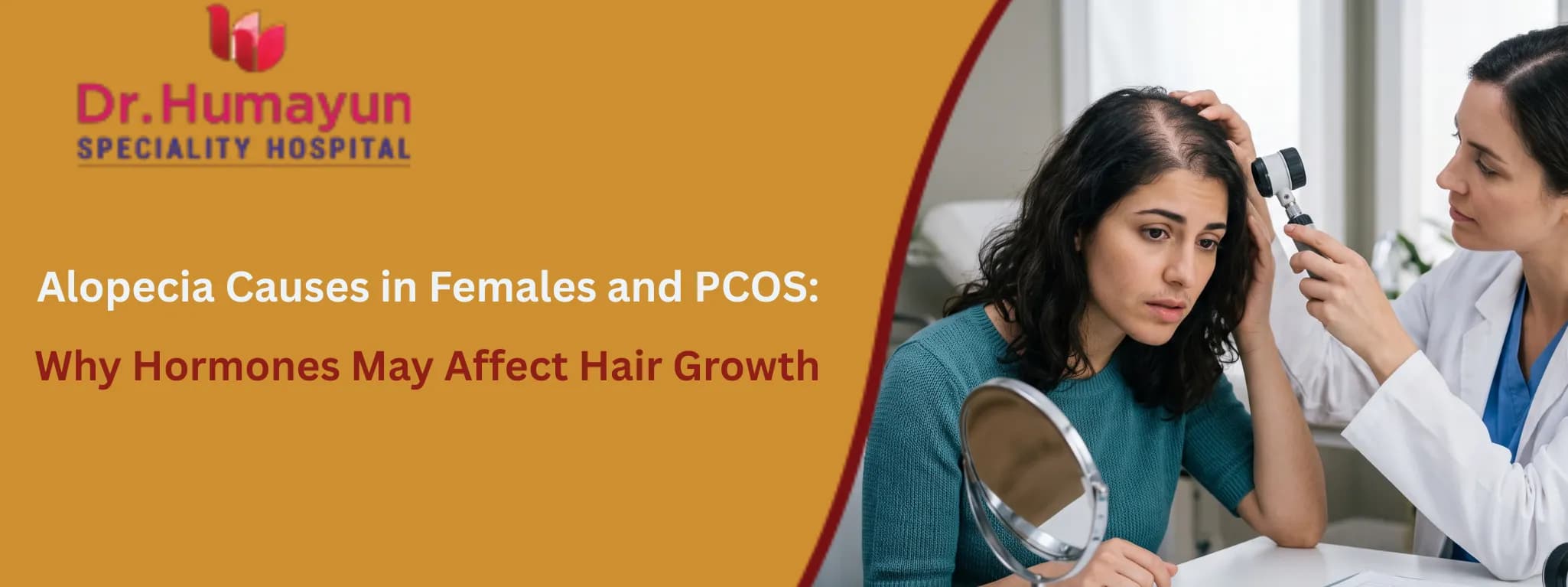

Hair is often deeply tied to a woman's sense of identity and confidence. When it begins to thin, to fall out in the shower in larger amounts than before, or when the parting visibly widens, the emotional impact can be significant. And yet, many women experiencing hair loss go months or years without a proper explanation, dismissed with advice to "reduce stress" or to try a different shampoo. The truth is that alopecia causes in females are specific, identifiable, and often directly treatable. And for a very large proportion of women who notice hair thinning between the ages of 15 and 40, particularly those who also have irregular periods, acne, or unexplained weight gain, the cause may lie not in the scalp but in the ovaries. Understanding what drives hair loss in women, how PCOS fits into this picture, and what distinguishes the different types of alopecia gives every woman a framework for seeking the right assessment and the right treatment.
How Hair Growth Works and Why It Goes Wrong
Hair grows in a cycle consisting of three phases:
- Anagen (active growth phase): lasts two to seven years. Approximately 85 to 90% of scalp hair is in this phase at any time.
- Catagen (transition phase): lasts two to three weeks. The hair follicle shrinks.
- Telogen (resting and shedding phase): lasts two to three months. The hair is shed and the follicle prepares for a new anagen cycle. Normal hair loss is 50 to 100 hairs per day. This is not alarming because each shed hair is replaced by a new one growing from the same follicle. Alopecia occurs when the growth cycle is disrupted: when more hairs enter the telogen phase simultaneously, when the anagen phase shortens, when follicles miniaturise and produce progressively thinner hairs, or when follicles are permanently destroyed. Each of these mechanisms corresponds to a different type of alopecia and a different underlying cause.
Alopecia Causes in Females — The Full Clinical Range
Androgenetic Alopecia (Female Pattern Hair Loss)
Androgenetic alopecia is the most common alopecia cause in females globally. It is caused by the effects of androgen hormones, specifically dihydrotestosterone (DHT), on genetically susceptible hair follicles.
DHT is the primary hormone responsible for female pattern hair loss. It binds to androgen receptors in susceptible scalp hair follicles and progressively shortens the anagen phase, causing follicles to produce shorter, finer hairs with each cycle. Over years, the follicles miniaturise to the point where visible hair coverage is lost.
Female pattern hair loss presents differently from male pattern baldness. Rather than a receding hairline, women typically experience:
- Widening of the central parting
- Diffuse thinning over the crown and top of the scalp
- Retention of the frontal hairline in most cases
- A Christmas tree-shaped pattern visible when the hair is parted
The Ludwig scale classifies female pattern hair loss in three grades of increasing severity.
Androgenetic alopecia in women is closely associated with conditions that raise androgen levels, the most significant of which is PCOS.
PCOS and Hair Loss — The Hormonal Connection
PCOS, now also referred to as polycystic ovarian syndrome or PMOS in updated clinical terminology, affects approximately 1 in 8 women worldwide. It is characterised by hormonal imbalances including elevated androgens, irregular ovulation, and metabolic dysfunction.
Women with PCOS are more than twice as likely to experience hair loss compared to non-PCOS women of the same age. The mechanism is direct:
- PCOS elevates circulating testosterone and other androgens produced by the ovaries and adrenal glands
- Elevated androgens are converted peripherally to DHT by the enzyme 5-alpha reductase
- DHT binds to androgen receptors in genetically susceptible scalp hair follicles
- Follicles miniaturise progressively, producing finer hairs with each cycle until coverage is visibly reduced
Elevated insulin, which is frequently raised in women with PCOS due to insulin resistance, additionally stimulates androgen production in the ovaries, compounding the effect. Low progesterone, which is common in anovulatory PCOS, removes a natural counterbalance because progesterone inhibits 5-alpha reductase and therefore reduces DHT production.
PCOS causes both hair loss and hirsutism from the same elevated androgens. The paradox is explained by the different sensitivity of follicles in different locations: scalp follicles with androgen receptors are suppressed by DHT, while facial and body hair follicles are stimulated by it. The same hormone drives scalp hair loss and excess chin, upper lip, and body hair simultaneously.
A 2025 systematic review and meta-analysis confirmed a bidirectional association between female pattern hair loss and PCOS, meaning women with androgenetic alopecia have higher rates of PCOS, and women with PCOS have higher rates of androgenetic alopecia. This bidirectional relationship supports evaluating PCOS in any woman with female pattern hair loss, particularly in younger women where the hormonal cause is more likely to be treatable.
Telogen Effluvium
Telogen effluvium is the second most common alopecia cause in females. It occurs when a significant physical or emotional stressor triggers a large proportion of hair follicles to simultaneously shift from the anagen (growth) phase into the telogen (shedding) phase.
The result is diffuse, sudden hair shedding, typically beginning two to three months after the triggering event, because this is how long it takes for the follicles that shifted to telogen to complete their resting phase and shed.
Common triggers in women:
-
Childbirth (postpartum telogen effluvium is extremely common, typically occurring two to four months after delivery)
-
Rapid or significant weight loss
-
Major surgery or serious illness
-
Severe emotional trauma or prolonged psychological stress
-
High fever or hospitalisation
-
Starting or stopping hormonal contraception
-
Nutritional deficiency, particularly iron deficiency
Telogen effluvium is usually self-limiting. When the trigger is removed and the underlying cause addressed, the hair regrowth cycle resumes and hair density recovers over six to twelve months. Persistent or recurrent telogen effluvium, lasting more than six months, warrants full blood testing to identify a persisting underlying cause.


Nutritional Deficiency
Nutritional deficiencies are among the most correctable alopecia causes in females, and in India, they are extremely common.
Iron deficiency is the most prevalent correctable cause of hair loss in Indian women. The combination of menstrual blood losses, vegetarian diets with lower bioavailable iron, and high rates of anaemia in the female population makes iron deficiency the first nutritional cause to test for in any woman presenting with hair loss. Even non-anaemic iron deficiency (depleted ferritin stores without haemoglobin fall) can cause significant hair shedding.
Vitamin D deficiency is associated with alopecia areata and with diffuse hair thinning. Vitamin D receptors are expressed in hair follicles, and deficiency impairs the hair growth cycle.
Zinc deficiency impairs hair follicle cell division and protein synthesis. Low zinc is associated with telogen effluvium and diffuse hair loss.
Vitamin B12 deficiency is common in vegetarians and is associated with hair loss alongside fatigue and neurological symptoms.
Supplementing identified deficiencies is one of the most reliable interventions for hair loss when nutritional depletion is confirmed on blood testing.
Thyroid Disorders
Both hypothyroidism and hyperthyroidism can cause diffuse hair thinning. Thyroid hormones regulate the rate of the hair growth cycle. When thyroid function is abnormal in either direction, the hair cycle is disrupted and diffuse hair shedding results.
Thyroid-related hair loss is entirely reversible when thyroid function is normalised with appropriate treatment. Any woman with unexplained diffuse hair loss should have thyroid function tested as part of her initial blood investigation.
Alopecia Areata
Alopecia areata is an autoimmune condition where the immune system attacks hair follicles, producing patchy, well-defined areas of complete hair loss. The patches are typically round or oval, appear suddenly, and may affect the scalp, eyebrows, eyelashes, or any hair-bearing area.
Alopecia areata is non-scarring, meaning the follicles are not permanently destroyed, and regrowth is possible. It is associated with other autoimmune conditions including thyroid disease and vitiligo. Treatment includes topical and intralesional corticosteroids, minoxidil, and newer Janus kinase (JAK) inhibitor therapies that have shown significant efficacy in clinical trials.
Traction Alopecia
Traction alopecia is caused by repeated pulling forces on the hair from tight hairstyles: high ponytails, tight braids, extensions, and hair weaves. The repeated tension damages the hair follicle at its root. Early traction alopecia is reversible. Chronic, severe traction eventually causes scarring alopecia with permanent follicle destruction.
Traction alopecia characteristically affects the margins of the scalp, particularly the temples, the hairline, and the areas above the ears, where the tension from tight hairstyles is greatest.
Menopausal Hair Loss
The decline in oestrogen and progesterone at menopause, without a corresponding fall in androgen levels, shifts the hormonal balance toward relative androgen excess. This is why female pattern hair loss frequently accelerates in the perimenopausal and postmenopausal period, even in women whose hair was previously unaffected. Hormone replacement therapy assessment and topical minoxidil are the most commonly discussed management options for postmenopausal hair thinning.
Diagnosing Alopecia in Women: What Assessment Involves
A thorough assessment of alopecia in women is not simply a visual inspection of the scalp. It is a structured clinical and biochemical investigation designed to identify the specific cause from the wide range of possibilities described above.
Key blood tests in female alopecia assessment:
-
Full blood count and ferritin (iron stores)
-
Thyroid function tests (TSH, free T4)
-
Serum zinc and vitamin D
-
Vitamin B12 and folate
-
Fasting glucose and insulin resistance markers
-
Hormonal profile: testosterone (total and free), DHEAS, LH, FSH, prolactin
-
Anti-TPO antibodies when autoimmune thyroid disease is suspected
Scalp examination and trichoscopy: A dermatoscope allows magnified examination of the scalp and hair follicles, identifying the miniaturisation pattern of androgenetic alopecia, the exclamation mark hairs of alopecia areata, or the peripilar casts and scaling of inflammatory scalp conditions.
Scalp biopsy: Reserved for cases where the diagnosis remains unclear after clinical assessment and blood testing, or when scarring alopecia is suspected.
Treatment of PCOS-Related Alopecia in Women
Treating the hair loss without treating the underlying hormonal cause produces incomplete and temporary results. For women with PCOS, addressing androgen excess is the foundation of effective hair loss management.
Treating PCOS to Reduce Androgen Levels
-
Lifestyle modification and weight management: Reducing insulin resistance through dietary change, regular aerobic exercise, and weight loss meaningfully reduces PCOS-related androgen production and can slow or partially reverse hair loss. This is the most powerful and most underused intervention for PCOS-related hair changes.
-
Combined oral contraceptive pill: Low-androgenic or anti-androgenic contraceptives (containing drospirenone or cyproterone acetate) reduce free androgen levels and are among the first-line pharmacological options for PCOS-related androgenetic alopecia in women who are not trying to conceive.
-
Spironolactone: An anti-androgen medication that blocks the androgen receptor, reducing DHT's effect on hair follicles. It is used off-label for androgenetic alopecia in women and produces meaningful improvement in hair density over six to twelve months of treatment.
-
Metformin: Reduces insulin resistance and thereby reduces androgen production from the ovaries. Its hair-specific benefit is less direct than anti-androgen therapy but contributes to the overall hormonal improvement.
Direct Hair Treatments
-
Minoxidil (topical): The most evidence-supported topical treatment for female pattern hair loss. Available as a 2% or 5% solution or foam applied to the scalp daily. It prolongs the anagen phase and increases follicle size. It does not address the androgenic cause but slows progression and promotes regrowth. Long-term use is required to maintain benefit.
-
Nutritional correction: Treating identified iron, vitamin D, zinc, or B12 deficiency with appropriate supplementation produces hair cycle improvement over three to six months of sustained normalisation.
-
Low-level laser therapy: An adjunct treatment with modest evidence of benefit for female pattern hair loss, available in clinic-based and at-home device formats.
-
Platelet-rich plasma (PRP) therapy: Growth factors extracted from the patient's own blood are injected into the scalp to stimulate follicle activity. Evidence is growing and it is increasingly offered as an adjunct in women with androgenetic alopecia.
Assessment at Humayun Hospital, T Nagar
At Humayun Hospital, T Nagar, Chennai, our gynaecology and internal medicine team provides structured, comprehensive assessment for women presenting with hair loss, with specific attention to PCOS and its hormonal drivers. We offer:
-
Full hormonal assessment including androgen profile, LH, FSH, and prolactin
-
Pelvic ultrasound for PCOS diagnosis and ovarian assessment
-
Blood tests for thyroid function, iron studies, vitamin D, and metabolic markers
-
Diagnosis of PCOS subtype and personalised hormonal management plan
-
Anti-androgen and oral contraceptive management for PCOS-related alopecia
-
Metformin and insulin sensitisation therapy for women with significant insulin resistance
-
Dietary, lifestyle, and weight management guidance
-
Dermatology and trichology referral for scalp assessment, trichoscopy, and direct hair treatments including minoxidil and PRP
-
Monitoring and long-term follow-up for women with chronic PCOS and hair loss
Hair loss in a young woman is not simply cosmetic. It is often the visible signal of a hormonal condition that also affects fertility, metabolic health, and cardiovascular risk over the long term. Treating the cause, not just the symptom, is the approach that produces lasting results.
Chat with our medical care assistant for quick guidance and support.