
Infertility affects approximately one in six couples globally, and the number of people seeking fertility treatment in India has grown significantly over the past decade. The range of treatments available has expanded equally, from simple ovulation-stimulating tablets to complex laboratory procedures capable of achieving pregnancy in cases that would have been considered untreatable a generation ago.
Understanding what the different types of fertility treatments are, how they work, who they are designed for, and how they differ from one another helps couples make informed decisions about their care. The right starting point varies widely. Not every couple needs IVF. Many achieve pregnancy with much simpler interventions.
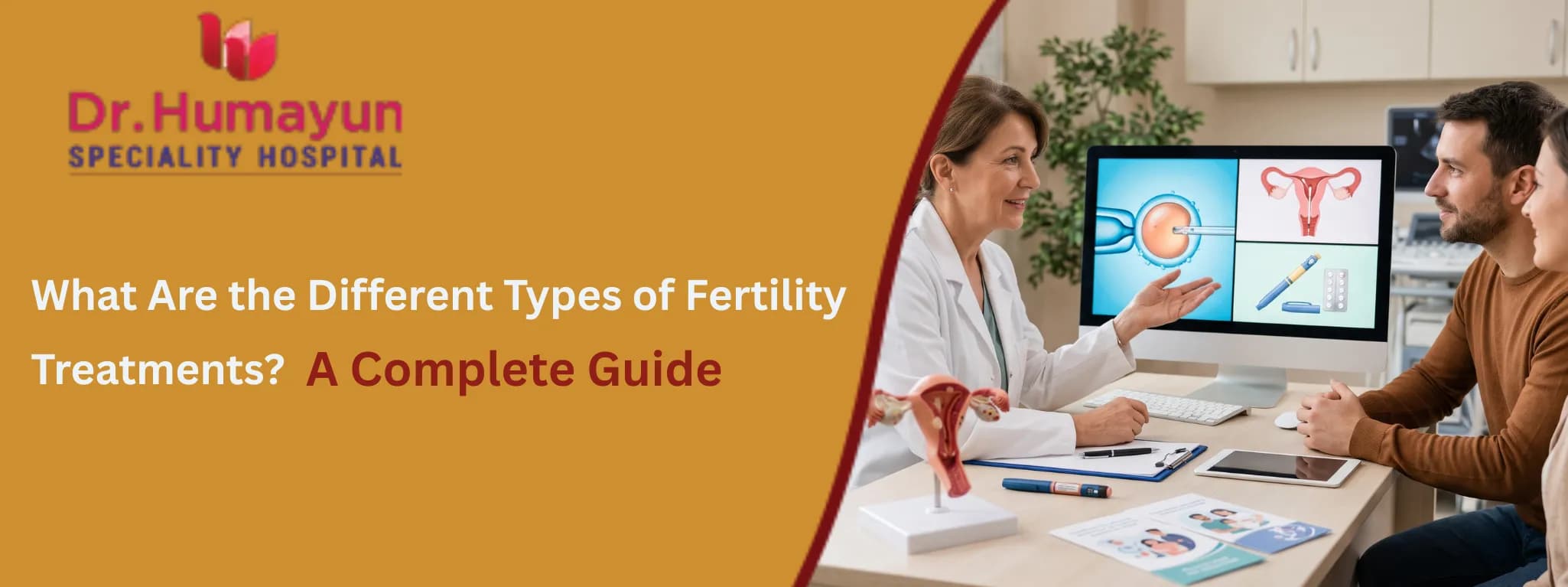
This guide covers the full spectrum of fertility treatments, from ovulation induction and IUI through to IVF, ICSI, frozen embryo transfer, surgical fertility procedures, and the specialist care available at Humayun Hospital, T Nagar, Chennai.
When Is Fertility Treatment Recommended?
Before discussing the types of fertility treatments, it is useful to understand when treatment is typically indicated. The clinical definition of infertility is the failure to achieve pregnancy after 12 months of regular unprotected intercourse. For women aged 35 and above, investigation is recommended after 6 months rather than 12, because age-related fertility decline accelerates significantly after 35.
Common Causes That Lead to Fertility Treatment
-
PCOS and ovulatory disorders: Irregular or absent ovulation is one of the most common causes of female infertility and responds well to ovulation induction medications.
-
Tubal damage: Blocked or scarred fallopian tubes, often from previous infection (PID), endometriosis, or surgery, prevent sperm and egg from meeting. IVF bypasses the tubes entirely.
-
Endometriosis: Affects egg quality, ovarian reserve, the uterine environment, and tubal function. Depending on severity, treatment may involve surgery, IVF, or both.
-
Male factor infertility: Low sperm count, poor motility, and abnormal morphology account for approximately 40 to 50% of infertility cases. ICSI can achieve fertilisation even with severely impaired sperm.
-
Diminished ovarian reserve: Age-related or premature decline in egg quantity and quality, identified by low AMH, elevated FSH, and low antral follicle count on ultrasound.
-
Uterine factors: Fibroids (particularly submucous), polyps, uterine adhesions (Asherman's syndrome), or a septate uterus can impair implantation.
-
Unexplained infertility: Approximately 10 to 15% of couples complete investigation with no identifiable cause found. IUI and IVF are both used in unexplained infertility management.
Types of Fertility Treatments From Simple to Complex
Fertility treatments are typically arranged in a stepped pathway, beginning with the least invasive effective option for each couple's situation and escalating if needed.
Ovulation Induction and Cycle Monitoring
Ovulation induction is the use of medication to stimulate the ovaries to produce and release one or more mature eggs in a cycle where ovulation is absent or irregular. It is the first-line fertility treatment for women with PCOS, hypothalamic amenorrhea, or other ovulatory disorders.
How it works:
-
Oral medications: Clomiphene citrate or letrozole are taken for 5 days early in the cycle (usually days 2 to 6). They work by blocking oestrogen receptors at the pituitary gland, triggering increased FSH production and ovarian stimulation. Letrozole is now preferred over clomiphene for PCOS, as it produces fewer multiple pregnancies.
-
Injectable gonadotropins (FSH injections): Used when oral medications fail to produce a satisfactory response. They are more powerful, require closer monitoring, and carry a higher multiple pregnancy risk.
-
Cycle monitoring: Transvaginal ultrasound scans track follicle growth. When follicles reach maturity (18 to 20 mm), a trigger injection of hCG or GnRH agonist is given to time ovulation precisely. The couple is advised to have intercourse or undergo IUI 36 to 40 hours after the trigger.
Who it is for: Women with irregular or absent ovulation, particularly PCOS, as a first-line treatment. Often combined with IUI for better outcomes.
Success rates: 15 to 30% per cycle when combined with IUI.
Intrauterine Insemination (IUI)
IUI is a procedure in which prepared sperm is placed directly into the uterine cavity through a thin catheter at the time of ovulation, bypassing the cervix and reducing the distance sperm must travel to reach the egg.
How it works:
The male partner's semen sample, or donor sperm, is processed in the andrology laboratory. The process, called sperm washing, separates the most active sperm from seminal fluid, removing prostaglandins and other compounds that would cause uterine cramping if introduced directly. The concentrated preparation of motile sperm is drawn into a fine catheter and placed into the uterine cavity. The procedure takes approximately 60 to 90 seconds and is no more uncomfortable than a smear test for most women.
IUI can be performed in a natural (unmedicated) cycle or a stimulated cycle with ovulation induction, which improves outcomes.
Who it is for:
- Mild male factor infertility (mildly low count, motility, or morphology)
- Unexplained infertility as a first treatment step
- Cervical mucus problems
- Couples using donor sperm
Success rates: 5 to 20% per cycle. Success declines with age, particularly over 35. Most clinicians recommend no more than 3 to 4 IUI cycles before moving to IVF if pregnancy has not been achieved.
In Vitro Fertilisation (IVF)
IVF is the most widely known and most commonly performed advanced fertility treatment globally. It is the process of retrieving eggs from the ovaries, fertilising them with sperm in the embryology laboratory, and transferring one or more resulting embryos into the uterus.
How it works the IVF cycle step by step:
-
Ovarian stimulation: Daily injections of FSH (and often LH) are given for 8 to 14 days to stimulate the ovaries to develop multiple follicles simultaneously. The response is monitored with regular transvaginal ultrasound scans and blood hormone levels.
-
Trigger injection: When follicles reach maturity, a trigger injection causes final egg maturation.
-
Egg retrieval (oocyte pick-up): 36 hours after the trigger, eggs are retrieved under sedation or light anaesthesia using a fine needle guided by transvaginal ultrasound through the vaginal wall into each follicle. The procedure takes approximately 15 to 20 minutes.
-
Fertilisation: Retrieved eggs are placed with prepared sperm in culture dishes in the embryology laboratory and incubated overnight. Fertilised eggs are identified the following morning.
-
Embryo culture: Fertilised embryos are cultured for 3 to 5 days in the laboratory. Day 5 embryos (blastocysts) have higher implantation rates than day 3 embryos.
-
Embryo transfer: One or two embryos are placed into the uterine cavity through a fine catheter under ultrasound guidance. The procedure is typically painless and takes a few minutes.
-
Luteal support: Progesterone pessaries or injections support the uterine lining after transfer. A pregnancy test is done approximately 14 days later.
Who it is for:
-
Tubal factor infertility (IVF bypasses the fallopian tubes entirely)
-
Endometriosis-related infertility
-
Diminished ovarian reserve, particularly in women over 35
-
Unexplained infertility after failed IUI cycles
-
Moderate to severe male factor infertility (usually combined with ICSI)
IVF success rates in India: Approximately 30 to 35% live birth rate per embryo transfer cycle for women under 35. Success rates decline with age: approximately 20% at age 40 and around 3% at age 45 or above.


Intracytoplasmic Sperm Injection (ICSI)
ICSI is performed as part of an IVF cycle. Instead of placing eggs and sperm together and allowing fertilisation to occur naturally, the embryologist selects a single sperm under high magnification and injects it directly into the egg using a fine glass needle.
When ICSI is used:
-
Severe male factor infertility (very low count, very poor motility, high abnormal morphology)
-
Surgically retrieved sperm (from a man with obstructive or non-obstructive azoospermia, where sperm are extracted from the testis or epididymis rather than ejaculated)
-
Previous failed fertilisation in a conventional IVF cycle
-
Frozen sperm with reduced function after thawing
-
Small number of eggs retrieved where maximising fertilisation rate is important
Fertilisation rate with ICSI: 50 to 80% of injected eggs fertilise successfully. Pregnancy success rates with ICSI are comparable to conventional IVF when other factors are equal.
Frozen Embryo Transfer (FET)
In many IVF and ICSI cycles, more embryos are created than are transferred in the fresh cycle. Surplus good-quality embryos are frozen (vitrified) and stored for future use. A frozen embryo transfer cycle involves preparing the uterine lining with oestrogen and progesterone, then thawing and transferring a previously frozen embryo.
Why FET is used:
-
To use surplus embryos from a previous stimulated cycle without repeating the full stimulation process
-
When the fresh transfer is cancelled due to ovarian hyperstimulation syndrome (OHSS) risk or an unfavourable uterine lining
-
For patients who wish to plan family timing
-
In a freeze-all strategy where all embryos are frozen and transferred in a subsequent natural or prepared cycle, which some evidence suggests may improve implantation rates
Vitrification (ultra-rapid freezing) has transformed frozen embryo outcomes. Modern FET success rates are comparable to or in some studies higher than fresh transfer rates.
Surgical Fertility Treatments
Some fertility problems cannot be addressed by medication or assisted reproduction alone. Surgical treatment of the underlying condition improves fertility outcomes both for natural conception and for assisted reproduction cycles.
Laparoscopy for fertility:
-
Endometriosis: Laparoscopic excision or ablation of endometriotic deposits, ovarian endometriomas (chocolate cysts), and adhesions improves the pelvic environment and egg quality. In moderate to severe endometriosis, surgery before IVF may improve outcomes.
-
Tubal surgery: Selected cases of distal tubal blockage (hydrosalpinx) are treated laparoscopically. A hydrosalpinx (fluid-filled blocked tube) actively reduces IVF success rates and is removed or clipped before IVF.
-
Fibroids: Laparoscopic myomectomy removes submucous or intramural fibroids that distort the uterine cavity and impair implantation.
-
Ovarian drilling: Laparoscopic ovarian drilling for PCOS resistant to oral ovulation induction medications can restore regular ovulation in selected patients.
Hysteroscopy for fertility:
Hysteroscopy passes a thin camera through the cervix into the uterine cavity, allowing direct visualisation and treatment of intrauterine problems.
-
Uterine polyps: removed under direct vision during diagnostic hysteroscopy
-
Submucous fibroids: resected hysteroscopically
-
Uterine adhesions (Asherman's syndrome): divided under hysteroscopic guidance
-
Uterine septum: divided to restore a normal cavity
Correcting intrauterine abnormalities before an IVF or FET cycle is a standard part of optimising the uterine environment for embryo implantation.
Choosing the Right Fertility Treatment
The appropriate treatment depends on the specific cause or causes of infertility identified at assessment. Fertility assessment at a specialist centre evaluates both partners simultaneously: the woman with hormonal blood tests (FSH, LH, AMH, oestradiol, prolactin, TSH), a transvaginal pelvic ultrasound (uterus, ovaries, antral follicle count), and a uterine cavity assessment; the man with a semen analysis examining count, motility, morphology, and volume.
| Cause of Infertility | First-Line Treatment | If First-Line Fails or Conditions Are Severe |
|---|---|---|
| Ovulatory disorder (PCOS) | Ovulation induction + IUI | IVF / ICSI |
| Unexplained infertility | Ovulation induction + IUI | IVF |
| Tubal factor | IVF (bypass tubes) | FET with surplus embryos |
| Mild male factor | IUI with stimulation | IVF + ICSI |
| Severe male factor | IVF + ICSI | Surgical sperm retrieval + ICSI |
| Endometriosis (mild/moderate) | Laparoscopy then IUI or IVF | IVF |
| Uterine factor (polyp, fibroid) | Hysteroscopic removal, then natural/IUI | IVF after correction |
| Diminished ovarian reserve | IVF (limited window, act promptly) | FET or donor egg discussion |
Fertility Treatments at Humayun Hospital, T Nagar, Chennai
Humayun Hospital offers the full spectrum of fertility treatments at its IVF centre in T Nagar, Chennai, within an accredited hospital environment.
The fertility team includes:
-
Dr. Madhupriya Ananthakrishnan Consultant, Reproductive Medicine and Gynaecology, with over 22 years of experience in fertility management and assisted reproduction.
-
Dr. Hemalatha Consultant, Reproductive Medicine, with over 25 years of experience in reproductive endocrinology and fertility treatment.
-
Dr. Asma Humayun Senior Consultant Obstetrician and Gynaecologist, with over 17 years of clinical experience including a Fellowship in Minimal Access Surgery (F.MAS) and Fellowship in Assisted Reproductive Techniques (F.ART, MRCOG UK), bringing integrated surgical and reproductive medicine expertise.
Fertility services at Humayun Hospital include:
-
Fertility assessment for both partners (including semen analysis, hormonal panel, pelvic ultrasound, and antral follicle count)
-
Ovulation induction and cycle monitoring
-
Intrauterine insemination (IUI)
-
IVF and ICSI with in-house embryology laboratory
-
Frozen embryo transfer (FET) and embryo cryopreservation
-
Hysteroscopy and laparoscopy for fertility surgery
-
Preconception counselling and fertility preservation
Laboratory and technology:
The IVF and embryology laboratory at Humayun Hospital features controlled air handling, continuous-monitoring incubators for embryo culture, micromanipulation equipment for ICSI, and a cryopreservation facility for embryo and gamete storage. Costs are provided in writing before any cycle begins.
Chat with our medical assistant to understand which fertility treatment is right for your situation.