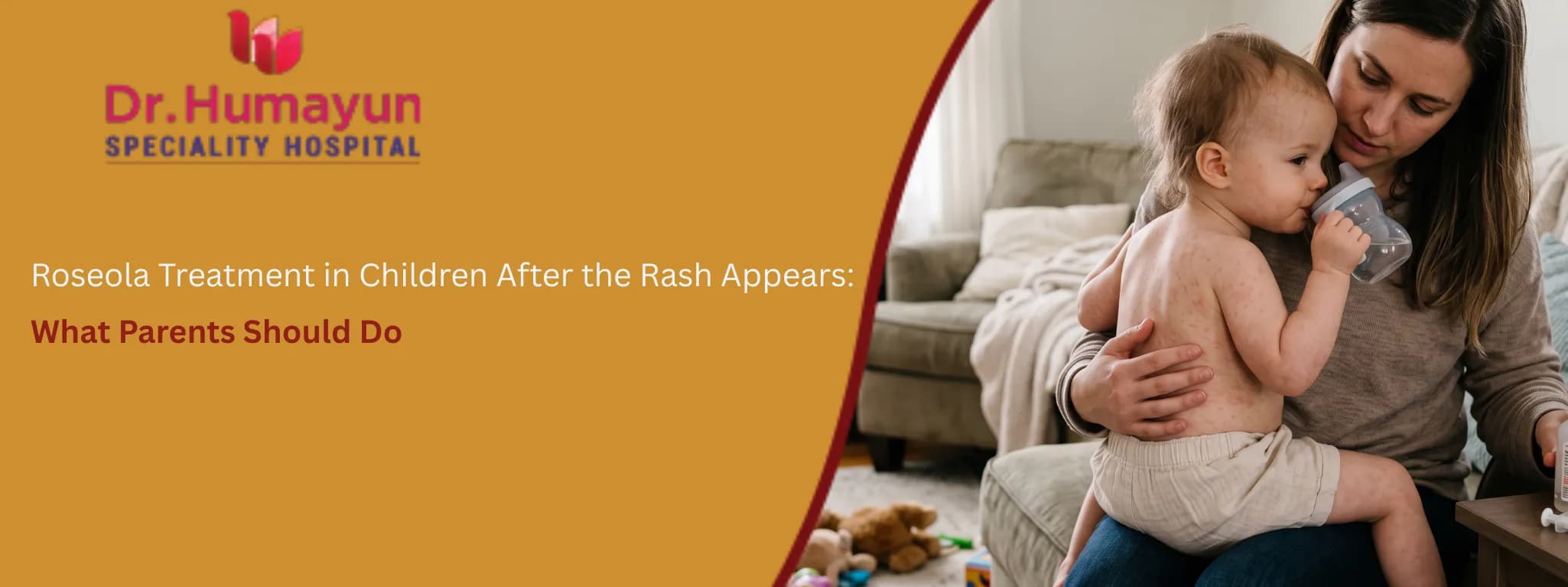

The past three to five days have been frightening. Your baby or toddler developed a sudden, high fever, often above 39 degrees Celsius, and nothing seemed to bring it down adequately. No cough, no cold, no obvious explanation. Just a persistently high temperature and a miserable, fussy child.
Then, as the fever finally broke, something new appeared. A pink, spotty rash spreading across the chest, back, and stomach, moving to the neck, face, and arms. Another alarm. What now?
For most parents encountering roseola for the first time, the rash feels like a new development to worry about. In fact, it is the opposite. The rash is the clearest possible sign that the difficult part of the illness is over.
Understanding exactly what the rash means, what roseola treatment in children involves at this stage, and what warning signs still require medical attention turns a frightening experience into a manageable one.
What Is Roseola and Why Does It Follow This Pattern?
Roseola, also known as sixth disease or exanthem subitum, is a viral illness caused by human herpesvirus 6 (HHV-6), and less commonly by human herpesvirus 7 (HHV-7). Almost all children develop roseola at some point in the first two years of life, making it one of the most universally experienced childhood viral infections. The illness follows a highly distinctive two-stage pattern:
-
Stage 1: The fever phase (days one to five) A sudden, high fever, often 39 to 40.5 degrees Celsius, develops abruptly. The child may be fussy and uncomfortable but often appears less unwell than the temperature would suggest. There is no rash, and no obvious explanation for the fever. Some children also have a mild runny nose, mild sore throat, or swollen lymph nodes in the neck.
-
Stage 2: The rash phase (after the fever breaks) Within 12 to 24 hours of the fever resolving, a rash appears. It typically starts on the chest and back, spreads to the abdomen, then moves to the neck, face, and arms. It is pink or red on lighter skin tones and may appear as a faint red or purple colour on children with darker skin tones, where it can be harder to notice.
The rash:
-
Is flat or slightly raised
-
Blanches (fades) when pressed with a finger or glass
-
Is usually not itchy
-
Does not hurt
-
Lasts one to three days before fading on its own
The child with a roseola rash is typically no longer feverish and often appears much more comfortable. The rash phase is the recovery phase.
What Roseola Treatment in Children Involves After the Rash Appears
Once the roseola rash has appeared, the specific treatments needed are minimal. Roseola is a viral illness and there is no antiviral medication that treats it. The goal of treatment is symptom management, and during the rash phase, the primary symptom is the rash itself.
The Rash Does Not Need Treatment
This is the most important message for parents during the rash phase. No creams, no ointments, no lotions, and no medications are needed for the rash.
The roseola rash is harmless, non-itchy in most cases, and self-resolving. Applying creams or topical treatments does not speed healing and is unnecessary. Washing the affected skin gently with water is appropriate. Soap, particularly fragrant or antibacterial soaps, should be avoided as they can dry and irritate the skin.
Managing Mild Itching (If Present)
Roseola rash is usually not itchy. A small proportion of children experience some mild itching. If itching is present:
-
Apply a fragrance-free moisturising cream once or twice a day after bathing
-
A cool, damp cloth applied gently to the skin provides temporary relief
-
An antihistamine may be given if itching is significant, with guidance from a paediatrician on appropriate dosing for the child's age and weight
Do not use calamine lotion or hydrocortisone cream without medical advice.
Continue Adequate Hydration
Even during the rash phase, maintaining adequate fluid intake remains important. The child may still have reduced appetite from the preceding fever illness. Encourage:
-
Water and clear fluids
-
Breast milk or formula for infants
-
Light, easily digestible food as appetite returns
-
Oral rehydration solution if the child is showing any signs of dehydration
A child who is drinking well, urinating normally, and gradually becoming more active and playful during the rash phase is recovering as expected.
Rest and Normal Activity
A child with the roseola rash who is afebrile (no longer feverish) and feeling well can resume light activity. There is no need to keep a child with only a rash confined to bed. Most children with roseola become noticeably more energetic and engaged within hours of the fever breaking.
Full return to nursery or school: once the fever has been absent for 24 hours and the child is well enough to participate, they can return. The child with only the rash is not contagious. Roseola is spread during the fever phase, not the rash phase.


What Parents Often Get Wrong About the Roseola Rash
Mistaking the Rash for an Allergic Reaction to Fever Medicine
A very common parental concern is that the rash is an allergic reaction to paracetamol or ibuprofen given during the fever. This happens because the timing is coincidental: parents give fever medication for three to five days, the fever breaks, and a rash appears. It looks like the medication caused the rash.
Roseola causes the most confusion because most viral rashes start with a fever. Parents give fever medicine when the rash starts. The fever medicine had nothing to do with the rash.
The roseola rash is caused by the viral illness, not by any medication. Drug rashes from paracetamol are rare. If there is genuine concern about a drug reaction, a paediatrician can assess, but stopping fever medication out of concern for a rash is not necessary if the medicine was appropriate.
Confusing Roseola Rash With Other Conditions
The roseola rash can be mistaken for:
-
Measles rash: A measles rash begins on the head and face and moves downward. A roseola rash typically starts on the trunk. Measles is also accompanied by cough, runny nose, and conjunctivitis before the rash.
-
Rubella: Also produces a rash, but rubella is associated with swollen lymph nodes and a milder fever that overlaps with the rash, not a high fever followed by a rash.
-
Drug rash: Drug rashes are often itchy, start in different distributions, and may involve hives. A paediatrician can distinguish these.
-
Heat rash: Small, fine bumps typically in skin folds after overheating. Non-spreading and not associated with a preceding fever illness.
The most reliable distinguishing feature of roseola is the sequence: three to five days of high unexplained fever, followed by fever resolution, followed by the rash. This sequence is specific enough that a paediatrician can usually diagnose roseola from the history alone.
The Complication Parents Must Know Before the Rash Appears
The most serious complication of roseola is a febrile seizure. It occurs during the fever phase, not the rash phase, but because many parents research roseola only after the rash has appeared, this section belongs in any complete guide.
A febrile seizure is a convulsion triggered by a high or rapidly rising fever. Roseola is one of the most common causes of febrile seizures in young children because the fever it produces is often very high and rises quickly.
If a febrile seizure occurs:
-
Lay the child on their side on a safe, flat surface
-
Do not restrain the child or put anything in their mouth
-
Note the time the seizure starts
-
Call for emergency care if the seizure lasts more than five minutes or if the child does not recover to normal alertness within 30 minutes
-
Any first-ever seizure should be assessed medically even if it has stopped
A febrile seizure, while terrifying to witness, does not cause brain damage in most cases and does not mean the child has epilepsy. However, medical assessment after a febrile seizure is always appropriate.
Warning Signs During the Rash Phase That Need Medical Assessment
The rash phase is generally the safe phase. But certain signs during or after the rash phase warrant paediatric assessment.
See a paediatrician if:
-
The rash lasts longer than four days without beginning to fade
-
The rash is spreading rapidly or changing in character from the typical flat, pink spots
-
The rash does not blanch when pressed with a glass, which raises concern for a non-viral cause
-
The child develops a fever again after the rash has appeared (a new fever after the rash is unusual and warrants assessment)
-
The child remains unusually lethargic, not feeding, or irritable beyond what would be expected during recovery
-
The child is not producing adequate urine, suggesting dehydration despite the rash phase
-
The child has a weakened immune system, such as from immunosuppressive medication or a known immune disorder, where roseola can be more severe and prolonged
Seek same-day or emergency assessment for:
-
A non-blanching rash (spots that do not fade when pressed firmly with a clear glass), which can be a sign of a more serious condition including meningococcal disease
-
A seizure occurring at any point during or after roseola illness
-
Extreme drowsiness, difficulty waking, or confusion during the rash phase
-
Any child under three months of age with a rash following a fever
Roseola in Children With Darker Skin Tones
This is a clinically important point that is frequently overlooked in standard parent information about roseola.
In children with lighter skin, the roseola rash appears as clearly visible pink or red spots, easy for parents and clinicians to recognise. In children with darker skin tones, which includes the large majority of Chennai's child population, the rash may appear as a faint red or purple discolouration that is significantly harder to see under normal lighting.
In a dark-skinned child, roseola may appear to resolve without a visible rash even though the rash is present. Gentle stretching of the skin or examining under good natural light can help make the spots visible.
For parents who notice that the child's skin texture or colour is slightly different over the trunk during the recovery period, particularly after several days of high fever that broke suddenly, this is the roseola rash in darker skin. It is just as benign and resolves just as reliably as in lighter-skinned children.
When to Bring Your Child to Humayun Hospital, T Nagar
Roseola is one of the most self-limiting of all childhood viral illnesses. Most children recover completely without any medical intervention beyond home support. However, the paediatric team at Humayun Hospital, T Nagar, Chennai, is here when parents need assessment, reassurance, or treatment for any complication. We recommend coming in for:
-
Any febrile seizure, even if it has stopped by the time you arrive
-
A rash that is non-blanching when pressed with a glass
-
Significant dehydration during any phase of the illness
-
A child who remains unwell, lethargic, or not recovering normally after the rash has appeared
-
A child with an underlying immune condition who develops roseola
-
Any parent who is genuinely uncertain whether the rash is roseola or something more serious
Our paediatric team provides clinical examination, accurate diagnosis, and clear guidance on what to watch for at home, giving parents the confidence to manage recovery safely.
Chat with our medical care assistant for quick guidance and support.