
A child lands awkwardly jumping from playground equipment. A young footballer twists the ankle making a sharp cut. A basketball player comes down from a jump and the ankle rolls. The immediate result is pain, rapid swelling, and difficulty walking.
For most parents, the first assumption is a sprain. And in many cases, the ankle is indeed sprained. But in a significant proportion of children who twist an ankle, what has actually happened is an avulsion fracture, a genuine break in the bone that looks and feels nearly identical to a sprain in the first hours after injury. Missing an avulsion fracture in a child and treating it as a simple sprain is not a minor clinical error. Because children's bones are still growing, the way a fracture heals, particularly one involving the growth plate, directly affects how the limb develops in the months and years that follow. Getting the right diagnosis and the right ankle avulsion fracture treatment is therefore not just about the current injury. It is about the child's long-term bone health.
What Is an Avulsion Fracture?
An avulsion fracture is a specific type of fracture in which a fragment of bone is pulled away from the main body of the bone by the force of an attached tendon or ligament.
To understand how this happens, it helps to understand the mechanics of a sudden ankle injury. When the ankle rolls inward sharply, the lateral ligaments on the outer side of the ankle are put under sudden, intense tensile force. In an adult, this force typically tears the ligament itself. In a child, the ligament is often stronger than the growth plate or the bone it attaches to. So instead of the ligament tearing, it pulls a fragment of bone away from its attachment point.
Avulsion fractures occur most commonly in children and adolescents during growth, before the growth plates have closed. They are particularly common in the ankle region, where the lateral malleolus (the bony prominence on the outer ankle) and the base of the fifth metatarsal (the outer midfoot bony bump) are both vulnerable sites.
Sports that carry the highest risk include:
-
Football and soccer (sudden cutting and pivoting)
-
Basketball (jumping and landing)
-
Gymnastics (landing and twisting)
-
Volleyball (landing and direction changes)
-
Tennis and badminton (explosive lateral movements)
-
General playground activity (falls from height and awkward landings)
Avulsion fractures occur most frequently in female athletes between the ages of 13 and 14 and in male athletes between the ages of 15 and 17, corresponding to the periods of rapid growth when the growth plates are most active and therefore most vulnerable.
Why Children Are More Vulnerable Than Adults
This is the most important biological distinction between paediatric and adult ankle injuries.
In adults, the growth plates have closed and the bone has reached its mature, solid structure. The ligaments and tendons are, in relative terms, less strong than the dense, closed bone. When a force is applied, the ligament is usually the weakest link and tears.
In children, the growth plates (physes) remain open and actively growing. Growth plates are located at the ends of the long bones and consist of cartilaginous tissue that has not yet been replaced by hard bone. This cartilaginous growth plate is significantly weaker than the surrounding mature bone and often weaker than the ligaments themselves.
When a child rolls an ankle, the force that would tear an adult ligament may instead propagate through the growth plate, pulling the bony attachment of the ligament away as a fragment. This is an avulsion fracture.
Preserving the integrity of the growth plate is the central concern in paediatric avulsion fracture management, because growth plate damage that is not properly treated can lead to uneven bone growth, limb length discrepancy, and angular deformity of the ankle as the child continues to develop.
Symptoms: Why Avulsion Fractures Are So Easily Mistaken for Sprains
An ankle avulsion fracture can often mirror the symptoms of a standard ankle sprain, making it tricky to identify without diagnostic imaging.
Both conditions produce:
-
Immediate pain around the outer ankle following a twisting injury
-
Rapid swelling that develops within the first hour
-
Bruising that appears within 24 to 48 hours
-
Tenderness directly over the affected area
-
Difficulty bearing weight or walking
The symptoms that more specifically suggest an avulsion fracture rather than a simple sprain include:
-
Tenderness that is localised directly over the bony prominences (the tip of the lateral malleolus, or the base of the fifth metatarsal on the outer midfoot)
-
A sensation of something "popping" or "snapping" at the time of injury
-
Pain that is more severe and more persistent than expected for the mechanism of injury
-
Inability to bear any weight whatsoever in the first 30 minutes after injury
Even experienced clinicians cannot reliably distinguish an avulsion fracture from a sprain without imaging. Any child who has sustained a significant ankle injury and has tenderness directly over the bony prominences should have an X-ray as part of the assessment.
The Ottawa Ankle Rules, validated clinical decision guidelines used by orthopaedic and emergency physicians, indicate that an X-ray is required when there is bone tenderness at the posterior edge or tip of either malleolus, at the navicular, or at the base of the fifth metatarsal, combined with inability to take four weight-bearing steps.
In children, most orthopaedic specialists apply the Ottawa Rules conservatively, with a lower threshold for imaging than in adults, because the consequences of missing a growth plate injury are significantly more serious in a developing child.
Diagnosis: What Imaging Reveals
X-ray is the first-line and most important imaging investigation. It identifies the bone fragment, its size, its location, and its displacement from the parent bone. X-ray also assesses whether the growth plate is involved and to what degree.
The degree of displacement is the key measurement that guides treatment decisions. Modern 2025 to 2026 protocols establish that a fragment displaced more than approximately 3 mm, or one that clearly involves the growth plate with significant gapping, requires more aggressive management than a minimally displaced fragment.
MRI provides more detailed information about growth plate integrity, the degree of ligament injury alongside the fracture, cartilage involvement, and any additional soft tissue damage that X-ray cannot show. It is used when the X-ray appears normal but clinical suspicion of a growth plate or bony injury remains high, or when planning surgical intervention.
Comparison X-rays of the uninjured ankle are sometimes taken alongside the injured side in children, because the growth plate and normal bony prominences can be mistaken for fracture fragments by those unfamiliar with normal paediatric ankle anatomy.


Ankle Avulsion Fracture Treatment in Children
The fundamental principle that drives current paediatric ankle avulsion fracture treatment is growth plate preservation. Every treatment decision is evaluated through the lens of how it protects normal, symmetric bone growth.
Conservative Treatment (Most Children)
Most minimally displaced ankle avulsion fractures in children heal well with conservative management. The 2025 to 2026 paediatric orthopaedic approach establishes that plenty of minimally displaced avulsion fractures heal beautifully without surgery, as long as alignment across the growth plate stays clean.
Conservative ankle avulsion fracture treatment involves:
-
Immobilisation with a walking boot or cast: A walking boot or air cast holds the ankle in a stable position that protects the fracture site from further displacement while healing begins. For most minimally displaced fractures, a walking boot is preferred over a rigid cast because it allows for earlier functional rehabilitation once pain subsides, typically within two to three weeks of injury.
-
Pain management: Anti-inflammatory medications (ibuprofen or naproxen) reduce pain and swelling in the acute phase. Paracetamol is appropriate when anti-inflammatories are not tolerated. These should be taken as directed and weaned off as soon as pain allows.
-
Ice application: Cold packs applied for 10 to 15 minutes every two to three hours in the first 48 to 72 hours reduce swelling and pain. Ice should never be applied directly to skin. After the acute phase, heat may be used before stretching or rehabilitation exercises.
-
Crutches: Crutches are used initially when weight-bearing is too painful. The goal is to wean off crutches as soon as the child can walk comfortably in the boot.
-
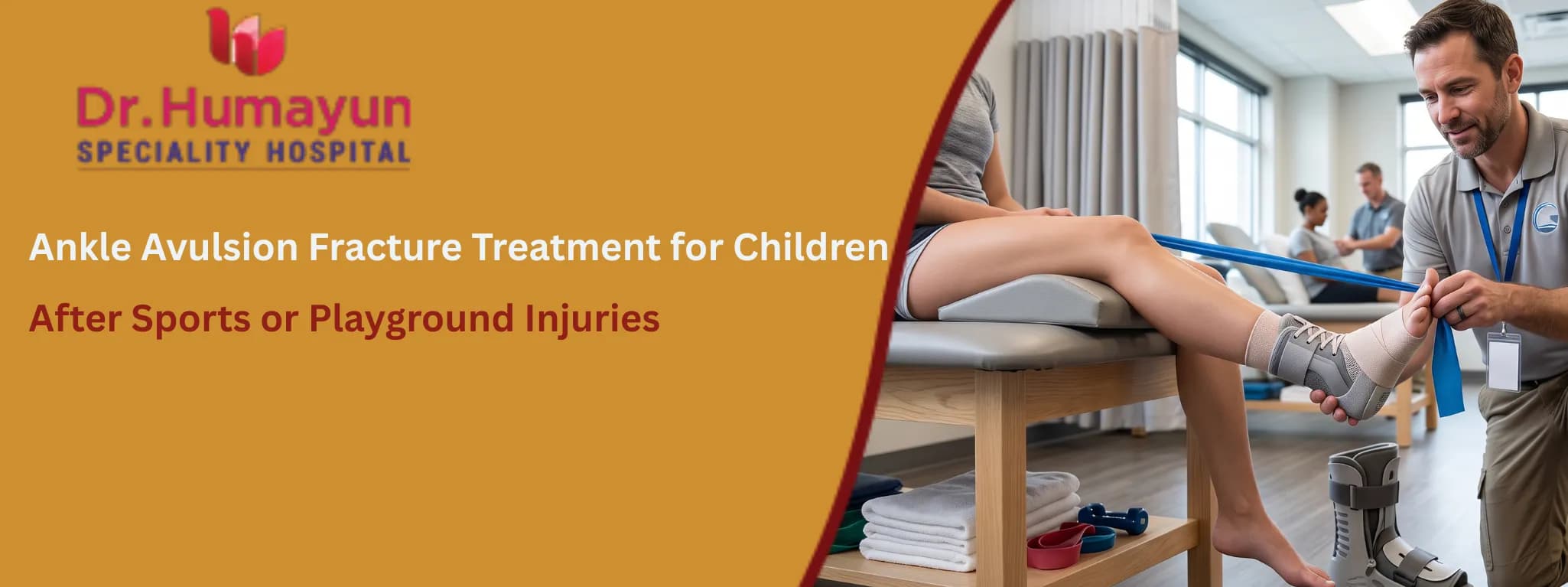
Rehabilitation: Early functional rehabilitation, typically starting within two to three weeks once acute pain has settled, is a critical component of treatment. A physiotherapist guides the child through exercises that restore range of motion, rebuild ankle strength, and retrain proprioception (the ankle's sense of its own position), which is the most important factor in preventing future ankle injuries.
-
Growth plate monitoring: A major advance in the 2025 to 2026 standard of care is the routine scheduling of growth plate follow-up X-rays at six and twelve months after injury to confirm that the physis remains open and symmetric. If early closure is detected, guided growth procedures can correct it before limb alignment is affected. These follow-up X-rays are now considered standard care rather than an optional investigation.
Surgical Treatment (Selected Cases)
Surgery is indicated in a minority of paediatric ankle avulsion fractures. The specific indications include:
-
Displacement of the bone fragment greater than approximately 3 mm
-
Significant growth plate involvement with gapping or angulation
-
A bone fragment that is large enough to affect joint stability or surface integrity
-
Failure of the fracture to progress toward healing after an adequate conservative trial
-
Fractures in older adolescents whose growth plates are approaching closure, where the consequences of growth plate damage are less severe but the mechanical stability requirements are higher
Surgical fixation options for paediatric ankle avulsion fractures include:
-
Smooth pin fixation: One or more smooth Kirschner wires (K-wires) are placed through the fragment and into the parent bone under fluoroscopic guidance, holding the fragment in its correct position while healing occurs. Smooth pins are preferred over threaded screws in younger children because they do not cross the growth plate in a way that damages it.
-
Low-profile screw fixation: In older adolescents whose growth plates are more mature, a small screw provides more stable fixation and may allow earlier functional rehabilitation. The choice of smooth pin versus screw is made by the orthopaedic surgeon based on the child's skeletal maturity and fracture pattern. Surgery is performed under general anaesthesia. Most paediatric ankle avulsion fracture surgeries are day procedures. The post-operative period includes a period of immobilisation followed by structured rehabilitation.
When to Return to Sports After Ankle Avulsion Fracture
Return to sport is guided by clinical assessment and radiological healing, not by a fixed calendar. A child should return to sport only when:
-
The fracture is confirmed healed on X-ray
-
Pain at the fracture site has resolved
-
Full ankle range of motion has been restored
-
Ankle strength has been restored to match the uninjured side
-
Balance and proprioception have been rehabilitated
-
The child can perform sport-specific movements (jumping, cutting, pivoting) without pain or instability
For most minimally displaced fractures managed conservatively, return to non-contact exercise is typically possible at six to eight weeks. Return to full contact sport may take ten to twelve weeks or longer depending on healing progress and rehabilitation completion.
Returning a child to sport before these criteria are met significantly elevates the risk of a new injury to the same ankle, of chronic ankle instability developing from an incompletely healed fracture, and of growth plate complications from premature loading.
Preventing Ankle Avulsion Fractures in Young Athletes
While avulsion fractures cannot always be prevented, specific measures meaningfully reduce risk in young athletes:
-
Adequate warm-up including dynamic stretching before every training session and match
-
Progressive loading principles in training, avoiding sudden spikes in training intensity that outpace the young skeleton's adaptation capacity
-
Sport-specific ankle strengthening and proprioceptive training as part of regular conditioning
-
Correctly fitted, sport-specific footwear that provides adequate lateral support
-
Age-appropriate training loads that avoid overspecialisation before skeletal maturity
-
Ankle taping or bracing in athletes who have had a previous ankle injury
Ankle Avulsion Fracture Treatment at Humayun Hospital, T Nagar
At Humayun Hospital, T Nagar, Chennai, Dr. Omer Sheriff, Consultant Orthopaedic and Joint Replacement Surgeon, provides comprehensive ankle avulsion fracture treatment for children from initial assessment through to return-to-sport clearance.
Dr. Omer Sheriff holds an MBBS, Diploma in Orthopaedics (Sri Ramachandra University), MS in Orthopaedics, and a Fellowship in Joint Replacement. He trained at CMC Vellore and brings international experience from Hamad Medical Corporation, Doha, Qatar, to his clinical practice. With over 25 years of experience and more than 3,500 successful orthopaedic procedures, his approach to paediatric fracture management reflects the 2025 to 2026 priority of growth plate preservation alongside precise, appropriately aggressive management where displacement or growth plate involvement requires it.
We offer:
-
Paediatric ankle assessment with X-ray guided by Ottawa Ankle Rules criteria
-
MRI for cases where growth plate injury is suspected but not visible on X-ray
-
Conservative management with walking boot, rehabilitation coordination, and growth plate follow-up imaging at six and twelve months
-
Surgical fixation for displaced fractures or growth plate injuries requiring stabilisation
-
Physiotherapy referral for structured ankle rehabilitation and return-to-sport programming
-
Clear guidance for parents and coaches on safe return-to-sport timelines
If your child has twisted an ankle during sport or playground activity and is experiencing significant pain, tenderness over the outer ankle bone, or difficulty bearing weight, do not assume it is a sprain. An orthopaedic assessment with imaging is the right first step.
Chat with our medical care assistant for quick guidance and support.